
The era of the back office as a mere cost center is officially over. While many enterprises remain trapped in a cycle of rising labor costs and legacy system silos, a new class of leaders is leveraging back office automation solutions to unlock unprecedented operational velocity. You've likely realized that basic RPA is no longer enough to handle the complexity of unstructured data or the demands of a global market. It's a common frustration to feel stalled by high error rates and repetitive administrative tasks while trying to build a bridge toward true digital maturity.
This guide promises to redefine your perspective on efficiency. You'll discover how the convergence of Agentic AI and Intelligent Document Processing (IDP) allows your organization to move beyond simple task replacement toward autonomous outcome management. We'll examine the strategic shift from reactive administration to proactive growth, detailing how to implement a scalable AI infrastructure that ensures long-term viability. We will also preview the frameworks necessary to avoid the pitfalls that cause many AI projects to fail, showing you instead how to build a frictionless, automated future that prioritizes high-value creative work.
Key Takeaways
• Understand the critical transition from rule-based RPA to reasoning-based Agentic AI for managing complex, end-to-end business outcomes.
• Learn how Intelligent Document Processing (IDP) utilizes Large Language Models to interpret context and intent within unstructured data streams.
• Identify the most impactful back office automation solutions for your enterprise using a strategic roadmap focused on process mining and data engineering.
• Discover how to integrate autonomous agents into existing ERP and CRM systems to eliminate manual bottlenecks and accelerate processing times.
• Realize the potential of enterprise modernization to transform traditional cost centers into scalable engines of strategic growth and human potential.
The Evolution of Back Office Automation Solutions in 2026
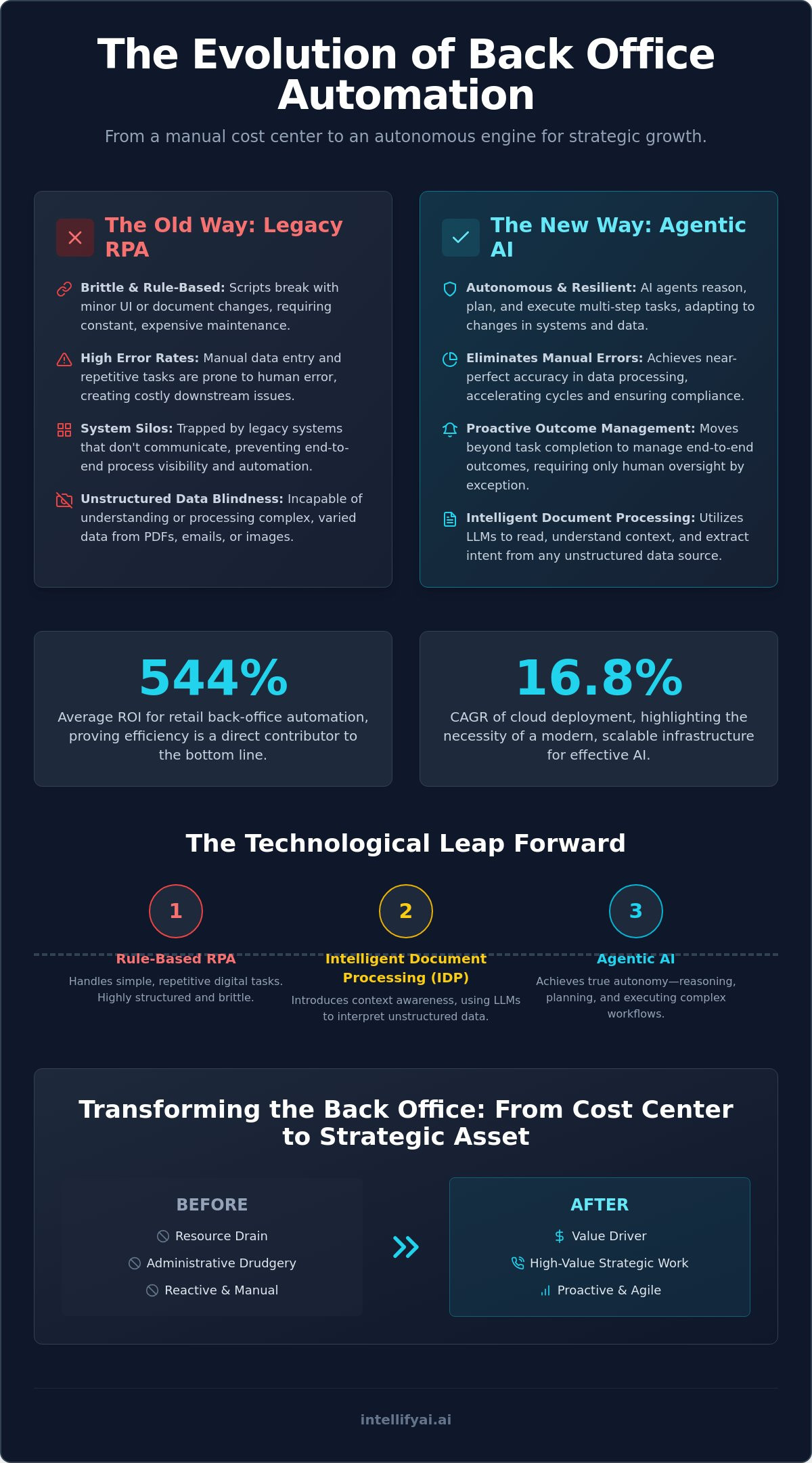
The enterprise landscape has shifted. By 2026, the reliance on manual back-office processing has become the primary bottleneck for organizations attempting to scale. Traditional models of operation are buckling under the weight of unstructured data and rising labor costs. To remain competitive, leaders are pivoting toward sophisticated back office automation solutions that integrate reasoning-based Agentic AI into their core workflows. This is no longer about simple task completion; it's about system-wide intelligence.
This evolution marks a departure from the early days of Robotic Process Automation (RPA). While RPA provided a foundational layer for repetitive tasks, it lacked the cognitive flexibility required for modern complexity. In 2026, cloud-native modernization isn't just a trend; it's a prerequisite. With cloud deployment growing at a 16.8% CAGR, the ability to deploy frictionless automation at scale is what separates market leaders from those tethered to legacy silos. This shift fundamentally alters the operational expenditure (OpEx) model, moving from fixed labor overhead to a variable, performance-driven technology spend.
From Cost Center to Strategic Asset
Modernizing your operations transforms the back office from a drain on resources into a driver of value. Autonomous operations in finance, HR, and supply chain allow human teams to shed the burden of administrative drudgery. They can then focus on high-value creative and strategic initiatives. The ROI of these implementations extends far beyond simple headcount reduction, focusing instead on:
• Accelerated processing cycles for core business functions.
• Elimination of manual entry errors across data-heavy workflows.
• Increased organizational agility in response to regulatory changes.
For example, retail back-office automation has shown an average ROI of 544%. This proves that efficiency is a direct contributor to the bottom line. By removing the friction of manual intervention, the back office becomes a liberating force that fuels enterprise growth.
The Limitations of Legacy RPA
Legacy bots are notoriously brittle. They fail the moment a UI changes or a document contains a slight variation. This brittleness problem makes traditional scripts expensive to maintain and impossible to scale for complex, multi-step workflows. Sophisticated back office automation solutions require a more robust foundation. Successful deployment starts with AI Strategy & Consulting to ensure your enterprise architecture can support agentic systems. Without a cloud-native foundation and clean data streams, even the most advanced AI will struggle to deliver its promised impact. Modernizing the legacy stack is the only way to transition from basic automation to true autonomous operations.
Harnessing Agentic AI for Autonomous Workflows
The distinction between an AI tool and an AI agent is fundamental to the next generation of back office automation solutions. While a tool requires a human to initiate a prompt and oversee the output, an AI agent operates with a degree of autonomy. These systems are engineered to reason, plan, and execute multi-step tasks across disparate platforms without constant supervision. They don't just suggest an answer; they perform the work. This shift represents a move from passive software to active digital partners that understand business objectives.
Autonomous agents function as a bridge between your core business systems. By interacting directly with existing ERP and CRM environments, these agents can retrieve data, validate it against business rules, and execute transactions. This is particularly transformative in complex reconciliation cycles where manual intervention once created significant delays. Research by Brookings on robotic process and intelligent automation suggests that these technologies are already fundamentally altering performance benchmarks across large-scale organizations. In 2026, the goal is to shift from human-led processes to agent-orchestrated workflows that only require human oversight by exception.
Agentic Engineering in the Back Office
Building a reliable autonomous workflow requires more than off-the-shelf software. It demands specialized Agentic AI engineering services to create custom agents tailored to specific enterprise use cases. For example, an automated procurement agent can monitor inventory levels, evaluate vendor quotes, and initiate purchase orders based on real-time demand. These agents are designed for exception management. If a vendor price exceeds a predefined threshold, the agent doesn't simply stall; it reasons through alternative suppliers or flags the specific discrepancy for review. This level of technical sophistication ensures that back office automation solutions remain resilient even when faced with unpredictable data or shifting market conditions.
Collaborative Intelligence: Humans and Agents
Technology should unlock human potential, not replace it. The human-in-the-loop model remains a critical component of high-stakes decision-making. AI agents act as force multipliers, handling the cognitive load of data processing while leaving final strategic approvals to experienced staff. This partnership ensures transparency and maintains high ethical standards in automated reasoning. By removing the burden of repetitive administrative tasks, your team can pivot toward high-value work that requires empathy and nuanced judgment. To begin architecting these resilient systems, you can explore our AI Strategy & Consulting frameworks to identify your most impactful automation candidates.
Intelligent Document Processing (IDP): The Engine of Efficiency
Unstructured data represents the final frontier for operational efficiency. While structured databases are relatively simple to manage, the vast majority of enterprise information resides in PDFs, emails, and images. These formats act as a significant barrier to traditional automation. By 2026, roughly 70% of organizations are expected to use some form of IDP to overcome this hurdle. This technology moves beyond the limitations of simple Optical Character Recognition (OCR). It leverages Large Language Models (LLMs) to understand context, nuance, and intent. This allows back office automation solutions to process complex documents with a level of sophistication previously reserved for human reviewers.
The strategic advantage of IDP lies in its ability to extract actionable intelligence from historical data. It transforms dormant archives into active assets. By integrating IDP into end-to-end automated pipelines, you create a continuous flow of information that informs decision-making in real-time. This process isn't just about reading text; it's about identifying patterns and ensuring compliance across every document your enterprise generates. It turns a massive administrative burden into a source of strategic insight.
i_Nova: Transforming Unstructured Data
Our flagship i_Nova platform is engineered to handle this complexity with precision. It extracts intelligence from diverse document formats while maintaining high standards for data integrity. To scale these operations effectively, we utilize cloud-native MLOps pipelines. These pipelines ensure that models are constantly refined and monitored, preventing the performance drift that often plagues off-the-shelf software. This rigorous engineering approach ensures that your back office automation solutions remain accurate and reliable at any volume.
Use Cases: Finance, Legal, and Operations
The applications for IDP are immediate and measurable across various departments. Implementing these tools allows your staff to pivot away from manual data entry toward high-value analysis. Key use cases include:
Automated Accounts Payable
Processing invoices from receipt to payment execution. This typically delivers a payback in as little as 60 to 90 days.
Legal Contract Analysis
Monitoring compliance and extracting key clauses at a scale impossible for manual teams.
Streamlined Onboarding
Accelerating KYC and client onboarding in financial services to remove friction from the acquisition process.
These implementations demonstrate that IDP is more than a tool; it's a fundamental shift in how businesses handle information. By removing the manual document bottleneck, you allow your enterprise to move at the speed of modern commerce.
Strategic Roadmap for Implementing Back Office Automation
Implementing back office automation solutions requires a disciplined, phase-based approach. It's not a single software installation; it's a structural realignment of your enterprise. Success depends on moving from discovery to optimization with surgical precision. This roadmap ensures that every automated workflow is grounded in business reality and engineered for long-term stability.
Step 1: Process Mining and Discovery.
Start by identifying high-impact candidates for automation. Use process mining to detect bottlenecks where manual intervention slows down core functions. This data-driven phase eliminates guesswork.
Step 2: Data Foundation.
Clean data is the currency of the modern enterprise. You must engineer accessible data streams that your AI models can digest. Without this foundation, even the most advanced agents will provide inconsistent results.
Step 3: Pilot and Proof-of-Value (PoV).
Validate your automation logic in a controlled environment. A successful PoV demonstrates the tangible ROI of your strategy before you commit to a full-scale rollout.
Step 4: Scaled Deployment.
Once validated, integrate your autonomous agents across departmental boundaries. This breaks down silos and allows data to flow seamlessly between finance, HR, and operations.
Step 5: Continuous Optimization.
Use MLOps pipelines to monitor model performance. This ensures your systems adapt to changing data patterns and maintain their accuracy over time.
AI Strategy and Consulting
Deploying technology without a plan is a recipe for technical debt. You need a comprehensive enterprise AI strategy to align your goals with measurable business KPIs. This involves a critical "buy vs. build" analysis. While off-the-shelf software offers speed, custom engineering provides the unique competitive advantage required for complex back-office functions. A structured strategy ensures your back office automation solutions deliver measurable financial returns rather than just temporary fixes.
Governance, Risk, and Compliance (GRC)
Security is not an afterthought in autonomous systems. You must address data encryption and strict access control from day one. With the EU AI Act transparency requirements taking effect in August 2026, and Colorado's AI Act in June 2026, compliance is a moving target. Your automated workflows must include robust version control and immutable audit trails. These measures ensure that every decision made by an AI agent is traceable and meets the highest regulatory standards. To begin this journey with a partner focused on security and scale, you can architect your automation roadmap with our strategic team.
Future-Proofing the Enterprise with IntellifyAi
Enterprise modernization is not a destination; it's a continuous state of evolution. To navigate this shift, organizations need a Strategic Architect capable of bridging the gap between abstract technical potential and concrete financial returns. IntellifyAi fulfills this role by providing a holistic methodology that integrates back office automation solutions into the very fabric of your business. Our approach combines high-level consulting services with custom engineering to ensure every implementation is both innovative and dependable. We don't just deploy tools. We build resilient systems that serve as a lasting investment in your relevance.
The transition toward Agentic AI represents a fundamental move from reactive operations to proactive leadership. By 2026, the ability to manage end-to-end outcomes autonomously will be the primary marker of a mature enterprise. This shift allows your executive team to focus on data-driven strategy rather than administrative troubleshooting. Our engineering expertise ensures that your AI infrastructure remains scalable, secure, and aligned with your long-term growth objectives. We treat technology as a liberating force, removing the friction of manual entry to unlock the creative potential of your workforce.
Global Expertise, Local Impact
Our global presence across the UK, USA, India, and UAE provides our clients with a continuous cycle of innovation. We operate as a professional partner for serious enterprises looking to modernize their legacy stacks without disrupting their core stability. Our commitment is simple: we remove the burden of repetitive tasks so your team can focus on high-value work. This global reach allows us to implement best practices from diverse markets, ensuring your back office automation solutions are world-class. We specialize in transforming complex technological concepts into digestible, actionable business outcomes.
Next Steps: Your Automation Journey
The path to a frictionless future begins with a single strategic decision. We invite you to explore the i_Nova platform to see how document intelligence can revolutionize your data workflows. Our team is ready to help you map a clear automation roadmap that prioritizes your most critical business functions. Don't let legacy silos dictate your operational capacity. Schedule a strategic consultation today to begin your transformation. It's time to modernize your back office and turn your administrative cost centers into engines of strategic growth.
Leading the Agentic Transformation
The transition from manual administrative tasks to autonomous operations is a strategic necessity for the modern enterprise. You've seen how Agentic AI moves beyond the limitations of legacy bots to provide reasoning-based decision making across your entire workflow. By integrating our flagship i_Nova IDP Platform, your organization can finally unlock the intelligence trapped within unstructured documents like emails and PDFs. Implementing these back office automation solutions isn't just about cutting costs; it's about liberating your team to focus on high-value work that drives performance.
Success requires a partner who balances technical depth with a clear Strategic Enterprise Consulting Framework. Our Global Agentic AI Engineering Expertise ensures that your digital transformation is both stable and scalable. It's time to move from reactive troubleshooting to proactive leadership. This evolution will define the market leaders of 2026. We're ready to help you architect a system that turns operational complexity into a competitive advantage.
Contact our Strategic Architects to automate your back office operations and secure your organization's long-term viability. We look forward to building your frictionless future together.
Frequently Asked Questions
What are back office automation solutions?
Back office automation solutions are integrated systems designed to digitize and execute administrative functions such as payroll processing, invoice management, and data entry. These solutions leverage technologies like Agentic AI and Intelligent Document Processing to transform manual cost centers into high-velocity engines of strategic growth. By removing the burden of repetitive tasks, they allow your enterprise to reallocate human talent toward high-value creative initiatives.
How does Agentic AI differ from traditional RPA in the back office?
Traditional RPA follows rigid, rule-based scripts that often break when process parameters change. In contrast, Agentic AI uses reasoning and planning to execute multi-step tasks across disparate systems. While a standard bot might only copy data, an agent can evaluate exceptions, interact with existing ERP environments, and make autonomous decisions based on business objectives. This shift provides the cognitive flexibility required for complex, modern workflows.
Can back office automation handle unstructured data like emails and handwritten forms?
Modern automation platforms can process unstructured data with high precision by utilizing Large Language Models (LLMs) and advanced computer vision. Systems like our i_Nova platform go beyond simple text recognition to understand the context and intent within emails, PDFs, and images. This capability eliminates the manual document bottleneck, allowing your organization to extract actionable intelligence from previously inaccessible historical data streams.
What is the typical ROI for enterprise back office automation?
The ROI for enterprise automation is often immediate and measurable. For instance, retail back-office automation has demonstrated an average return of 544%, while automated invoice processing typically delivers a full payback within 60 to 90 days. These returns are driven by reduced labor costs, the elimination of manual entry errors, and significantly faster processing times for core business functions.
How do you ensure security and compliance when automating financial tasks?
Security is maintained through a combination of data encryption, strict access control, and immutable audit trails. Every decision made by an autonomous agent is logged to ensure full transparency and accountability. This approach ensures compliance with global regulations such as GDPR, SOC2, and the transparency requirements of the EU AI Act. Robust version control further protects the integrity of your financial workflows.
What is the first step in building a back office automation strategy?
The first step is process mining and discovery to identify the highest-impact candidates for automation. You must analyze your existing workflows to detect bottlenecks where manual intervention slows down operations. This data-driven assessment allows you to ground your strategy in reality, ensuring that your initial implementations provide the most significant financial returns and operational velocity.
Is it necessary to modernize legacy systems before implementing AI automation?
Enterprise modernization is a critical prerequisite for sophisticated AI deployment. Attempting to layer advanced agents over brittle legacy silos often results in technical debt and inconsistent performance. Establishing a cloud-native foundation ensures that your back office automation solutions are scalable and resilient. Modernizing your stack allows for the frictionless data flow required to power reasoning-based autonomous workflows across departmental boundaries.
How does Intelligent Document Processing (IDP) improve back office efficiency?
IDP improves efficiency by automating the extraction and validation of data from diverse document formats. By removing the manual document bottleneck, it accelerates processing cycles in departments like accounts payable and legal. This technology transforms dormant archives into active assets, providing your leadership team with real-time insights that inform strategic decision-making. It effectively turns a massive administrative burden into a source of competitive advantage.









.svg)