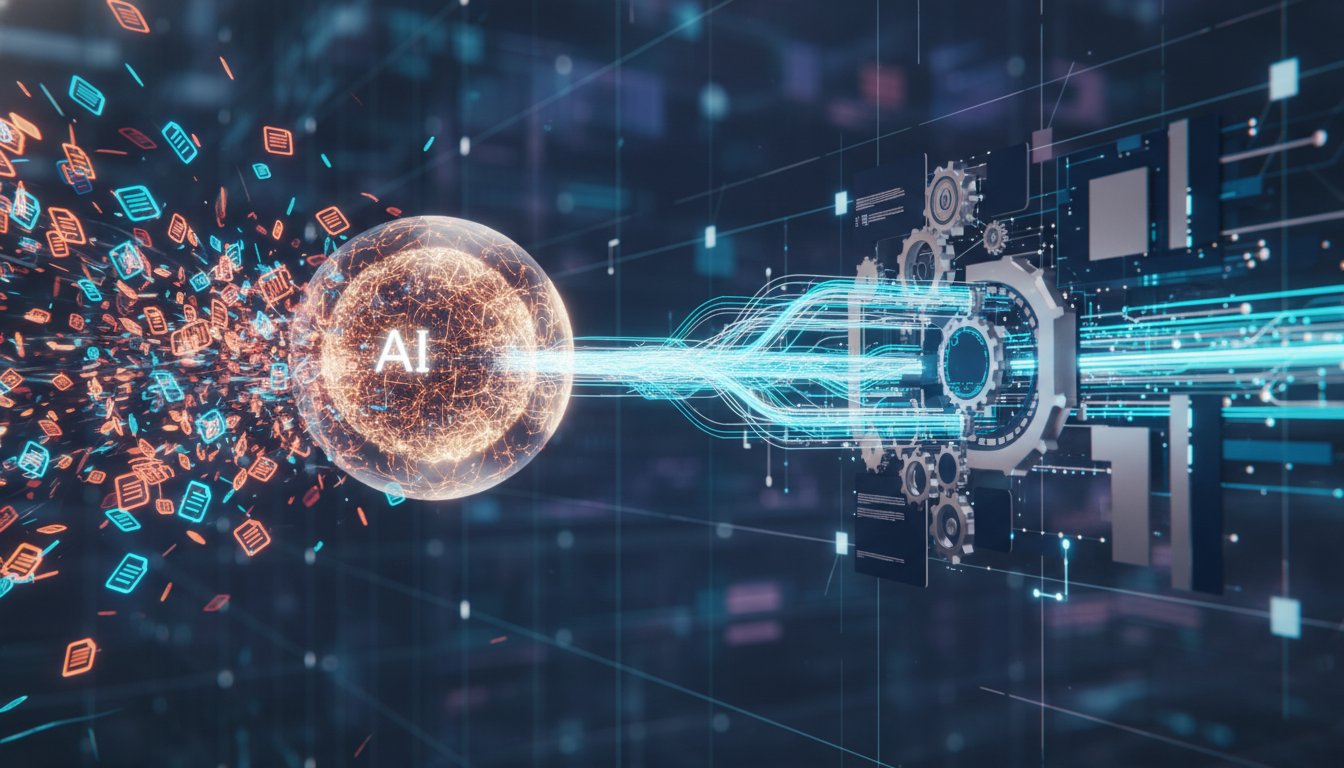
Most enterprises are still fighting a losing battle against the Document Wall, treating basic data extraction as a victory when it's actually just the starting line. If your teams are still bogged down by manual validation and fragile legacy ERP integrations, your automation strategy is likely leaking ROI. Identifying the best idp solutions for enterprise 2026 requires a fundamental shift in perspective. It's no longer about how accurately a system reads a page. It's about how effectively it acts on the information it finds.
You've likely realized that better OCR isn't enough to solve deep-seated workflow bottlenecks. We'll explore the top-ranked platforms for the coming year, including the LLM-integrated ABBYY Vantage 3.0 and Google Cloud’s Gemini-powered Layout Parser v1.6. This guide promises to help you transition from simple data capture to autonomous document execution. We'll examine how to replace manual entry with scalable Agentic AI workflows that turn static documents into frictionless business actions.
Key Takeaways
• Understand why the 2026 IDP landscape replaces legacy OCR with LLM-driven multimodal systems that prioritize autonomous action over simple data capture.
• Identify the four critical pillars, Intelligence, Integration, Governance, and Scalability, required to evaluate the best idp solutions for enterprise 2026.
• Compare market leaders like Google Cloud and ABBYY to determine which platform aligns with your specific modernization goals and technical resources.
• Learn how to bridge the implementation gap between document extraction and legacy ERP systems through strategic data engineering and AI services.
• Explore how agentic intelligence creates frictionless document-to-action pipelines that liberate your workforce for high-value strategic work.
The Evolution of Intelligent Document Processing (IDP) in 2026
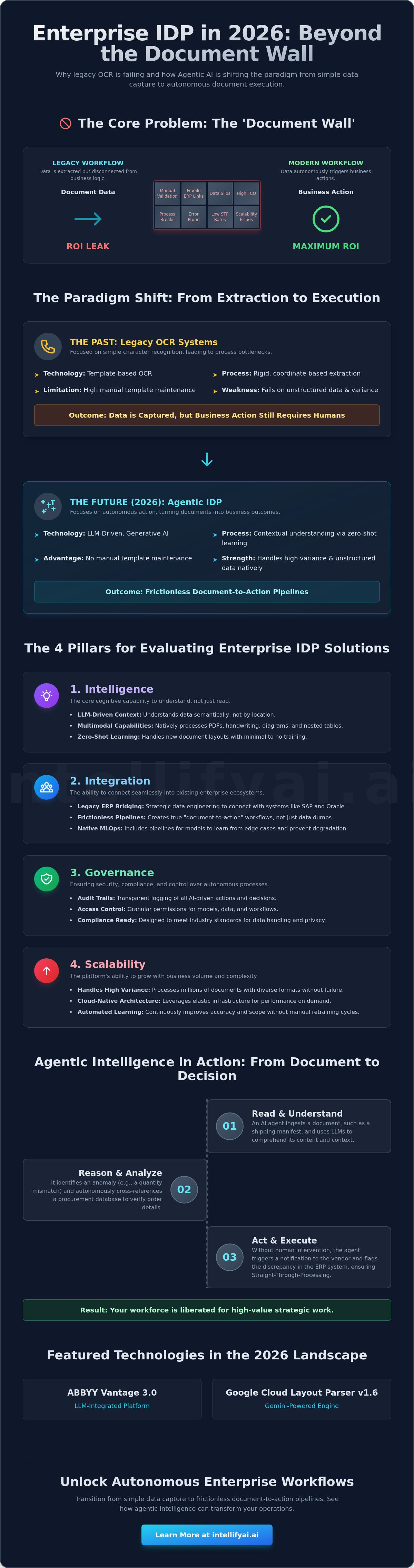
In the current landscape, Intelligent Document Processing (IDP) has transcended its origins as a mere digitization tool. It's now the cognitive engine of the autonomous enterprise. Legacy systems relied heavily on optical character recognition (OCR) to turn images into text, but they often failed at the "Document Wall." This wall represents the friction point where data is extracted but remains disconnected from the business logic required to process it. The best idp solutions for enterprise 2026 focus on breaking this wall by shifting from simple extraction to "Document-to-Action" pipelines.
To better understand how the modern enterprise handles document intelligence, watch this overview of current cloud capabilities:
From Template-Based to Generative Extraction
The era of rigid, coordinate-based templates is over. Modern platforms leverage generative AI to handle high levels of unstructured data variance through zero-shot learning. Instead of teaching a system where the "Invoice Number" is located on 500 different layouts, these models understand the context of the document. They recognize data points based on semantic meaning rather than physical location. This shift from character recognition to true contextual understanding allows enterprises to process complex contracts and non-standard forms with minimal training overhead. It's a liberating force that removes the burden of manual template maintenance.
The Rise of Agentic Document Intelligence
The most significant advancement in 2026 is the integration of the server intelligence agent within document workflows. These agents don't just read; they reason. An agentic IDP system can identify an anomaly in a shipping manifest, cross-reference it with a procurement database, and trigger a notification to the vendor without human intervention. This moves the needle on Straight-Through Processing (STP) rates by handling errors autonomously. By executing cross-platform business logic, agentic systems ensure that document data immediately fuels growth and operational performance. This represents a lasting investment in relevance for any serious organization looking to modernize.
Selection Framework: How to Evaluate Enterprise IDP Vendors
Selecting the best idp solutions for enterprise 2026 requires a departure from traditional procurement checklists. Accuracy is a commodity. While 99% extraction precision was the gold standard in previous years, the modern benchmark is autonomous utility. A platform that reads perfectly but requires manual mapping to your ERP is a bottleneck, not a solution. To achieve a frictionless document-to-action pipeline, leaders must evaluate vendors through a four-pillar framework: Intelligence, Integration, Governance, and Scalability.
Success in this transition often hinges on a vendor’s AI strategy consulting capabilities. Technology alone cannot solve structural process inefficiencies. You need a partner who understands how to embed intuitive AI in document management to transform static data into strategic assets. Additionally, ensure your chosen solution includes native MLOps pipelines. These pipelines allow models to learn from edge cases in real time, ensuring your automation doesn't degrade as document formats evolve over the next decade.
Multimodal Capabilities and Zero-Shot Learning
Modern enterprises don't just process clean digital PDFs. Your solution must natively support multimodal inputs, including messy handwriting, technical diagrams, and nested tables within a single stream. The best idp solutions for enterprise 2026 utilize zero-shot learning to eliminate the need for massive, pre-labeled datasets. This technology allows the system to understand a new document type immediately based on its semantic context. It reduces deployment times from months to days, allowing your team to focus on high-value creative work rather than data labeling.
Enterprise-Grade GRC and Security
Security is the foundation of system autonomy. Any platform handling sensitive corporate data must adhere to rigorous standards, including SOC2, GDPR, and Sarbanes-Oxley (SOX) compliance. For highly regulated industries, look for vendors offering private LLM instances. This ensures your data never leaves your controlled environment or contributes to public model training. Version control is equally vital; every automated decision must be traceable and auditable to maintain long-term institutional trust. If you're unsure where your current infrastructure stands, a professional AI Strategy & Consulting audit can identify critical gaps before they become liabilities.
The Best IDP Solutions for Enterprise 2026: A Comparative Analysis
The market for document automation has bifurcated into two distinct camps: hyperscale cloud providers offering raw cognitive power and specialized process leaders focused on workflow orchestration. To find the best idp solutions for enterprise 2026, you must look beyond extraction accuracy and prioritize agentic readiness. According to Gartner's Market Guide for Intelligent Document Processing, the ability to summarize content and identify anomalies autonomously is now a core requirement for enterprise-grade deployments. This shift ensures that technology acts as a collaborative partner rather than a passive tool.
The Hyperscalers: Microsoft vs. Google
Google Cloud Document AI remains a powerhouse for high-volume, multimodal processing. The release of Layout Parser v1.6 on February 9, 2026, powered by Gemini 3 Flash, has set a new standard for speed in complex document parsing. However, Google’s aggressive deprecation schedule requires teams to migrate to newer processors by June 30, 2026, to avoid service interruptions. Microsoft Azure AI Document Intelligence offers superior integration for organizations already anchored in the M365 ecosystem. While Google prioritizes custom engineering flexibility, Microsoft excels in providing a seamless path for business users to deploy document-to-action pipelines within familiar environments.
The Process Leaders: UiPath and ABBYY
ABBYY Vantage 3.0, launched in January 2026, represents a successful transition from legacy OCR to a modern, low-code "document skills" framework. Its direct integration with Large Language Models (LLMs) allows for sophisticated reasoning over unstructured data. UiPath Document Understanding continues to lead in end-to-end automation by linking extraction directly to RPA and voice agents. While the average enterprise cost for UiPath reached $402,960 in 2026, the total cost of ownership is often justified by the massive reduction in manual validation requirements across back-office operations.
Choosing the best idp solutions for enterprise 2026 depends heavily on your industry archetype. Financial Services firms often favor the governance-heavy frameworks of ABBYY or UiPath to meet strict audit requirements. In contrast, high-growth logistics companies typically leverage the pay-as-you-go scalability of Google Cloud to handle fluctuating document volumes. For those looking to bridge the gap between these off-the-shelf platforms and a fully autonomous workflow, Agentic AI Engineering Services provide the necessary custom logic to ensure documents don't just get read, they get executed.
Overcoming Implementation Gaps: From Extraction to Execution
Extraction is only half the battle. The most common objection from leaders is that while they now have high-quality data, their legacy systems simply can't ingest it. This gap between extraction and execution is where most automation initiatives stall. This is the primary reason why even the best idp solutions for enterprise 2026 fail to deliver value. Extraction is useless if the data sits in a silo. To bridge this divide, data engineering becomes the essential connective tissue. It transforms raw, unstructured outputs into structured, validated inputs that your ERP or CRM can process without human intervention.
Building a successful implementation starts with a Proof-of-Value (PoV) rather than a broad pilot. This PoV must demonstrate measurable financial impact, such as a 40% reduction in invoice processing cycle times or a significant increase in Straight-Through Processing (STP) rates. As trust in the system grows, your oversight model should transition from "Human-in-the-Loop," where every document is checked, to "Human-on-the-Loop." In this mature stage, experts only intervene when the system flags a high-complexity anomaly. This shift allows your team to focus on strategic growth rather than repetitive validation tasks.
Modernizing the Back Office Infrastructure
Successful deployment of the best idp solutions for enterprise 2026 requires a foundation of enterprise modernization. Legacy on-premise environments often lack the elasticity needed to handle the high-velocity data streams generated by modern IDP. A cloud-native architecture is a prerequisite for scalability. Legacy debt is the silent killer of automation. You must also implement FinOps strategies to monitor and optimize the cost of high-volume LLM API calls. Without cost governance, the intelligence of your system can quickly outpace its profitability.
The Strategic Architect Persona in Implementation
IDP projects fail when they're treated as isolated software installs. They require a unified AI strategy to align technology with long-term business goals. Cross-departmental data governance ensures that the intelligence extracted in one silo benefits the entire organization. The final stage of document maturity is Agentic Orchestration. This describes the state where autonomous agents manage the entire document lifecycle across multiple platforms. Modernize your document workflows with our Agentic AI Engineering Services to ensure your data drives immediate action.
i_Nova: Leading the Shift to Agentic Document Intelligence
i_Nova is the definitive Intelligent Document Processing platform for the 2026 enterprise landscape. While many vendors focus on high-speed extraction, i_Nova prioritizes high-speed execution. It represents the pinnacle of the best idp solutions for enterprise 2026 by integrating autonomous reasoning directly into the document lifecycle. This platform doesn't just digitize information; it interprets intent and triggers the next logical business step. It's a liberating force that allows your most talented employees to abandon repetitive data validation and focus on high-value creative work.
The i_Nova Advantage: Actionable Intelligence
i_Nova leverages Agentic AI to validate and execute extracted data without manual friction. It moves beyond simple character recognition to handle complex cross-platform business logic. If a document contains a discrepancy, the system doesn't just flag it; it investigates the root cause across your connected databases. The platform scales effortlessly for global enterprise workloads, maintaining high performance across millions of pages. Seamless integration with existing MLOps and data pipelines ensures that your document intelligence remains a central, dependable pillar of your technical architecture. This is not a temporary fix. It's a lasting investment in your company's operational relevance.
Partnering for Transformation
Technology alone is rarely the complete answer. We invite leaders to explore IntellifyAi consulting services to develop a comprehensive automation roadmap. Our partnership model combines custom AI engineering with strategic oversight. This ensures your models are continuously optimized for long-term viability. We align document success with our broader CX Improvement Framework. This ensures that back-office efficiency translates directly into superior customer outcomes and improved financial returns. Secure your competitive edge in 2026 with a tailored IDP strategy that turns your document wall into a gateway for growth.
Modernize your document infrastructure today. Contact our Strategic Architects to begin your transition to agentic document intelligence.
Architecting Your Autonomous Document Strategy
The transition from simple data extraction to autonomous document execution isn't just a technical upgrade; it's a strategic imperative. As you evaluate the best idp solutions for enterprise 2026, remember that the most effective platforms are those that bridge the gap between raw data and actionable business logic. Legacy bottlenecks are solved not by more extraction, but by agentic orchestration that handles anomalies and executes cross-platform workflows without constant human intervention. This shift turns document processing from a cost center into a high-velocity engine for growth.
Through our global presence across the UK, USA, UAE, and India, we provide the expert-led Agentic AI engineering services required to modernize your back office. Our flagship i_Nova platform stands as the central pillar for unstructured document intelligence, allowing your workforce to focus on high-value creative tasks while technology manages the repetitive burden. Don't let your data remain trapped behind the Document Wall. Explore the i_Nova IDP Platform and Secure Your Enterprise Strategy to ensure your organization stays ahead of the curve in an increasingly automated world. The future of document processing is active, intelligent, and ready for deployment.
Frequently Asked Questions
What is the difference between OCR and IDP in 2026?
OCR remains a basic utility for converting images into text characters. In 2026, Intelligent Document Processing (IDP) uses multimodal LLMs to understand the semantic context and intent of that text. Modern IDP moves beyond simple digitization to autonomous reasoning, allowing systems to identify anomalies and summarize complex content without human intervention.
How do I calculate the ROI of an Intelligent Document Processing solution?
Calculate ROI by measuring the increase in Straight-Through Processing (STP) rates and the subsequent reduction in manual validation costs. You should also factor in the financial impact of faster cycle times, such as captured early-payment discounts or reduced vendor late fees. A successful deployment of the best idp solutions for enterprise 2026 typically yields measurable returns through improved data accuracy and reclaimed employee hours.
Can IDP solutions handle handwritten or low-quality documents?
Modern multimodal IDP systems excel at processing handwritten notes, skewed scans, and low-resolution images. Unlike legacy template-based tools, these platforms use contextual reasoning to "read" through noise and interpret messy input based on surrounding data. This capability significantly reduces the need for manual data entry in industries like logistics where paper forms remain common.
Is Agentic AI safe for processing sensitive financial or medical documents?
Agentic AI is highly secure when deployed within private cloud environments that adhere to SOC2 and GDPR standards. By using private LLM instances, enterprises ensure that sensitive document data is never used to train public models. Version control and detailed audit logs provide the transparency required for strict regulatory compliance in financial and medical sectors.
What are the main implementation challenges for enterprise IDP?
The primary challenges include bridging the gap between extracted data and legacy ERP systems through robust data engineering. Many projects also struggle with a lack of a unified AI strategy, which leads to isolated automation silos. Overcoming these hurdles requires a focus on cloud-native modernization and clear cross-departmental governance to ensure long-term scalability.
How does i_Nova compare to hyperscale IDP solutions from Microsoft or Google?
Hyperscalers like Google and Microsoft provide powerful raw cognitive engines for general parsing. i_Nova is an execution-oriented platform designed specifically to bridge the gap between extraction and business action. It integrates custom agentic workflows that not only read documents but also execute cross-platform logic, providing a more holistic solution for the best idp solutions for enterprise 2026.
Does IDP require a complete overhaul of my existing ERP system?
You don't need to overhaul your ERP to benefit from modern document intelligence. IDP acts as a sophisticated ingestion layer that sits on top of your current infrastructure, feeding it validated, structured data. While cloud-native modernization improves overall efficiency, a well-engineered IDP solution can integrate with legacy systems using custom APIs and middleware.
What role does data engineering play in a successful IDP deployment?
Data engineering is the connective tissue that transforms raw IDP outputs into the specific formats required by your downstream applications. It handles the cleaning, validation, and mapping of data to ensure it's ready for immediate ingestion. Without strong data engineering, document processing tools remain isolated extraction engines rather than integrated business drivers.








.svg)