
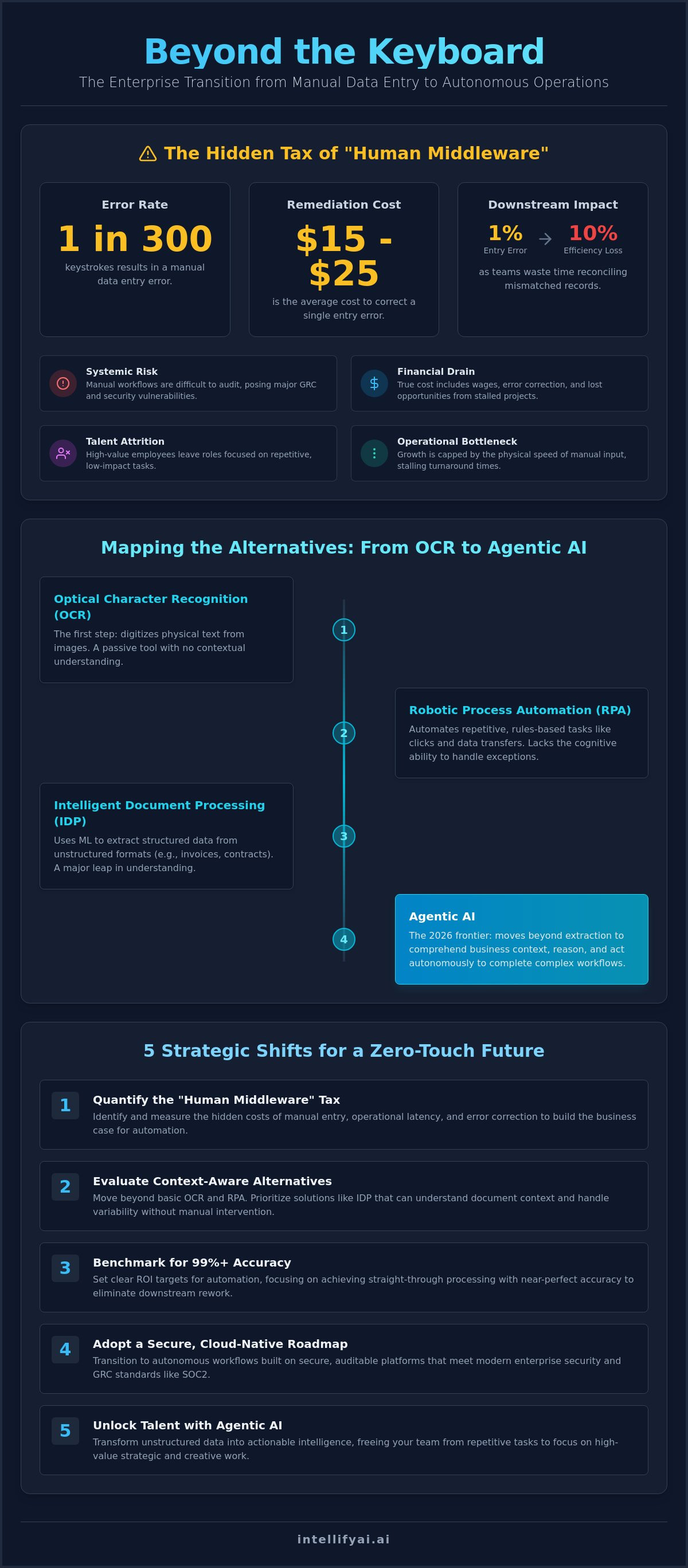
Every 300 keystrokes, your enterprise likely absorbs a manual data entry error that costs between $15 and $25 to remediate. For high-growth organizations, finding viable alternatives to manual data entry isn't just about saving time. It's about removing the "human middleware" that caps your operational capacity and introduces systemic risk. You've likely seen how these bottlenecks stall your turnaround times and force you to hire more heads just to keep pace with basic administrative volume.
We agree that your human talent is too valuable to be used as a bridge between disconnected systems. It's time to move beyond the keyboard. This guide shows you how to eliminate manual friction and transition to autonomous, high-accuracy data workflows that scale effortlessly with your enterprise. We will preview five strategic shifts for 2026, ranging from Intelligent Document Processing to agentic AI, designed to deliver zero-touch operations and allow your team to focus on high-value strategic execution.
Key Takeaways
• Identify the hidden "human middleware" tax and how manual entry bottlenecks create an invisible ceiling on enterprise scalability.
• Evaluate strategic alternatives to manual data entry that move beyond basic OCR to context-aware, autonomous processing.
• Quantify the ROI of Intelligent Document Processing, including benchmarks for 99%+ accuracy and straight-through processing.
• Learn a structured roadmap for transitioning to secure, cloud-native workflows that meet modern enterprise security and GRC standards.
• Discover how agentic AI engineering transforms unstructured data into actionable intelligence, allowing your team to focus on high-value creative work.
The Strategic Cost of Manual Data Entry in 2026
Manual data entry functions as a "human middleware" tax, creating an invisible ceiling on enterprise growth. When humans act as the primary bridge between disconnected systems, the speed of your entire operation is limited by the physical constraints of typing and cognitive load. While Manual Data Entry was once the standard for information transfer, its role in 2026 has transitioned from a necessary utility to a significant strategic liability. Organizations seeking alternatives to manual data entry often discover that the real cost isn't found in a line-item salary, but in the compounding friction of operational latency.
The math of manual entry is unforgiving. Industry data confirms that human error rates average one mistake for every 300 keystrokes. These "fat-finger" errors don't stay contained. A 1% error rate at the point of entry typically results in a 10% loss in downstream efficiency as departments waste hours reconciling mismatched records. Enterprises investigating alternatives to manual data entry must first quantify this invisible drag to understand the true urgency of modernization.
To better understand the evolution of these roles and how businesses are shifting their approach, watch this helpful video:
Beyond the financial drain, manual workflows create a culture of "waiting for data." In a high-velocity market, operational latency is a competitive disadvantage that prevents real-time decision-making. This environment also accelerates employee attrition. High-talent workers don't stay in roles that demand repetitive, low-value tasks. They move to organizations that leverage technology to unlock their creative and strategic potential, leaving manual-heavy firms in a perpetual cycle of hiring and retraining.
The Hidden Financial Drain
Calculating the true cost of data entry requires looking past basic wages. You must factor in the cost of error correction, which can be two to three times the initial labor cost, and the lost opportunity of stalled projects. Throwing more people at the problem fails to scale because it increases the management overhead and multiplies the chance of non-standardized data silos. True scalability in 2026 is achieved by removing human touchpoints, not adding them.
Security and Compliance Risks
Human error remains the primary vulnerability in data privacy and GRC (Governance, Risk, and Compliance). Manual workflows are notoriously difficult to audit, making it nearly impossible to maintain a single source of truth in unstructured data environments. This complexity poses a major hurdle when attempting to achieve or maintain SOC2 compliance. Transitioning to autonomous systems ensures that every data point is tracked, validated, and secured without the risk of human oversight or fatigue.
From OCR to Agentic Intelligence: Mapping the Alternatives
The journey toward digital autonomy requires a clear understanding of the technical landscape. When enterprises evaluate alternatives to manual data entry, they often encounter a spectrum of technological maturity. This evolution moves From OCR to Agentic Intelligence, shifting the focus from simple character recognition to systems that actually comprehend business context. Identifying where your current processes sit on this spectrum is the first step toward building a frictionless operation.
Optical Character Recognition (OCR) provided the first foundational step by digitizing physical text, yet it remains a passive tool. Robotic Process Automation (RPA) followed, allowing businesses to automate repetitive clicks and data transfers between applications. While RPA handles the mechanics of a task, it lacks the cognitive depth to handle exceptions. Intelligent Document Processing (IDP) bridged this gap by using machine learning to extract structured data from unstructured formats like invoices or complex contracts. It's a significant upgrade, but 2026 has introduced an even more powerful paradigm.
By 2026, the frontier has shifted decisively toward Agentic AI. This represents a move from rigid, rule-based scripts to autonomous agents capable of sophisticated orchestration. These agents don't just extract data. They validate it against external databases, resolve discrepancies, and update downstream systems without human intervention. For organizations seeking high-accuracy alternatives to manual data entry, this level of autonomy is the only way to scale without a corresponding increase in headcount.
Why Traditional OCR Falls Short
Rigid systems rely on template-dependency, which makes traditional OCR notoriously fragile. If a vendor changes an invoice layout by even a few pixels, the extraction rules often break. This leads to the "noisy data" problem, where character recognition fails to account for context, resulting in nonsensical entries that still require human review. The hidden cost here is maintenance. Engineering teams spend excessive time updating legacy scripts to keep up with changing document formats, negating much of the initial efficiency gains.
The Rise of Agentic AI and Autonomous Workflows
Modern workflows use Agentic AI to replace "if-then" logic with goal-oriented behavior. Instead of following a linear path, an agent understands the desired outcome, such as "process this claim and verify the policy status." These agents interact with multiple systems to enrich data, ensuring a higher level of accuracy than any manual process could achieve. To understand the underlying mechanics, explore our guide on What Is Agentic AI? and its role in the modern enterprise. For organizations ready to move beyond basic automation, our Agentic AI Engineering Services provide the custom architecture needed for true digital autonomy.
Evaluating the ROI of Intelligent Document Processing (IDP)
Return on investment for automation is often measured by what you stop doing, such as manual typing. A more sophisticated approach focuses on what you start achieving. High-performance IDP solutions aim for 99% straight-through processing (STP) rates. This means the vast majority of data moves from document to system without any human intervention. For organizations seeking alternatives to manual data entry, these benchmarks represent the difference between a minor efficiency gain and a total operational transformation.
Scalability is the most immediate byproduct of this accuracy. A robust IDP framework allows an enterprise to handle a 10x increase in document volume with zero additional staff. This isn't just about speed. It's about data enrichment. Modern IDP adds value during the entry process by cross-referencing external databases to validate and append information. This ensures your downstream systems receive high-fidelity data that is already contextualized. We also prioritize FinOps and cloud optimization to ensure your transition to autonomous workflows remains cost-effective, preventing the cloud bill shock that often accompanies unoptimized AI deployments.
When you evaluate alternatives to manual data entry, consider the compounding benefit of data accuracy. Every error avoided at the point of ingestion saves hours of reconciliation in finance, logistics, or customer service. This creates a frictionless environment where data is a reliable asset rather than a source of constant correction. It's a fundamental shift from reactive data management to proactive business intelligence.
Measuring Success Beyond Time Saved
True ROI is found in decision velocity. When data flows into your systems instantly, your market response time shrinks. This rapid processing directly improves customer experience (CX) by reducing wait times for applications, claims, or onboarding. Achieving these outcomes requires high-quality inputs, which is why robust Data Engineering is a prerequisite for any successful IDP implementation. It ensures the pipeline remains clean, reliable, and ready for advanced analytics.
Technical Implementation vs. Strategic Consulting
Purchasing software won't solve a systemic data bottleneck. Success requires a comprehensive AI Strategy that aligns technology with specific business outcomes. We advocate for a Proof of Value (PoV) rather than a simple Proof of Concept (PoC). While a PoC proves the technology works, a PoV proves it generates measurable financial returns. Maintaining these returns over time requires rigorous MLOps to monitor model performance and prevent data drift as your business evolves.
Building a Roadmap: How to Transition to Autonomous Workflows
Transitioning from a manual operation to a fully autonomous enterprise is a strategic evolution that requires a structured architecture. It is not enough to simply replace a keyboard with a script. Success in 2026 demands a roadmap that prioritizes security, scalability, and technical depth. Organizations seeking alternatives to manual data entry must move beyond fragmented fixes and adopt a holistic framework that integrates seamlessly with their existing cloud infrastructure.
The first step involves a comprehensive audit of your data landscape. You must identify high-friction bottlenecks where human intervention causes the most significant delays. Once these points are mapped, define your GRC (Governance, Risk, and Compliance) and security requirements. Security is never an afterthought in autonomous processing. It is the foundation that ensures data privacy and regulatory alignment from the moment of ingestion.
Next, evaluate the "Buy vs. Build" dilemma. While SaaS IDP platforms offer speed for standard document types, custom Agentic AI Engineering Services provide the bespoke logic needed for complex, multi-system orchestration. Start your implementation with a high-impact, low-complexity pilot, such as Accounts Payable. This allows you to prove value quickly before scaling horizontally across the enterprise using a robust, cloud-native framework.
If you are ready to architect a frictionless future, our team provides the AI Strategy and Consulting needed to turn these technical possibilities into operational reality.
Assessing Data Maturity
Before deploying advanced alternatives to manual data entry, you must determine if your information is structured, semi-structured, or trapped in a "dark data" swamp. Implementing AI on top of messy data only accelerates the production of errors. Data Maturity is the readiness of an organization to utilize its data for autonomous operations. Prioritize data cleaning and standardization to ensure your autonomous agents have high-fidelity inputs to work with.
Managing the Human Element
Modernization changes the nature of work rather than eliminating it. Focus on upskilling your team to manage and oversee AI agents instead of performing repetitive manual entry. We frame this transition as a tool for unlocking human potential, allowing your best talent to focus on strategic decision-making. Establishing clear AI governance protocols ensures that as you scale, your autonomous workflows remain transparent, ethical, and fully under your control.
Modernising with IntellifyAi: From Data Extraction to Intelligence
IntellifyAi positions itself as the strategic architect for enterprises ready to transcend the limitations of human middleware. We provide the technical depth and visionary leadership required to implement robust alternatives to manual data entry that endure. Our approach is not about temporary software fixes. It is about a holistic philosophy that treats data intelligence as a central pillar of business growth. We help you move from passive data collection to active operational intelligence.
Our flagship platform, i_Nova, represents the pinnacle of Intelligent Document Processing. It doesn't just read text; it understands the underlying business logic of your documents. When paired with our Agentic AI Engineering Services, i_Nova becomes an autonomous engine that orchestrates data across your entire enterprise ecosystem. We build bespoke agents that handle the complex edge cases where standard automation typically fails. This ensures your workflows remain fluid even when faced with unstructured or unpredictable data inputs.
Modernisation is a journey from legacy systems to autonomous excellence. Our AI Strategy & Consulting team maps this path with precision. We ensure every implementation is anchored in measurable financial returns and long-term viability. As a global partner for serious enterprises, we provide the stability and security needed to lead in the 2026 market. We don't just offer tools. We deliver a permanent shift in how your business processes information.
Why i_Nova is the Last Data Entry Solution You’ll Need
i_Nova leverages context-aware extraction that learns from your specific business rules. It doesn't require rigid templates. Instead, it adapts to the nuances of your industry. Seamless integration is a core feature, allowing the platform to push and pull data from SAP, Oracle, and modern cloud-native stacks without friction. We prioritize enterprise-grade security, ensuring every workflow is SOC2-ready and compliant with global GRC standards. This makes it one of the most secure alternatives to manual data entry available for the modern enterprise.
Partnering with the Strategic Architects
We take an end-to-end approach to modernisation. This begins with roadmap development and extends through to continuous MLOps maintenance. We don't just deploy a model and walk away. We monitor performance, prevent data drift, and ensure your investment remains relevant as your operations scale. Our focus is on sustainable ROI, transforming your back office into a high-performance intelligence hub that supports rapid growth.
Unlock your organization's true potential by removing the burden of repetitive tasks. Book a Strategic AI Consultation to begin your modernisation journey today.
Architecting Your Autonomous Future
The cost of manual data entry is no longer just a line item; it is a ceiling on your enterprise's potential. By adopting advanced alternatives to manual data entry, you liberate your human talent for high-value strategic work. We've explored how moving from legacy OCR to agentic intelligence transforms unstructured data into a competitive asset. Achieving near-perfect straight-through processing is a present reality for organizations that prioritize data engineering and cloud-native modernization.
IntellifyAi brings global enterprise modernization experience to your digital transformation. Through our i_Nova IDP platform and expert agentic AI engineering, we provide the stability and technical depth required for long-term viability. Don't let operational latency dictate your growth trajectory in 2026. Transform your data workflows with IntellifyAi’s i_Nova platform. The bridge between abstract technology and practical business impact is ready for you to cross. Your enterprise's frictionless future begins with a single strategic realization.
Frequently Asked Questions
What is the best alternative to manual data entry for large enterprises?
Intelligent Document Processing (IDP) and Agentic AI are the superior alternatives for large enterprises seeking digital autonomy. Unlike simple character recognition, these technologies understand business context and can handle unstructured data at scale. This allows for high-accuracy, autonomous workflows that grow with your organization without requiring a corresponding increase in headcount. It represents a fundamental shift from passive tools to active, intelligent orchestration.
Is manual data entry still used in 2026?
Manual data entry remains present in legacy environments, but it functions as a significant strategic liability in 2026. Organizations that fail to transition to automated alternatives to manual data entry absorb higher costs and suffer from slower operational turnaround times. This outdated approach also creates a barrier to recruitment, as high-talent professionals increasingly avoid roles defined by repetitive, low-value administrative tasks.
How does Intelligent Document Processing (IDP) differ from OCR?
IDP uses Generative AI and machine learning to understand the meaning and relationship of text, whereas OCR only converts images of characters into machine-encoded text. This distinction allows IDP to extract data correctly even when document layouts change or information is presented in complex formats. It effectively bridges the gap between simply seeing data and actually comprehending its role within your business logic.
What are the security risks of automating data entry?
The primary risks involve data privacy and potential model bias, yet automated systems are generally more secure than manual ones. They provide a comprehensive, immutable audit trail and eliminate the risk of human browsing of sensitive information. You can build these systems within SOC2 and GDPR-compliant cloud-native environments to ensure maximum stability and data protection across your entire enterprise architecture.
Can Agentic AI handle complex, non-standardized invoices?
Agentic AI is specifically designed to "reason" through discrepancies in complex, non-standardized invoices. These agents can cross-reference purchase orders and interact with multiple internal systems to resolve issues that traditionally require a human clerk. This level of autonomous orchestration ensures that even the most unstructured data is processed with high precision, allowing your staff to focus on high-value strategic execution.
How much can a business save by replacing manual data entry?
Enterprises typically realize a 60-80% reduction in processing costs within the first year of replacing manual workflows. While these financial savings are measurable, the most impactful ROI is found in "Decision Velocity." This refers to your organization's ability to act on data insights instantly. Moving to alternatives to manual data entry ensures your strategic responses are no longer delayed by the friction of human processing.








.svg)