
In 2026, the traditional build vs buy idp solution debate is officially dead. With 80 to 90 percent of enterprise data remaining unstructured and the EU AI Act now fully in force, the stakes for document automation have shifted from simple extraction to autonomous execution. You're likely feeling the pressure of rising manual processing costs while simultaneously fearing that any system you build today will be obsolete by next year. It's a valid concern. Engineering talent is scarce, and technical debt can accumulate much faster than your actual ROI.
We understand that you need a solution that is both innovative and dependable. This guide provides a strategic framework to move beyond binary choices toward orchestrated intelligence. You'll learn how to secure a foundation that scales with agentic AI while maintaining the precise flexibility your specific industry demands. We'll analyze the total cost of ownership, current compliance requirements, and the specific milestones that signal when to customize and when to leverage enterprise-grade platforms. This ensures your document workflows remain a lasting investment in relevance rather than a temporary fix.
Key Takeaways
• Redefine Intelligent Document Processing as a bridge between unstructured data and autonomous action rather than simple OCR extraction.
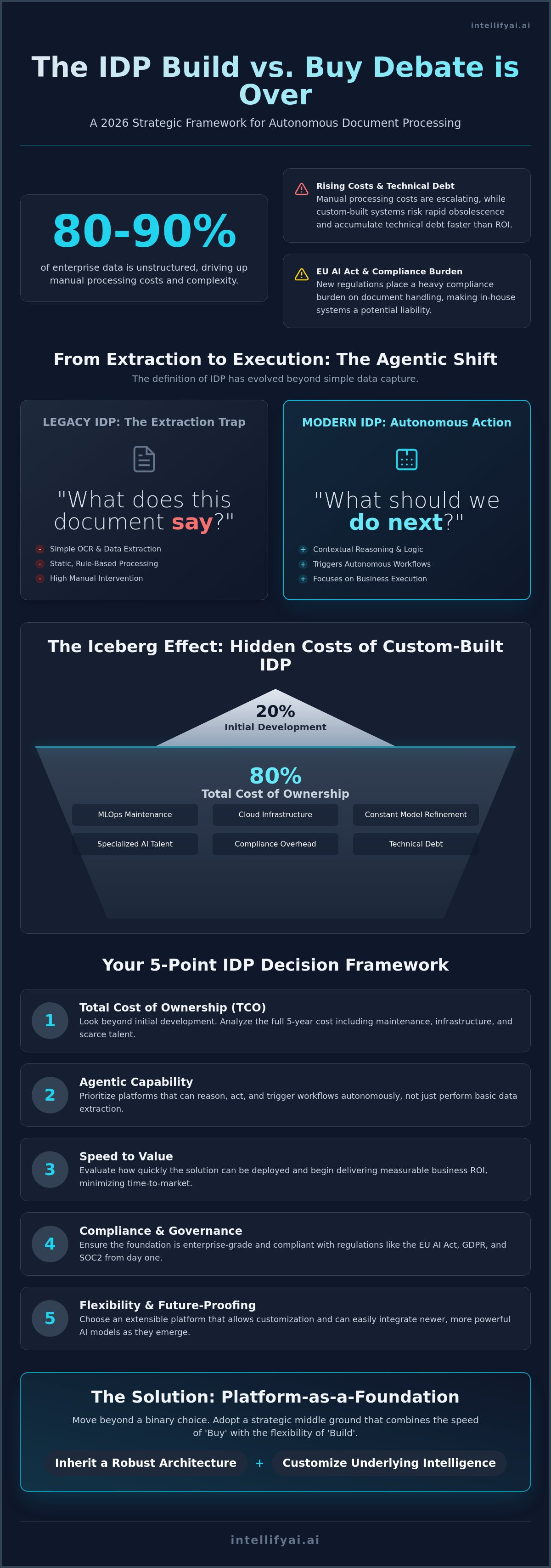
• Uncover the "Iceberg Effect" where initial development represents only 20 percent of the total cost of ownership for custom systems.
• Apply a five-point strategic framework to navigate the build vs buy idp solution decision with a focus on long-term ROI and agentic scalability.
• Distinguish between rigid legacy software and extensible platforms that offer the speed of buying with the flexibility of building.
• Discover how i_Nova provides a strategic middle ground by allowing you to inherit a robust architecture while customizing the underlying intelligence.
Beyond the Extraction Trap: The State of IDP in 2026
By 2026, the definition of Intelligent Document Processing (IDP) has evolved. It's no longer just a tool for digitizing paper. It's the critical bridge between unstructured data and autonomous action. Most enterprises find that 80 to 90 percent of their data is unstructured. Merely extracting this data is the first step, not the final goal. Real value lies in how that data triggers workflows. This shift is a core component of enterprise modernization, moving from static systems to agentic intelligence.
To better understand this transition from simple capture to intelligent execution, watch this helpful video:
We've entered the "Agentic Shift." This means IDP systems must now reason, not just read. A system shouldn't just identify an invoice. It should understand the context of the vendor contract, verify the delivery status, and initiate payment or flag a discrepancy. When evaluating a build vs buy idp solution, leaders must prioritize this reasoning capability over simple character recognition. Static extraction is now a commodity; autonomous execution is the new frontier.
The Commodity of Extraction vs. The Value of Intelligence
High accuracy in data capture is now the entry fee. It's expected. With the integration of Large Language Models (LLMs), document understanding has been democratized. You don't need a custom-built model just to read a passport or a bank statement. The focus has shifted from "What does this document say?" to "What should we do next?" Intelligence is the differentiator. It allows your human workers to focus on high-value creative work while the system handles the repetitive logic of document execution.
Why the Build vs. Buy Decision has Changed
The build vs buy idp solution decision is no longer about saving on licensing fees. The speed of AI evolution makes ground-up builds risky. If you start building a custom solution today, it might be obsolete by the time it's deployed. We're seeing the rise of "Platform-as-a-Foundation" strategies. This approach lets you inherit a robust, compliant architecture while building your specific business logic on top. Additionally, the 2026 regulatory environment, including the EU AI Act, places a heavy compliance burden on custom document handling systems. Buying a foundation ensures you aren't building a liability.
The Architect’s Burden: The Hidden Costs of Building Custom IDP
Building a custom IDP solution often presents what we call the "Iceberg Effect." While the initial development budget might seem manageable, it typically accounts for only 20 percent of the total cost of ownership over a five-year period. The remaining 80 percent is submerged in maintenance, cloud infrastructure, and the constant refinement required to handle evolving document formats. The build vs buy idp solution decision often pivots on a misunderstanding of these hidden expenses. You're not just buying code; you're funding a long-term operational commitment that grows more expensive as your data volume increases.
The talent gap complicates this further. Finding specialized AI engineers remains a significant hurdle as demand continues to outpace supply. Maintaining high-performance MLOps pipelines requires a level of expertise that most generalist software teams lack. When you choose to build, you're committing to a permanent AI laboratory within your IT department. This includes managing SOC2 and GDPR compliance for in-house data processing, which adds significant legal and security overhead that scales with every new document type you process.
The MLOps Maintenance Loop
Modern document processing is not a "set and forget" project. Custom models require continuous training to combat data drift. As document formats shift, your models must adapt or lose accuracy. Version control in complex document workflows is notoriously difficult, often leading to technical debt that slows down broader innovation. To maintain long-term viability, enterprises frequently find themselves needing specialized agentic AI engineering services just to keep their custom builds functional. If you're weighing these technical risks, our AI Strategy & Consulting can help map your specific requirements against market capabilities.
Opportunity Cost and Core Competency
Strategic leaders must ask if building a document parser is the best use of their top engineers. Every hour spent debugging a custom OCR pipeline is an hour not spent on products that differentiate your brand in the market. This often leads to "Not Invented Here" (NIH) syndrome, where internal teams reject superior external tools in favor of protecting legacy custom builds. You must measure "Time to Intelligence" rather than just "Time to Launch." A system that launches in six months but requires two years to reach 99 percent accuracy is a strategic drain. Evaluating the build vs buy idp solution requires a cold look at whether your engineering team should be an AI research lab or a business value driver.
The Vendor Lock-In Myth vs. Reality: Evaluating 'Buy' Options
The fear of vendor lock-in often paralyzes leaders when weighing a build vs buy idp solution. Historically, "buying" meant adopting a rigid SaaS tool that forced your business processes into its pre-defined boxes. In 2026, the market has shifted toward extensible IDP platforms. These systems provide the core infrastructure while allowing you to retain control over the logic and data. Modern platforms use open APIs to eliminate the "black box" problem, giving your engineers the transparency they need to verify how decisions are made. You aren't just buying a tool; you're investing in an extensible foundation.
Data sovereignty is no longer a trade-off in the build vs buy idp solution debate. Cloud-native architectures now allow for localized data residency, ensuring compliance with global regulations like the EU AI Act without sacrificing the speed of the cloud. By choosing a partner that prioritizes interoperability, you ensure your document workflows remain a portable asset rather than a trapped resource. This flexibility allows you to pivot as technology evolves, avoiding the stagnation that often plagues custom-built legacy systems.
Speed to Market vs. Customisation Depth
Most enterprises find the greatest success with a 90/10 split. You want 90 percent of the functionality out-of-the-box to ensure rapid deployment. The remaining 10 percent should be deep customization for your unique industry requirements. Generic AI often fails on specialized documents like complex legal contracts or logistics manifests. Evaluating a vendor's roadmap against your own enterprise ai strategy is essential. You need to know if the platform will support the "Agentic Shift" or if it will remain a static extraction tool that requires manual oversight for every exception.
Integration Friction and Ecosystem Compatibility
Integration friction is the silent killer of ROI. A superior IDP platform must integrate seamlessly with your existing ERP and CRM systems. It shouldn't require a total overhaul of your back office. A cloud-native approach ensures that as your document volume grows, your infrastructure scales without manual intervention. Look for platforms that support agentic hand-offs. This means the AI can pass tasks to human workers or other systems with full context. This maintains the collaborative relationship between technology and humans, ensuring that your automated workflows actually reduce the burden on your team rather than creating new technical silos.
Strategic Framework: 5 Criteria for Your IDP Decision Matrix
The 2026 technology landscape demands a more rigorous evaluation than the basic checklists of the past. You shouldn't base your build vs buy idp solution decision on a three month development window. Instead, you need a weighted matrix that accounts for long-term operational stability and the rapid shift toward system autonomy. This framework allows you to move past emotional attachments to custom code and focus on measurable business outcomes.
Your decision matrix should prioritize these five critical pillars:
Strategic Alignment
Evaluate if document processing is a core differentiator that creates a unique competitive advantage for your brand.
Technical Maturity
Assess if your internal team has deep, hands-on experience with agentic ai and complex neural networks.
Volume and Complexity
Determine if your document types are standardized or if they represent the 80 to 90 percent of unstructured data that requires advanced reasoning.
Regulatory Environment
Calculate the literal cost of building and maintaining compliance with the EU AI Act versus inheriting a pre-validated framework from a vendor.
Total Cost of Ownership (TCO)
Model the full three year cost, including cloud infrastructure, MLOps, and the engineering hours required for continuous model retraining.
The 'Core vs. Context' Test
Perform a core-competency audit before committing a single line of code to a custom IDP build. In most enterprises, document processing is "context" rather than "core." It's a supporting function that enables your business to operate but doesn't define your value proposition. When you outsource this context to a specialized platform, you liberate your top engineers to focus on the core business logic that actually drives revenue. Don't let your team become a document parser factory if your true business is logistics, finance, or healthcare.
Future-Proofing for 2027 and Beyond
The solution you choose today must handle more than just PDFs. It needs to be adaptable to multimodal AI inputs and support autonomous decision-making agents that can execute tasks across your enterprise. A static custom build often lacks the architectural flexibility to integrate these emerging technologies without a total rewrite. If your team is struggling to weigh these variables, our AI Strategy & Consulting provides the technical clarity needed to move forward with confidence. We help you design a roadmap that prioritizes long-term relevance over short-term fixes.
Orchestrated Intelligence: Why i_Nova is the Strategic Middle Ground
The choice between building and buying doesn't have to be a binary trap. In fact, the most successful enterprise leaders are moving toward a third option: orchestrated intelligence. i_Nova is our Intelligent Document Processing platform designed specifically for agentic workflows. It represents a "Platform-First" approach where you inherit a sophisticated, compliant architecture and focus your resources on customizing the intelligence that drives your specific business. This model effectively solves the build vs buy idp solution dilemma by providing the stability of a managed foundation with the flexibility of a custom build.
IntellifyAi serves as your strategic architect in this transition. We provide the platform, but we also deliver the strategic consulting required to ensure your implementation aligns with your long-term ROI goals. You don't just get a tool; you get a partner who understands the deep technical nuances of agentic AI and enterprise modernization. We bridge the gap between abstract technology and your practical operational needs.
i_Nova: Extracting Intelligence, Not Just Data
i_Nova goes beyond simple character recognition. It uses agentic reasoning to understand context and intent across multiple unstructured formats. This capability reduces your "Time to Intelligence" from several months of custom development to just a few weeks of platform configuration. For global enterprises, the built-in security and compliance frameworks ensure you meet the strict standards of the EU AI Act and SOC2 from day one. You gain a frictionless, automated future without the burden of maintaining the underlying infrastructure. This allows your human workers to unlock their potential by removing the weight of repetitive document tasks.
Custom Engineering on a Proven Foundation
By utilizing our Agentic AI Engineering Services, you can build bespoke agents directly on top of the i_Nova foundation. This creates the best of both worlds. You maintain ownership of your business logic and proprietary workflows while relying on a stable, scalable platform for the heavy lifting. This approach eliminates the "Architect's Burden" discussed earlier, allowing your team to focus on high-value innovation rather than document parsing. It's a lasting investment in relevance that ensures your build vs buy idp solution strategy remains viable as multimodal AI continues to evolve. Explore the i_Nova platform and our custom AI services to start your transformation today.
Architecting Your Autonomous Document Future
The 2026 landscape for document automation has moved beyond simple data capture. Your decision regarding a build vs buy idp solution will determine if your enterprise leads through innovation or struggles with technical debt. By prioritizing orchestrated intelligence, you ensure that your document workflows aren't just reading data but executing complex business logic. This transition from extraction to execution is the key to unlocking human potential and focusing on high-value creative work.
IntellifyAi stands as a global partner with a presence in the UK, USA, India, and the UAE. We are specialists in Cloud-Native and Enterprise Modernization, helping you navigate the complexities of agentic AI. Our i_Nova platform already handles millions of documents with sophisticated reasoning, proving that you can have the stability of a managed foundation with the flexibility of custom intelligence. Don't let the "Iceberg Effect" of hidden maintenance costs slow your progress toward a frictionless back office.
Book a Strategic AI Consultation to evaluate your IDP roadmap and secure your path toward long-term viability. Your enterprise deserves a partner that is ahead of the curve yet remains focused on the security and stability of your operations. Let's modernize your workflows together.
Frequently Asked Questions
What is the average timeline for building a custom IDP solution?
A custom IDP solution typically requires six to twelve months to reach a functional state. This period includes the initial architecture design, data collection, and model training phases. However, achieving high accuracy for complex document types often takes much longer. Most internal teams find that the final 10 percent of accuracy requires more effort than the initial build, leading to extended deployment cycles.
How does Agentic AI differ from traditional Intelligent Document Processing?
Traditional IDP functions as a passive reader that converts images into structured text. Agentic AI goes further by adding a layer of reasoning and decision-making. Instead of just extracting a date or amount, an agentic system understands the context of the document. It can autonomously verify data against external databases and initiate the next step in a workflow, transforming document processing into active execution.
Is it cheaper to build or buy an IDP solution in the long run?
Buying is typically more cost-effective because it avoids the high maintenance costs associated with custom software. When analyzing the build vs buy idp solution trade-off, you must include the price of cloud infrastructure and the salaries of specialized AI engineers. A platform-first approach allows your enterprise to benefit from continuous updates and shared R&D, ensuring your technology remains relevant without requiring a massive internal laboratory.
Can a 'Buy' solution handle highly specialized or industry-specific documents?
Modern extensible platforms are specifically designed to handle highly specialized documents. Unlike rigid legacy software, these systems allow you to build custom intelligence layers on top of a proven foundation. This means you can process unique industry manifests or complex legal contracts with high precision. You get the benefit of a stable architecture while retaining the flexibility to address your specific business requirements.
How do I ensure data privacy when using a third-party IDP platform?
You ensure data privacy by selecting platforms that prioritize localized data residency and SOC2 compliance. Modern cloud-native solutions allow you to process data within specific geographic regions to meet strict regulatory requirements like the EU AI Act. Always verify that your provider uses advanced encryption and offers transparent data governance. This ensures your sensitive information remains secure while benefiting from the scalability of a third-party intelligence platform.
What are the common pitfalls when enterprises decide to build their own AI tools?
The most frequent pitfall is underestimating the long-term maintenance required for AI models. Enterprises often build solutions that perform well in a lab but fail when faced with real-world data drift. Additionally, many companies fall victim to "Not Invented Here" syndrome, rejecting superior external tools. This leads to massive technical debt and diverts your best engineering talent away from projects that drive revenue.
What role does MLOps play in a build vs. buy decision?
MLOps manages the entire lifecycle of an AI model, including deployment, monitoring, and retraining. It's a critical factor in the build vs buy idp solution decision because building requires you to maintain these complex pipelines internally. If your team lacks specialized MLOps expertise, your custom build will likely become obsolete as document formats change. Buying a platform with built-in MLOps ensures your system stays accurate without constant manual intervention.
How does i_Nova integrate with existing legacy systems?
i_Nova integrates through a robust set of open APIs and pre-built connectors for major ERP and CRM systems. It's designed to function as an intelligent orchestration layer that bridges the gap between unstructured data and your legacy infrastructure. This allows you to modernize your document workflows without a costly "rip and replace" strategy, ensuring a smooth transition to autonomous enterprise operations.








.svg)