
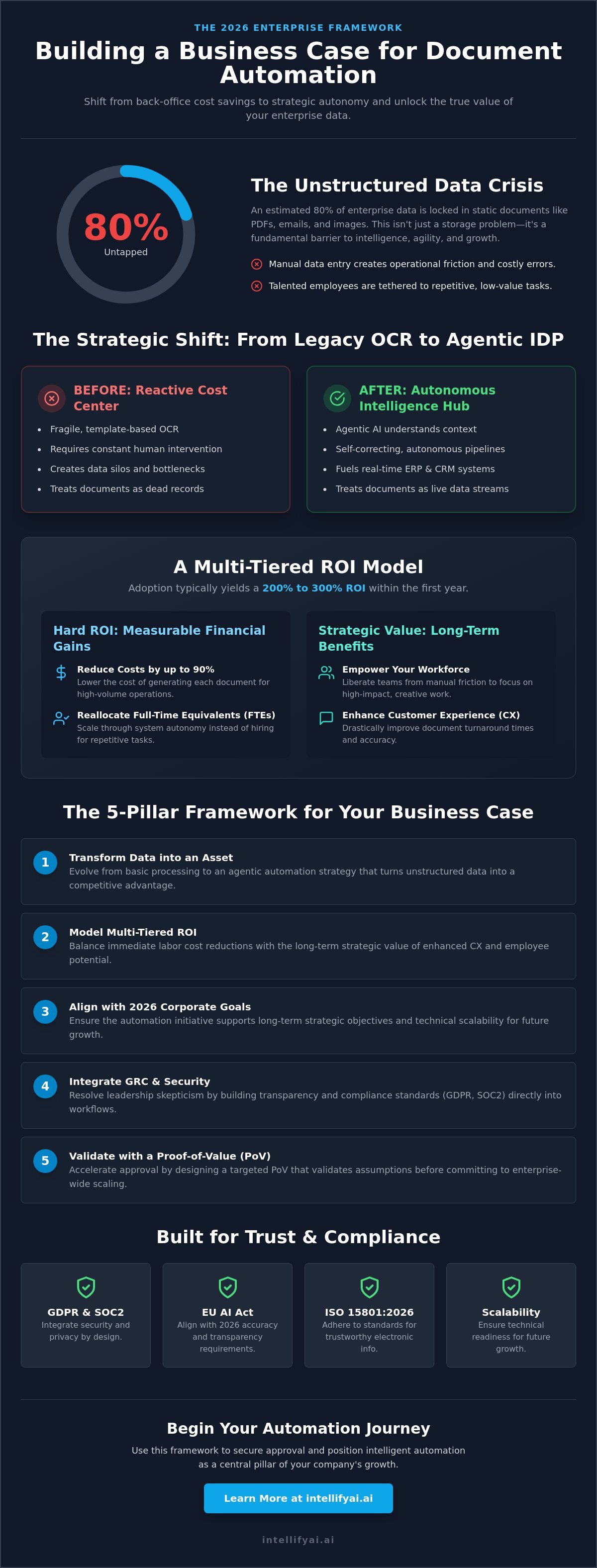
Enterprises adopting document automation frequently realize a 200 to 300 percent ROI within their first year, yet many leadership teams still hesitate. This friction often stems from legacy data silos and valid concerns regarding AI accuracy under the EU AI Act requirements effective August 2, 2026. If you're struggling to move past these hurdles, building a business case for document automation requires a shift from discussing back-office cost savings to demonstrating strategic autonomy. You likely recognize that manual data entry isn't just slow. It's a fundamental barrier to the high-value creative work your team should be performing.
This guide provides the 2026 Enterprise Framework to help you quantify benefits like employee morale and customer experience improvements. You'll master a strategic model to overcome stakeholder skepticism and secure approval for intelligent document processing initiatives. We'll preview a clear roadmap for implementation that bypasses operational friction and aligns with the latest ISO 15801:2026 standards for trustworthy electronic information. By the end of this article, you'll have a ready to present ROI model that positions automation as a central pillar of your company's long term viability and growth.
Key Takeaways
• Transform untapped unstructured data into a competitive asset by evolving from basic processing to an agentic automation strategy.
• Utilize a multi-tiered ROI model that balances immediate labor cost reductions with long-term strategic value and human potential.
• Master the 5-pillar framework for building a business case for document automation to ensure alignment with 2026 corporate goals and technical scalability.
• Resolve leadership skepticism by integrating transparency and compliance standards, such as GDPR and SOC2, directly into your automated pipelines.
• Accelerate approval through a Proof-of-Value (PoV) design that validates your assumptions before committing to enterprise-wide scaling.
The Strategic Shift: Why Document Automation is Essential in 2026
Modern document management has moved beyond simple digitization. Today, document automation represents a fundamental shift toward system autonomy within the era of Agentic AI and i_Nova. Most organizations are currently suffocating under an unstructured data crisis. Estimates indicate that 80% of enterprise data remains untapped because it's locked in static formats like PDFs, emails, and images. Building a business case for document automation isn't just about saving on paper. It's about reclaiming this lost intelligence. Legacy OCR systems were reactive and fragile. Modern Intelligent Document Processing (IDP) leverages agentic frameworks to understand context, not just characters. This evolution allows businesses to treat every document as a live data stream rather than a dead record.
To better understand the foundational steps of this strategic process, watch this video on effective business case development:
A robust business case serves as a strategic alignment tool that bridges the gap between technical capability and executive-level growth objectives.
From Cost Center to Intelligence Hub
Automated workflows transform static files into dynamic assets. By integrating Agentic AI, enterprises create self-correcting document pipelines that identify and resolve extraction errors without human intervention. This shift drastically increases organizational agility. When data flows autonomously into ERP and CRM systems, decision-making speeds up. You aren't just processing forms. You're fueling an intelligence hub that informs real-time strategy and identifies market trends hidden within your archives.
The Burden of Manual Processing Gaps
Manual processing creates invisible friction that erodes the bottom line. Human error in data entry leads to downstream delays that cost thousands in missed opportunities or compliance penalties. These bottlenecks directly hinder enterprise modernization efforts by tethering talented employees to repetitive, low-value tasks. The result is a cycle of burnout and high turnover. Removing document friction liberates your workforce to focus on high-impact initiatives. This ensures your modernization strategy remains on track while building a business case for document automation that resonates with the CFO's focus on operational efficiency.
Quantifying ROI: Hard Savings vs. Strategic Value
ROI is often miscalculated as a simple reduction in headcount. When building a business case for document automation, you must present a multi-tiered model that distinguishes between immediate fiscal relief and long-term strategic expansion. Organizations that adopt these frameworks typically realize a 200 percent to 300 percent ROI within the first year. This isn't a speculative projection. It's a measurable shift in how capital is deployed across the enterprise. By moving away from manual entry, you aren't just saving money. You're re-engineering the financial DNA of your operations.
Hard ROI: The CFO’s Perspective
Focus on the bottom line with concrete data. For organizations issuing over 100,000 documents monthly, automation can reduce the cost of generating each document by up to 90 percent. This allows for massive Full-Time Equivalent (FTE) reallocation. Instead of hiring more staff to manage growth, you scale through system autonomy. This minimizes error-related financial penalties and the expensive rework costs that plague manual pipelines. Autonomous systems that operate without fatigue or time-zone constraints ensure that critical business cycles never pause, directly accelerating the realization of net income and shortening the payback period for new initiatives.
Soft ROI: CX and Employee Empowerment
Strategic value extends deep into your CX Improvement Framework. Faster document turnaround times—often resulting in a 46 percent reduction in processing time—directly influence customer satisfaction and loyalty. When a client receives a contract or a resolution in minutes rather than days, your brand equity increases. Internally, the "Human-in-the-Loop" model removes the drudgery of repetitive clerical work. This unlocks human potential and allows your team to focus on high-value creative tasks. Modern, tech-forward environments are a primary driver for talent retention in 2026. Employees stay where they feel their skills are utilized effectively, not wasted on data entry.
Beyond the immediate ledger, document automation provides the high-fidelity, structured data streams required for sophisticated AI strategy consulting initiatives. It establishes a foundation for predictive analytics, allowing leadership to anticipate market shifts rather than reacting to them. Indirect value also manifests through enhanced compliance. Automated pipelines significantly reduce the risk of regulatory fines by ensuring every document meets the latest standards automatically. If you're looking to refine these projections for your specific infrastructure, engaging with strategic AI consulting can help bridge the gap between abstract goals and concrete financial returns. Scalability becomes a matter of adjusting compute resources rather than undertaking expensive, multi-month recruitment cycles.
The 5-Pillar Framework for Your Business Case
Constructing a professional proposal for executive review requires more than a simple spreadsheet. A successful strategy for building a business case for document automation rests on five interconnected pillars. These pillars ensure that your initiative isn't viewed as a isolated IT project but as a central business pillar essential for long term relevance. In the 2026 landscape, leadership expects a narrative that balances technical feasibility with aggressive growth targets.
Pillar 1: Strategic Alignment.
Connect automation directly to 2026 corporate goals. This includes meeting the digital-first requirements of the ISO 9001:2026 update and supporting market expansion through increased operational capacity.
Pillar 2: Technical Viability.
Assess your cloud-native readiness. Your framework must prove that new tools will integrate seamlessly with existing ERP and CRM systems without creating fresh data silos.
Pillar 3: Financial Justification.
Present a three-year Total Cost of Ownership (TCO). This should account for initial implementation costs, which typically range from $15,000 to $200,000 for enterprise-scale deployments, against the projected ROI.
Pillar 4: Risk Mitigation.
Address GRC (Governance, Risk, and Compliance) and security upfront. Ensure your plan complies with the EU AI Act and Article 22 of the GDPR regarding automated decision-making.
Pillar 5: Change Management.
Plan for organizational adoption. Frame the technology as a collaborative partner that unlocks human potential rather than a replacement for labor.
Mapping the Current State and Desired Future State
Begin by conducting a thorough audit of your existing document workflows. You must identify where the 80% of untapped data mentioned earlier is currently trapped. Categorize your findings into "Quick Win" use cases, such as invoice processing with its 60 to 90 day payback period, and long term transformation goals. Define success metrics that resonate with the board, such as a 38% reduction in manual errors or a specific increase in processing velocity. These KPIs transform abstract technical concepts into digestible business outcomes.
Selecting the Right Technology Partner
Evaluating platforms like i_Nova requires a focus on enterprise-grade scalability and system autonomy. When building a business case for document automation, the choice of partner is as critical as the technology itself. You need a partner who understands the transition from simple automation to agentic-ready processing. Utilizing specialized consulting services during the Proof-of-Value phase can help validate your assumptions and minimize operational friction. Prioritize software that offers "zero-shot" extraction models to reduce the time spent on extensive training and configuration. This ensures your infrastructure remains ahead of the curve while maintaining the stability and security of your core operations.
Addressing Objections: GRC, Security, and Scalability
Leadership skepticism often centers on the perceived lack of transparency in AI-driven extraction. When building a business case for document automation, you must address the "Black Box" concern by prioritizing explainable AI models. In the 2026 regulatory environment, the EU AI Act requires that high-risk AI systems maintain rigorous technical documentation and quality management. Providing a clear audit trail for how data is interpreted isn't just a technical requirement. It's a strategic necessity for executive buy-in. Centralized governance eliminates the risk of "Shadow AI," where disparate departments implement unvetted tools that create security vulnerabilities. Version control in MLOps protects document integrity by ensuring every iterative update to the extraction model is documented, tested, and reversible.
Maintaining GDPR and SOC2 compliance within automated pipelines requires a proactive architectural approach. Article 22 of the GDPR grants individuals the right not to be subject to solely automated decisions with significant effects. Your business case should detail how your framework incorporates "Human-in-the-Loop" checkpoints to satisfy these legal standards. This ensures that while the system handles the heavy lifting, human oversight remains a constant for sensitive or high-consequence processing. This collaborative relationship between technology and human workers adds an essential layer of ethical consideration to your proposal.
Securing Unstructured Data
Global enterprises face complex data residency requirements that demand sophisticated encryption standards. Your automated document hubs must utilize robust Role-Based Access Control (RBAC) to ensure that sensitive information is only accessible to authorized personnel. Intelligent automation actually reduces the risk of data breaches by minimizing the number of human touchpoints on sensitive records. By removing the need for manual sorting and filing, you eliminate the primary source of accidental data exposure. If you need to evaluate your current security posture against modern standards, you can consult with our security architects to refine your implementation strategy.
Future-Proofing through Scalability
A successful business case must account for unpredictable volume spikes and the inevitable emergence of new document types. Scalability isn't just about handling more of the same. It's about the system's ability to adapt to shifting business needs without requiring a total overhaul. Leveraging professional engineering services ensures that your infrastructure maintains long-term viability through custom implementations tailored to your specific operational rhythm. Integrating document intelligence into a broader Agentic AI ecosystem allows your documents to serve as high-fidelity inputs for autonomous agents. This transforms your archives from static storage into a fueling station for enterprise-wide intelligence and automated decision-making.
Implementation: From Business Case to Proof-of-Value
Approval is merely the beginning of the transformation. Execution is the final validator of your strategic vision. Designing a Proof-of-Value (PoV) allows you to test your assumptions in a controlled, low-risk environment before committing to a full-scale rollout. This phase is essential for building a business case for document automation that remains credible as you move into production. It provides the empirical data needed to confirm that your selected extraction models perform as expected under real-world conditions. By focusing on a high-impact, high-frequency workflow first, you create a tangible success story that builds momentum for broader adoption.
Success follows an iterative path: Pilot, Optimize, and Scale. Your pilot should focus on the "Quick Wins" identified during your initial audit. Once the pilot confirms the anticipated velocity gains, use those insights to optimize the system's logic and human-in-the-loop triggers. Only after these refinements should you scale across the enterprise. To maintain this momentum, establish a Center of Excellence (CoE). A CoE acts as the guardian of your automation standards, ensuring that every new document pipeline adheres to your established GRC and security protocols. Closing the loop is the final step. Regularly report realized ROI back to stakeholders to demonstrate how the initiative is meeting the targets set in your original proposal.
The i_Nova Implementation Roadmap
The i_Nova platform serves as the technical catalyst for this transformation, enabling rapid deployment without the typical friction associated with legacy integrations. Utilizing IntellifyAi strategy consulting accelerates the adoption curve by providing deep technical expertise and a proven framework for change management. This collaborative approach ensures that technology is viewed as a liberating force across the back office and contact centre. You aren't just implementing software; you're building a culture of automation that empowers employees to focus on high-value work. This cultural shift is what transforms a simple implementation into a lasting business pillar.
Next Steps for Your Enterprise
As you finalize your proposal, ensure your presentation addresses every pillar of the 2026 framework. Building a business case for document automation is a complex task that requires a balance of financial rigor and visionary strategy. Use this final checklist to prepare for your executive review:
• Confirm alignment with ISO 9001:2026 and EU AI Act standards.
• Validate the three-year TCO against projected efficiency gains.
• Detail the "Human-in-the-Loop" strategy for compliance.
• Outline the specific KPIs for the PoV phase.
The transition to a frictionless, automated future is a journey that requires a dependable partner. We invite your stakeholders to a discovery session to explore how agentic intelligence can modernize your specific operations. Contact IntellifyAi to build your custom document automation roadmap and take the first step toward unlocking your enterprise's full potential.
Architecting the Future of Enterprise Intelligence
The transition from manual processing to agentic intelligence is no longer a choice; it's a requirement for long term relevance. By utilizing the 2026 framework, you've learned how to transform untapped unstructured data into a strategic asset that fuels growth. Building a business case for document automation requires this shift in perspective, moving the conversation from simple labor reduction to a holistic model of system autonomy. You're now equipped to navigate complex GRC hurdles and present a clear, iterative roadmap that balances technical feasibility with aggressive financial returns.
IntellifyAi provides the deep technical expertise and end to end services needed to turn these strategic roadmaps into reality. Our proven i_Nova platform excels at complex unstructured data extraction, supported by a global presence across the UK, USA, India, and the UAE. From initial engineering to custom implementation, we serve as your dependable partner in the digital transformation journey. Secure your enterprise future; request a strategic AI consultation today. Your path toward a frictionless, automated enterprise starts with a single strategic realization. We look forward to modernizing your operations together.
Frequently Asked Questions
What is the difference between OCR and Intelligent Document Processing (IDP)?
OCR is a legacy technology that identifies characters but lacks context. Intelligent Document Processing (IDP) uses advanced models to interpret document intent, mapping unstructured data into structured formats. This distinction is vital when building a business case for document automation, as IDP enables the system autonomy required for complex enterprise workflows. IDP understands the document's meaning, while OCR only sees the text on the page.
How long does it typically take to see a positive ROI from document automation?
Payback periods vary by complexity, but many enterprises see a positive return within 60 to 90 days for high-frequency workflows like invoice processing. For broader implementations, a 200 to 300 percent ROI is common within the first year. These results depend on a well-defined strategic roadmap and clear success metrics established at the outset. High-velocity implementation ensures that initial costs are quickly offset by operational gains.
Can document automation handle handwritten or low-quality document scans?
Modern IDP platforms can effectively process handwritten text and low-resolution scans using specialized deep learning models. These systems identify patterns and correct visual noise that would typically cause legacy OCR to fail. This capability ensures that even older archives or field-generated documents contribute to your enterprise intelligence hub rather than remaining as untapped data silos. It turns previously unreadable files into actionable business intelligence.
How does document automation integrate with existing ERP or CRM systems?
Integration occurs through cloud-native APIs that synchronize automated document hubs with your core business systems. This frictionless data flow ensures that extracted information updates ERP and CRM records in real-time. By eliminating manual data entry, you ensure that your modernization efforts maintain high-velocity performance while protecting the stability of your existing operational infrastructure. The system acts as a bridge between unstructured inputs and your structured databases.
What are the main risks of not automating document workflows in 2026?
The primary risks include escalating compliance penalties under the EU AI Act and significant operational friction. Organizations that rely on manual processing face higher error rates and employee burnout, leading to talent turnover. In 2026, failing to automate means losing the agility required to compete against enterprises that treat unstructured data as a strategic asset. You risk becoming obsolete in an increasingly digital-first global market.
Is human oversight still required in an automated document processing system?
Human oversight remains a critical component of a responsible automation strategy, particularly for high-risk decisions or low-confidence extractions. This "Human-in-the-Loop" model satisfies GDPR Article 22 requirements regarding automated decision-making. It ensures that technology acts as a liberating force for workers, allowing them to focus on verification and high-value creative tasks rather than repetitive clerical labor. Humans provide the ethical guardrails for autonomous systems.
How do I choose between an off-the-shelf solution and a custom AI implementation?
Choose an off-the-shelf solution for standardized workflows, but opt for custom AI engineering when dealing with proprietary document types or unique security needs. Custom implementations provide long-term viability and deeper integration into your specific architecture. Building a business case for document automation often reveals that the scalability of a tailored system outweighs the initial convenience of retail software. Customization ensures the solution fits your specific business DNA.
What role does Agentic AI play in document automation?
Agentic AI moves beyond simple data extraction to autonomous process orchestration. These agents can reason about document content, flag risks, and self-correct errors within a pipeline. This technology transforms document processing into a proactive system that anticipates business needs, such as notifying legal teams of contract expirations or updating compliance records ahead of regulatory deadlines. It represents the shift from passive automation to intelligent, goal-oriented system autonomy.







.svg)