
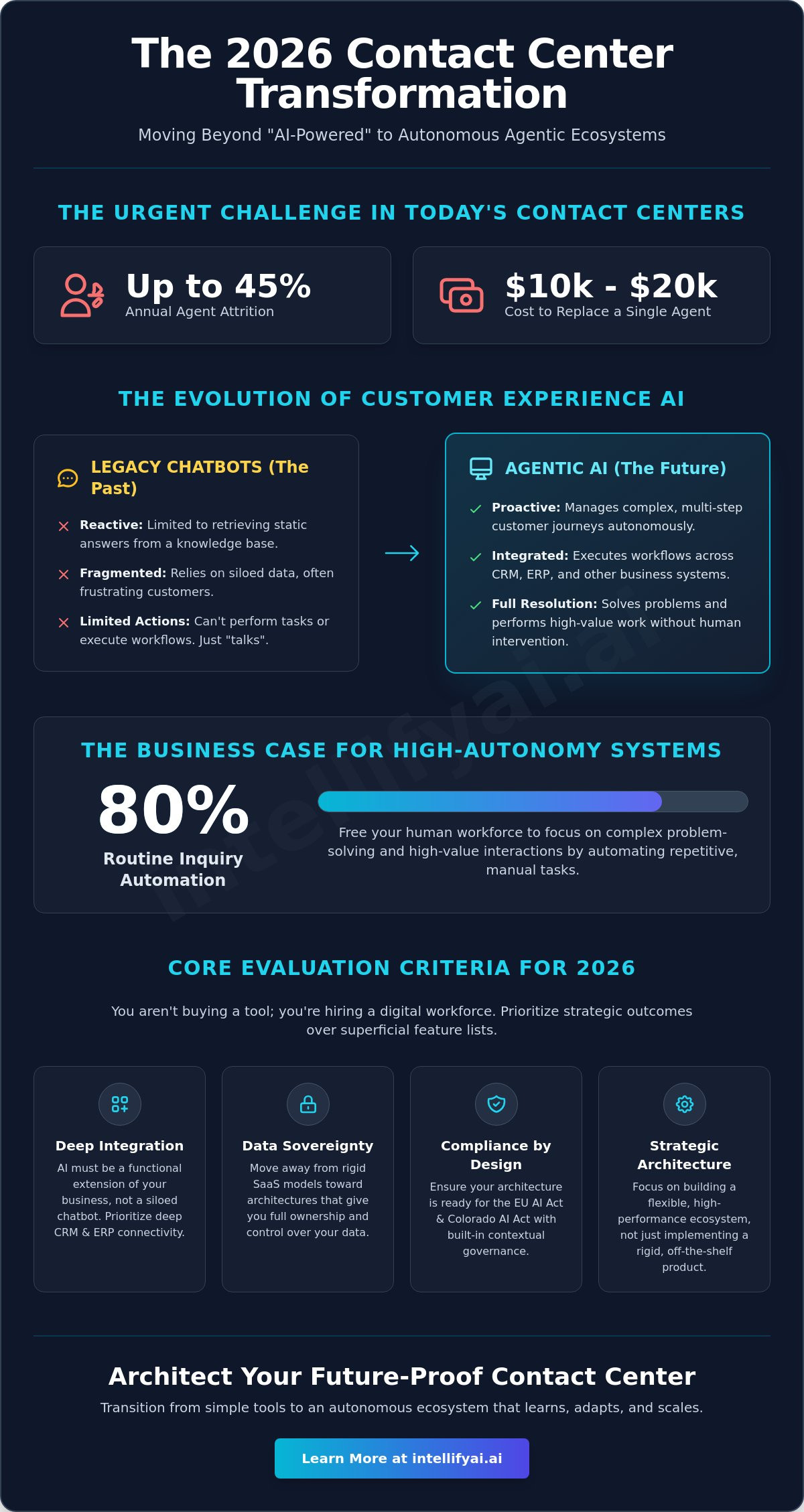
The cost to replace a single contact center agent now ranges from $10,000 to $20,000 per seat, yet annual attrition remains as high as 45%. You likely recognize the limitations of legacy systems that rely on fragmented data silos and chatbots that often frustrate customers rather than helping them. This contact center ai software comparison moves past the surface level to help you evaluate solutions based on their ability to deliver true agentic transformation. In 2026, the competitive advantage belongs to those who view AI not as a temporary fix, but as a central business pillar that empowers your team.
Addressing this attrition requires more than just better AI; it requires a superior work environment. DialGame.AI tackles this by providing a Call Center Operating System that uses a gamified predictive dialer to enhance agent productivity and job satisfaction.
We'll show you how to architect a system that achieves up to 80% routine inquiry automation and creates frictionless customer journeys. You'll discover the strategic framework needed to transition from simple tools to an autonomous ecosystem that learns, adapts, and scales. We'll also examine the critical implementation requirements for 2026, including data readiness and compliance with the latest global AI regulations like the EU AI Act and Colorado AI Act. By the end of this guide, you'll have a clear roadmap to reduce manual ticket handling and unlock the full potential of your human workforce.
Key Takeaways
• Identify the transition from reactive generative bots to autonomous agentic workflows that handle complex, full-call resolutions without human intervention.
• Apply a strategic contact center ai software comparison framework that prioritizes data sovereignty and contextual governance over superficial feature sets.
• Evaluate the operational trade-offs between rigid SaaS subscription models and the high-performance flexibility of custom Agentic AI engineering services.
• Master a structured five-step implementation roadmap designed to bypass experimental "pilot purgatory" and achieve scalable enterprise transformation.
• Shift your focus from simple software implementation to strategic architecture to unlock human potential by removing the burden of repetitive manual tasks.
The 2026 Landscape: Why "AI-Powered" Isn’t Enough for Modern Contact Centres
In 2026, the term "AI-powered" has become a baseline requirement rather than a competitive differentiator. When conducting a contact center ai software comparison, enterprises must look beyond simple automated responses. Modern contact center AI software is now defined by its agentic capabilities. This means systems no longer just generate text; they execute multi-step workflows across disparate business systems to solve problems autonomously. The goal is no longer to just talk to the customer, but to resolve their issue without human intervention.
Many legacy CCaaS platforms suffer from a significant "Intelligence Gap." They often offer basic generative layers that can summarize calls or suggest replies, but they lack the deep integration required to act as an independent worker. This limitation is driving serious enterprises toward custom-engineered AI ecosystems. Understanding the broader history of AI in customer experience helps clarify why this shift is essential. Organizations are moving away from rigid, off-the-shelf software toward architectures that prioritize data sovereignty and system autonomy. These custom builds allow for specific business logic that generic SaaS tools simply cannot replicate.
To better understand how the market is evolving to meet these demands, watch this analysis of modern contact center capabilities:
From Chatbots to Agentic AI: The Evolution of CX
The era of the "FAQ bot" is over. These reactive tools were limited to retrieving information from a knowledge base and providing static answers. In contrast, 2026 proactive AI agents are designed for full call resolution. They use sophisticated LLM orchestration to manage complex, multi-step customer journeys. For example, an agentic system can process a complex refund that requires checking real-time inventory, verifying purchase history across multiple databases, and updating CRM records simultaneously. These agents don't just talk; they perform the high-value work previously reserved for human staff.
The Business Case for High-Autonomy Systems
The strategic focus has shifted from minimizing cost-per-call to maximizing value-per-interaction. High-autonomy systems remove the burden of repetitive back-office tasks, which are often the primary source of operational friction. This shift is a central pillar of enterprise modernization. By framing technology as a liberating force, businesses allow their human talent to focus on complex problem-solving. Automating approximately 80% of routine inquiries helps stabilize the workforce. It directly addresses the high cost of agent replacement, which can range from $10,000 to $20,000 per seat, while ensuring long-term viability.
Core Evaluation Criteria: How to Compare Contact Centre AI Software
Successful evaluation starts with a shift in perspective. You aren't just buying a tool; you're hiring a digital workforce. A rigorous contact center ai software comparison must prioritize strategic outcomes over simple feature lists. High-performing enterprises evaluate solutions based on their ability to integrate deeply with existing CRM and ERP systems, transforming the AI from a siloed chatbot into a functional extension of your business operations.
Data sovereignty and contextual governance are no longer optional. With the Colorado AI Act taking effect on June 30, 2026, and the EU AI Act imposing strict requirements on high-risk customer-facing AI by August 2026, your architecture must ensure compliance by design. This involves more than just encryption. It requires a system that understands the context of every interaction while keeping sensitive data within your controlled environment. If you're looking to align your technology with these complex requirements, our AI strategy and consulting team can help define your specific roadmap.
Assess where each solution sits on the autonomy spectrum. While "Agent Assist" provides real-time coaching and knowledge retrieval to human staff, "Full Autonomy" allows the system to resolve inquiries without escalation. The right choice depends on your specific business logic, but the industry trend is clear. Organizations are moving toward high-autonomy models to capture the $80 billion in labor savings Gartner projects from conversational AI by the end of 2026. This transition requires a partner who understands the bridge between abstract technology and practical execution.
Technical Architecture and Scalability
Modern contact centers require low-latency voice processing to maintain a natural conversational flow. Cloud-native models offer superior scalability, but hybrid deployments remain relevant for enterprises with strict data residency needs. To maintain performance as your data grows, custom MLOps pipelines are critical. These pipelines automate the retraining and deployment of models, preventing the performance decay that often plagues off-the-shelf solutions. This ensures your investment remains a lasting pillar of your enterprise rather than a temporary fix.
Actionable Intelligence and Data Extraction
True intelligence goes beyond data collection. It requires the ability to extract value from unstructured data through Intelligent Document Processing (IDP). For example, an advanced system can ingest a customer's complex email, identify the intent, extract relevant account details, and cross-reference them with ERP records. This "actionable intelligence" allows the AI to make consequential decisions, such as authorizing a return or updating a policy, rather than just summarizing the text. Gartner estimates that 57% of organizations currently lack AI-ready data, making robust extraction capabilities a primary differentiator in any software comparison.
Market Comparison: SaaS Platforms vs. Custom Agentic Engineering
Choosing between standard software licensing and strategic architecture is the most consequential decision in your 2026 transformation journey. This contact center ai software comparison reveals that while SaaS platforms offer rapid deployment, they often lack the depth required for true agentic workflows. Enterprises frequently find themselves trapped in rigid licensing models that don't account for complex, multi-step business logic. When your goal is full autonomy rather than simple automation, the "build vs. buy" debate shifts toward custom-engineered solutions that act as a central business pillar.
The ROI of "ready-to-use" features is often front-loaded. You gain immediate functionality, but you quickly hit a ceiling where the software cannot adapt to your specific back-office requirements. In contrast, "built-to-purpose" intelligence offers compounding value. By engineering a system around your unique data and workflows, you solve the specific operational bottlenecks that generic tools ignore. IntellifyAi serves as the bridge for enterprises that have outgrown standard software, providing the technical expertise to move from fragmented tools to a unified, autonomous ecosystem.
Leading CCaaS Vendors: Strengths and Constraints
Platforms like Genesys and NICE CXone remain the gold standard for baseline CCaaS functionality. They excel at omnichannel routing and provide robust interfaces for human agents. However, these vendors often suffer from "feature bloat," forcing you to pay for a suite of secondary tools that may not align with your strategic goals. Their primary constraint lies in custom logic. Because these platforms are built for a broad market, they struggle to execute the high-velocity, specific tasks required for industry-specific agentic transformation. They're responders, not autonomous workers.
The Custom Engineering Advantage
Custom-engineered voice agents offer a level of precision that off-the-shelf software cannot match. These systems are trained on your specific data, allowing them to handle industry-specific jargon and complex procedural nuances with ease. A major advantage of this approach is the ownership of the IP and the model weights. Instead of being tethered to a vendor's roadmap, you control the evolution of your AI. This ensures long-term viability and security, particularly as you scale. For organizations ready to move beyond the limitations of standard bundles, our Agentic AI Engineering Services provide the framework to build a truly autonomous future. This isn't just a software implementation; it's a lasting investment in your company's relevance.
The Implementation Roadmap: Avoiding "Pilot Purgatory" in 2026
Many enterprises fail to move past the initial testing phase, a stagnation often called "pilot purgatory." This occurs when organizations treat AI as an isolated experiment rather than a core business transformation. A rigorous contact center ai software comparison should evaluate not just the tool, but the implementation framework provided by the vendor. To ensure long-term viability, you must adopt a model of Human-AI Collaboration. This approach frames technology as a liberating force that handles repetitive tasks, allowing your human agents to focus on high-value creative work.
Security and compliance remain the primary objections during any rollout. With the Colorado AI Act and the EU AI Act setting new standards in 2026, your roadmap must integrate impact assessments and consumer disclosure requirements from day one. This isn't a hurdle; it's a foundation for trust. By prioritizing contextual governance, you can scale without compromising data sovereignty or operational security. This proactive stance ensures your enterprise remains ahead of the curve while maintaining the stability of your operations.
Step 1-3: Strategy, Data, and PoV
Success begins before you select a vendor. Comprehensive AI strategy consulting is essential to align your technological goals with financial returns. This precedes the critical data engineering phase. Gartner estimates that 57% of organizations currently lack AI-ready data, and through 2026, 60% of projects will be abandoned due to poor data foundations. You must build a clean, integrated foundation before moving to a Proof-of-Value (PoV) engagement. A successful PoV focuses on measurable impact, such as a 30% reduction in operational costs, rather than just technical feasibility.
Step 4-5: Scaling and Continuous Optimization
Transitioning to full-scale deployment requires a robust MLOps framework to prevent model decay. Automated feedback loops allow the system to learn from every interaction, creating a cycle of continuous CX improvement. As you scale, "FinOps" becomes a vital discipline to manage cloud-native costs and ensure the investment remains profitable. This layered approach ensures that your agentic ecosystem remains a high-velocity asset for the enterprise. If you're ready to move beyond the experimental phase, explore our AI Strategy and Consulting services to architect your roadmap.
Architecting Your Future: Why IntellifyAi is the Strategic Choice
A standard software vendor provides a product; a strategic architect builds a foundation for long-term growth. When you finalize your contact center ai software comparison, the choice isn't just about comparing feature lists. It's about selecting a partner who will help you navigate the complexities of agentic transformation. We position technology as a liberating force. By removing the burden of repetitive tasks, we allow your organization to focus on high-value creative work. This shift doesn't just reduce costs. It unlocks human potential and ensures your enterprise remains relevant in an increasingly autonomous market.
The transition from reactive tools to an agentic ecosystem requires a deliberate balance between strategic thinking and practical execution. Off-the-shelf solutions often fail because they don't account for the unique data foundations and custom workflows that define your business. We bridge this gap by offering a unique blend of consulting and engineering. This ensures that your AI implementation isn't a temporary fix, but a lasting investment in your company's stability and security. We don't just help you keep pace with the industry. We help you define it.
The IntellifyAi CX Improvement Framework
Our CX Improvement Framework is a holistic methodology designed to transform contact centers into high-velocity assets. We integrate sophisticated data engineering with our proprietary i_Nova intelligence for advanced document processing. This allows our custom voice agents to extract actionable intelligence from unstructured data, moving beyond simple responses to full-scale problem resolution. Our commitment to human-centric AI ensures that technology acts as a partner to your workforce. We build systems that learn and adapt, creating a frictionless future for your enterprise and your customers alike.
Ready to Transform Your Contact Centre?
Moving beyond standard software is a strategic realization that distinguishes market leaders from the rest of the field. If you're ready to escape the limitations of rigid SaaS licensing and architect a truly autonomous future, our team is prepared to lead the way. We focus on the bottom line, ensuring every technological advancement translates into measurable growth and performance. Don't just buy software; build a legacy of efficiency. Access our AI Consulting Services today to book your strategic consultation.
Secure Your Competitive Advantage Through Agentic Intelligence
This contact center ai software comparison has demonstrated that the era of simple automation is over. To remain competitive in 2026, enterprises must move beyond reactive chatbots toward fully autonomous, agentic workflows. Success requires a commitment to data readiness and a shift from rigid SaaS licensing to custom-engineered intelligence. By prioritizing human-AI collaboration, you transform technology into a liberating force that removes the burden of repetitive tasks and unlocks your team's creative potential.
IntellifyAi provides the technical expertise and strategic vision needed to lead this transformation. With a global presence across the UK, US, UAE, and India, we specialize in Agentic AI and high-performance MLOps. Our flagship i_Nova IDP platform ensures that your system extracts maximum value from every interaction. Don't let your digital transformation stall in the experimental phase. It's time to build a lasting pillar of operational efficiency and security.
Architect your autonomous future with IntellifyAi Strategic Consulting
The path to a frictionless enterprise is clear. We're ready to help you build it.
Frequently Asked Questions
What is the main difference between CCaaS and Agentic AI software?
CCaaS provides the cloud-based infrastructure for communication channels, while Agentic AI acts as an autonomous worker within those channels. Traditional CCaaS focuses on routing calls to human agents efficiently. Agentic AI focuses on resolving those calls independently. This shift is a key factor in any contact center ai software comparison, as it determines whether you are simply managing interactions or actively eliminating them through intelligent execution.
How does Agentic AI improve the customer experience (CX) compared to traditional IVR?
Agentic AI eliminates the rigid, frustrating menus of traditional IVR by providing a natural, conversational interface. Instead of forcing customers to navigate numeric prompts, these agents understand intent and perform multi-step resolutions immediately. This results in frictionless customer journeys and significant reductions in manual ticket handling. It transforms the contact centre from a cost center into a high-performance value driver.
Is it better to build a custom contact centre AI or buy a SaaS solution?
Buying a SaaS solution offers rapid deployment for standard needs, but building custom AI provides ownership of intellectual property and specific business logic. For serious enterprises, a custom build ensures that the system aligns with unique back-office workflows. This comparison highlights that while SaaS is accessible, custom engineering services offer the long-term viability needed to handle complex, industry-specific jargon and proprietary processes.
What are the security risks of implementing AI in a contact centre?
The primary risks involve data sovereignty and compliance with emerging global regulations like the EU AI Act and the Colorado AI Act. These laws mandate strict impact assessments and disclosure requirements for customer-facing AI. Implementing a system without robust contextual governance can lead to legal exposure and loss of consumer trust. Your architecture must prioritize secure data engineering to keep sensitive information within your controlled environment.
How long does it take to deploy an enterprise-grade AI voice agent?
Deploying an enterprise-grade AI voice agent typically takes between eight to twelve weeks, depending on the complexity of your integration architecture. This timeline includes the critical data engineering phase and the development of a Proof-of-Value. Rapid setups often fail to deliver measurable ROI because they skip the necessary strategy and custom logic required for full call resolution without human intervention.
Can modern contact centre AI software handle unstructured data like emails and PDFs?
Modern agentic systems excel at processing unstructured data through technologies like Intelligent Document Processing (IDP). They can ingest emails, PDFs, and other documents to extract actionable intelligence. This allows the AI to cross-reference customer documents with CRM and ERP records automatically. It removes the burden of repetitive data entry, allowing your workforce to focus on more complex, high-value creative work.
What is the expected ROI for contact centre AI transformation in 2026?
Organizations can expect a reduction in operational costs of as much as 30% through successful AI implementation. Gartner projects $80 billion in total labor savings from conversational AI by the end of 2026. These returns are driven by the automation of approximately 80% of routine inquiries. This efficiency allows businesses to scale without the high cost of agent replacement, which currently ranges from $10,000 to $20,000 per seat.
How does human-in-the-loop (HITL) work in an autonomous contact centre?
Human-in-the-loop ensures a collaborative relationship where AI handles routine tasks and humans manage complex, high-emotion escalations. The system identifies interactions that require emotional intelligence or creative problem-solving and transitions them to a human agent. This hybrid model doesn't replace labor. It unlocks human potential by providing agents with real-time assistance and a clean, data-rich environment for decision-making.









.svg)