
The lowest per-minute rate on your vendor shortlist is often the most expensive line item your enterprise will face this year. With Gartner predicting that 40% of enterprise applications will feature task-specific AI agents by 2026, conversational ai platform pricing has evolved into a complex orchestration of usage-based fees and API costs. You aren't just buying a tool. You're investing in a new layer of your operational architecture. This transition requires a disciplined financial strategy to remain sustainable.
It's frustrating to watch a promising pilot's ROI evaporate due to unpredicted integration fees or the scarcity of internal AI talent. You've likely felt the pressure of vendor lock-in as call volumes scale and costs spiral. Efficiency requires a different approach. This guide provides the clarity you need to build a predictable cost model for the coming year. We'll break down the essential differences between SaaS subscriptions and custom agentic AI engineering. You'll gain a sophisticated ROI framework to transform these technical complexities into a high-performance roadmap for your enterprise.
Key Takeaways
• Analyze the shift toward autonomous agentic AI and identify the orchestration components that drive modern enterprise costs.
• Master the nuances of conversational ai platform pricing by balancing raw infrastructure consumption with platform licensing fees.
• Determine whether to accept the recurring seat-based tax of SaaS or invest in custom engineering for long-term scalability.
• Calculate your true total cost of ownership by uncovering hidden integration fees and the rising cost of manual back-office tasks.
• Build a high-ROI roadmap using the i_Nova advantage to automate repetitive workflows and secure sustainable financial returns.
Understanding the Landscape of Conversational AI Platform Pricing in 2026
The transition from rigid Interactive Voice Response (IVR) systems to autonomous Agentic AI platforms has fundamentally altered the financial commitment for modern enterprises. In 2026, conversational ai platform pricing is no longer a static monthly fee. It's a dynamic variable tied to the complexity of the tasks being automated. This shift allows your business to move beyond simple keyword detection into sophisticated, goal-oriented reasoning that mimics human decision-making.
To grasp the current market, one must look at the underlying architecture. A baseline Understanding Conversational AI requires recognizing three distinct cost drivers: orchestration logic, Large Language Model (LLM) tokens, and telephony infrastructure. By isolating these components, you can identify where your budget is actually being spent. This transparency is the first step toward building a high-ROI roadmap that scales without friction.
To better understand this concept, watch this helpful video:
The Evolution of AI Billing: From Seats to Tokens to Outcomes
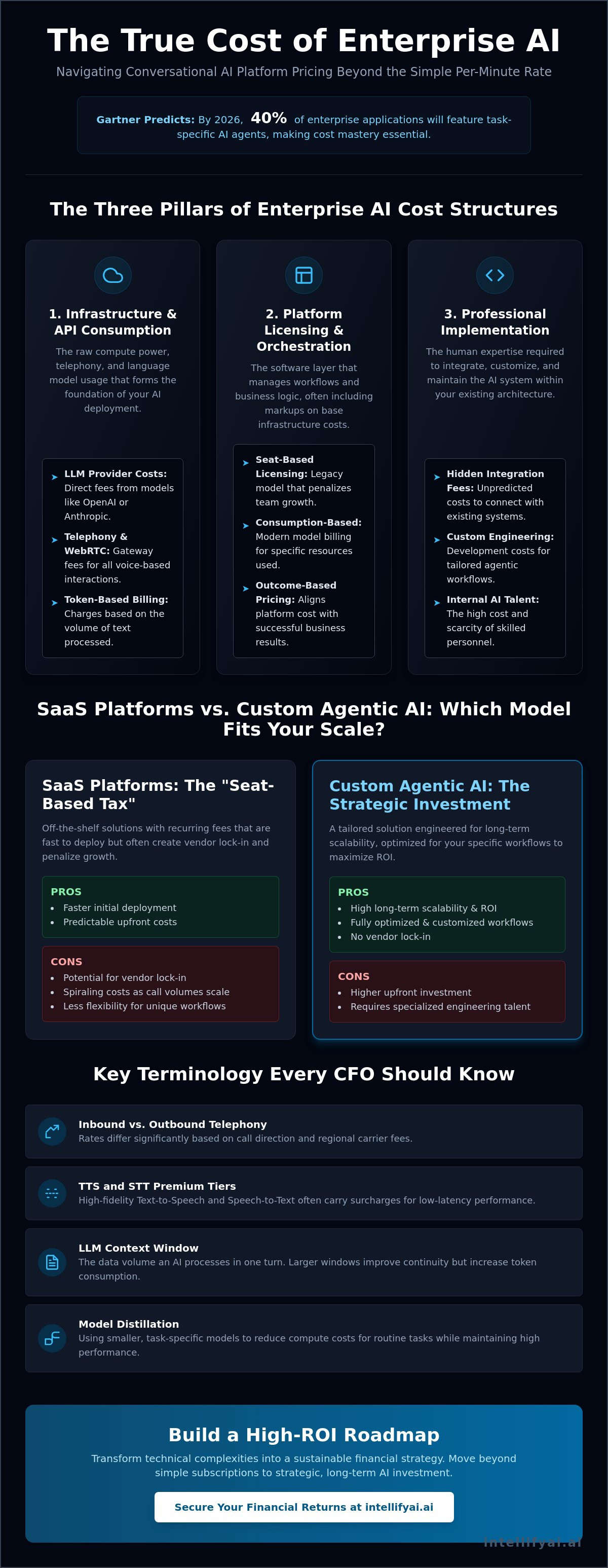
Legacy SaaS models relied on seat-based licensing. This was predictable but often penalized growth by increasing costs as you added more agents. Modern consumption-based billing has replaced it. You pay for the specific resources used. Agentic workflows change the math further. Instead of charging per message, many enterprise contracts now focus on outcome-based pricing. This aligns the platform's cost directly with successful resolutions. If you're considering Agentic AI Engineering Services, this distinction is vital for long-term budgeting.
Key Terminology Every CFO Should Know
Mastering the nuances of conversational ai platform pricing requires a deep dive into the technical line items that appear on your monthly statement. These variables determine the difference between a high-ROI deployment and an expensive experiment.
Inbound vs. Outbound telephony
Rates differ significantly based on call direction and regional carrier fees.
TTS and STT premium tiers
High-fidelity voice synthesis and real-time transcription often carry additional surcharges for low-latency performance.
LLM context window
This refers to the data volume the AI processes in a single turn. Larger windows improve continuity but increase token consumption and overall cost.
Model distillation is the final piece of the 2026 pricing puzzle. Smaller, task-specific models are replacing bloated general-purpose LLMs for routine tasks. This process reduces the compute power required for specific workflows. It effectively lowers your base operational costs while maintaining high performance. This efficiency ensures your investment remains sustainable as you scale.
The Three Pillars of Enterprise AI Cost Structures
Budgeting for a modern AI deployment requires a framework that accounts for both visible usage and the deep technical requirements of enterprise-grade systems. While many vendors highlight simple per-minute rates, a comprehensive view of enterprise AI cost structures reveals a more complex reality. To achieve a sustainable ROI, you must categorize your investment into three distinct pillars: infrastructure, platform licensing, and professional implementation.
Pillar 1: Infrastructure and API Consumption
The foundation of any voice or text agent is the raw compute power it consumes. This involves direct LLM provider costs from entities like OpenAI or Anthropic. Many platforms add a markup to these base rates to cover their own orchestration overhead. Telephony and WebRTC gateway fees also apply for voice-specific applications. Token-based billing refers to the method of charging for the specific volume of text processed to maintain a conversational memory during an interaction. Managing these variables is the core of effective conversational ai platform pricing strategy.
Pillar 2: Platform Licensing and i_Nova Integration
Licensing provides access to the orchestration layer and the user interface. These fees are typically tiered based on document volume or the number of monthly interactions. However, the true complexity often lies in connecting these tools to your existing ecosystem. Securely integrating AI with your CRM, ERP, or legacy back-office systems is a non-negotiable requirement for automation. Reviewing the capabilities of IntellifyAi Products can provide essential context for how these document-processing integrations impact your overall budget.
Pillar 3: Custom Engineering and Implementation
The final pillar is often the most underestimated. Building proprietary agentic logic that actually solves business problems requires specialized expertise. This includes data engineering to prepare unstructured company data for Retrieval-Augmented Generation (RAG). Without this step, your AI remains a generic tool rather than a strategic asset. Investing in Agentic AI Engineering Services ensures your implementation is tailored to your specific workflows. This upfront engineering cost is what prevents expensive failures and ensures the system remains stable over time.
Establishing these pillars early in your planning phase prevents the "Iceberg Effect," where hidden costs sink your project after deployment. If you're ready to define your specific requirements, consult with our strategy team to map out a precise financial roadmap for your modernization journey.
SaaS Platforms vs. Custom Agentic AI: Which Model Fits Your Scale?
Choosing between a subscription-based tool and a proprietary build is the most consequential decision in your 2026 modernization roadmap. This choice dictates your long-term cost efficiency and your ability to pivot as technology evolves. While off-the-shelf solutions offer speed, they often introduce a scaling tax that can erode your margins as interaction volumes grow. A Strategic Architect evaluates these options not just on initial setup costs, but on the total trajectory of conversational ai platform pricing over a three-year horizon.
The market is shifting away from rigid structures. IDC predicts that 70% of software vendors will move away from pure seat-based pricing by 2028. This transition reflects the reality that seat counts are a poor proxy for the value generated by autonomous systems. Your goal is to find a model that rewards efficiency rather than penalizing growth.
When to Choose an Off-the-Shelf SaaS Platform
SaaS platforms remain the ideal choice for non-core business processes where speed to market is the primary objective. If you need to deploy a standard customer service bot for a mid-market operation, the lower barrier to entry is attractive. However, these platforms often have hidden limitations. They struggle with complex, multi-modal workflows that require the simultaneous processing of voice and unstructured documents. You'll likely encounter "fair use" traps or steep overage charges when your enterprise reaches true scale. For many, the convenience of SaaS eventually becomes a bottleneck for innovation.
The Case for Custom Agentic AI Engineering
Enterprises with high-volume contact centres or specialized regulatory requirements should lean toward custom builds. A custom architecture allows you to protect your intellectual property and maintain full sovereignty over your proprietary data. This is particularly critical for industries governed by SOC2 or GDPR compliance. By investing in Agentic AI Engineering Services, you eliminate recurring per-seat licensing fees and gain the ability to fine-tune models for your specific domain.
The true value of a custom build lies in its ability to support autonomous enterprise workflows that go far beyond the capabilities of a standard chatbot. Unlike legacy bots that follow a linear script, agentic systems use reasoning to complete complex back-office tasks. This higher level of autonomy requires a more sophisticated conversational ai platform pricing strategy, one that prioritizes upfront engineering to secure a zero-license future. This approach transforms AI from a monthly expense into a permanent capital asset that grows in value as your data matures.
If you're unsure which path maximizes your returns, request a technical feasibility audit to compare SaaS scaling costs against a custom engineering roadmap.
Total Cost of Ownership (TCO): Calculating ROI Beyond the Per-Minute Rate
The sticker price of a platform is rarely the full picture. Many executives fall into the trap of evaluating conversational ai platform pricing based solely on visible usage rates, such as per-minute or per-token fees. This is the "Iceberg Effect." Below the surface lie the substantial costs of integration, data preparation, and ongoing model maintenance. A Strategic Architect looks past the immediate invoice to understand the long-term financial trajectory of the investment.
McKinsey research indicates that the payback period for AI investments is typically 6 to 12 months. However, achieving this requires a disciplined approach to FinOps. You must continuously optimize model performance to ensure that your automated workflows don't become more expensive than the manual processes they replaced. The cost of inaction is perhaps the heaviest burden. Manual call centre operations continue to drain resources that could be redirected toward high-value creative work, where tools like Kaika AI can help align employee purpose with organizational objectives.
The Hidden Costs of "Cheap" AI Solutions
Opting for a low-cost, off-the-shelf solution often results in integration debt. Poorly architected cloud-native systems require constant patching to maintain connectivity with your legacy ERP or CRM. There is also the reality of model drift. As customer behavior changes, an unmanaged AI begins to lose accuracy. This leads to manual retraining costs that weren't in the original budget. Latency is another silent ROI killer. Even a few seconds of delay in a voice agent can lead to increased customer churn, negating any savings gained from lower per-minute rates.
Building an ROI Business Case for the Board
When presenting to the board, shift the conversation from "Cost per Minute" to "Cost per Resolution." This is the only metric that truly reflects the value of automation. Forrester's analysis of voice AI platforms documented $10.3 million in risk-adjusted present value of labor savings over three years. This level of impact is only possible when you account for 24/7 autonomous back-office processing and the removal of repetitive human tasks. By implementing a CX Improvement Framework, you can quantify how reducing average handle time by 15% translates directly to the bottom line.
Navigating these variables requires more than just a software vendor. It demands a partner who understands the intersection of technology and corporate strategy. Engaging in ai strategy consulting allows you to stress-test your assumptions before you commit to a specific vendor. This ensures your roadmap is grounded in technical reality rather than marketing hyperbole. You aren't just buying software. You're re-engineering how your company operates.
Ready to move beyond estimates? Schedule a TCO workshop to calculate the precise ROI of your AI modernization strategy.
Strategic AI Investment with IntellifyAi: Beyond the Subscription
Modernizing your enterprise requires moving past the limitations of the subscription trap. While many providers offer a login and a list of features, IntellifyAi provides a holistic partnership that balances professional expertise with SaaS efficiency. We understand that conversational ai platform pricing is only one variable in a much larger financial equation. Our goal is to ensure your technology stack becomes a driver of growth rather than a recurring drain on your operational budget.
We deliver this through a disciplined focus on Cloud-Native Modernization and FinOps. By optimizing your architecture from the ground up, we eliminate the waste often associated with poorly managed API consumption. Our engineering services ensure your models are not just accurate, but cost-efficient. This transition from a Proof of Value (PoV) to global scale requires a partner who can navigate the complexities of system autonomy while maintaining a sharp focus on your bottom line.
Our i_Nova advantage provides a unique edge in cost reduction. By integrating Intelligent Document Processing directly into your conversational workflows, we automate the retrieval and synthesis of unstructured data. This reduces the token load on your LLMs and accelerates response times. It effectively turns your document archive into a strategic asset, allowing your voice agents to handle complex back-office tasks that previously required manual intervention.
Tailored AI Roadmaps for Enterprise Transformation
Generic platform subscriptions often fail because they don't account for your specific legacy constraints or unique customer journeys. Custom roadmaps outperform these off-the-shelf tools by aligning technology with your high-level corporate strategy. We focus on removing the burden of repetitive tasks, which allows your human workforce to dedicate their time to high-value creative work. By utilizing IntellifyAi Consulting Services, you gain a clear path toward a frictionless, automated future that scales predictably.
Future-Proofing Your AI Spend
Vendor lock-in is a significant risk in the rapidly evolving AI market. Our engineering approach is vendor-agnostic, ensuring your systems remain compatible with the best-performing models as they emerge. We build scalable MLOps pipelines that provide long-term viability and protect you from sudden shifts in conversational ai platform pricing or API access. This architecture ensures your investment remains relevant for years, not just months. The Strategic Architect perceives AI as a permanent capital investment that compounds in value by liberating human talent for high-impact innovation.
Your journey toward a more efficient enterprise begins with a single strategic realization. Connect with our team today to design a roadmap that transforms your contact centre into an autonomous engine of ROI.
Architecting a High-ROI Future for Your Enterprise
The transition to agentic automation is no longer a speculative venture. It's a strategic necessity for enterprises looking to maintain relevance in 2026. Successful budgeting requires looking beyond the surface of conversational ai platform pricing to account for the deep engineering and orchestration that drives real value. By focusing on custom agentic workflows and intelligent document processing via the i_Nova platform, you can eliminate the scaling taxes of generic SaaS models and build a permanent capital asset.
IntellifyAi brings deep expertise in high-ROI Agentic AI engineering to global markets across the UK, USA, India, and the UAE. We help you move from experimental pilots to a stable, automated back office that unlocks human potential. Don't let opaque billing structures or integration debt stall your progress. It's time to secure your competitive edge with a roadmap built for long-term viability. Schedule a Strategic AI Consultation to optimize your 2026 budget and transform your operational efficiency today. The future of your enterprise is frictionless and fully optimized.
Frequently Asked Questions
What is the average cost per minute for an enterprise-grade voice agent in 2026?
Total costs for enterprise voice interactions typically include fees for speech-to-text, the language model, and telephony infrastructure. Industry rates fluctuate based on the quality of the voice synthesis and the complexity of the orchestration required for real-time response. You should evaluate these rates in the context of your total volume to ensure the chosen platform remains sustainable as your contact centre operations grow.
How do token-based pricing and per-minute pricing differ in conversational AI?
Per-minute pricing is the standard for voice-based interactions, covering the duration of the connection and the telephony gateway. Token-based pricing applies to the underlying Large Language Model processing, where you pay for the specific volume of text generated or consumed. Most modern conversational ai platform pricing models now combine both to account for the delivery channel and the cognitive processing power required for reasoning.
Are there hidden costs associated with free or low-cost AI platforms?
Low-cost platforms often hide expenses in non-standard integration fees and premium support tiers that can add significant surcharges to your base monthly cost. You should also account for the time your internal team spends on onboarding and data preparation. These platforms frequently lack the robust security features required for regulated industries, which often leads to expensive compliance retrofitting later in the deployment cycle.
What is the typical setup fee for a custom Agentic AI implementation?
One-time costs for custom implementations vary based on the complexity of your domain and the depth of model fine-tuning required. These fees cover the technical architecture needed to build proprietary logic and secure data pipelines. While the initial investment is higher than a standard SaaS plan, it removes the burden of recurring per-seat licensing. This allows your enterprise to treat AI as a lasting capital asset.
Can I reduce my AI platform costs by using open-source models?
Open-source models can reduce direct API licensing fees but often increase your internal engineering and hosting requirements. You're responsible for the infrastructure, security, and maintenance that a SaaS provider would otherwise handle. For high-volume enterprises, the trade-off is often worth it to avoid vendor lock-in and to gain full control over proprietary data and model fine-tuning for specific back-office tasks.
How does Intelligent Document Processing (IDP) affect conversational AI pricing?
Intelligent Document Processing reduces long-term costs by automating the synthesis of unstructured data before it reaches the reasoning model. This pre-processing minimizes token consumption and reduces the number of turns required to resolve a complex query. By integrating IDP, you improve the efficiency of your agents. This results in a more predictable ROI by lowering the cognitive load on more expensive Large Language Models.
What is FinOps, and why is it critical for managing AI platform costs?
FinOps is a disciplined approach to managing the variable costs of cloud and AI resources through continuous monitoring and optimization. It's critical because usage-based billing can lead to unpredictable expenses if workflows aren't strictly governed. Managing conversational ai platform pricing through FinOps ensures that your agents remain cost-effective as they scale. This practice aligns technical performance with financial accountability to protect your enterprise margins.
Does IntellifyAi offer fixed-price consulting for AI strategy?
We provide structured strategic engagements tailored to the specific modernization needs of your enterprise. Our approach focuses on creating a high-performance roadmap that balances immediate efficiency with long-term technical viability. These consultations are designed to eliminate ambiguity in your 2026 budget. Reach out to our team to discuss a framework that suits your current operational scale and your objectives for digital transformation.









.svg)