
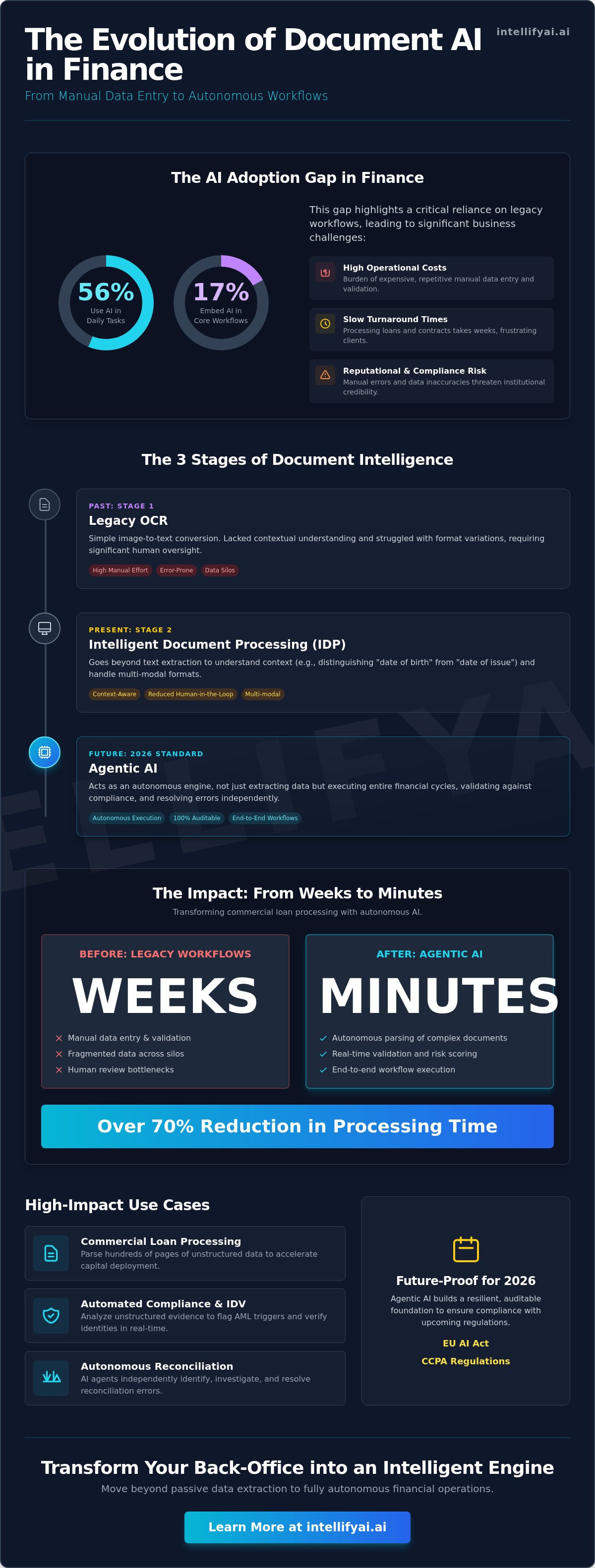
While 56% of finance professionals have integrated AI into their daily tasks, only 17% have successfully embedded it into core operational workflows. This gap represents a significant missed opportunity for institutions still burdened by the high cost of manual data entry and the reputational risks of data inaccuracies. Transitioning to advanced document ai use cases in finance isn't just about digitizing paper anymore. It's about moving toward a system where technology acts as a strategic partner that eliminates the burden of repetitive tasks.
You likely recognize that slow turnaround times for loan and contract processing are no longer sustainable in a market demanding instant decisions. We agree that manual oversight shouldn't be the bottleneck for your growth. This article demonstrates how Agentic AI and Intelligent Document Processing are evolving from simple data extraction tools into autonomous engines capable of executing entire financial cycles. You'll learn how to achieve 100% auditable AI workflows while reducing operational overhead. We'll explore the strategic shift toward system autonomy that ensures your institution remains compliant with the upcoming EU AI Act and CCPA regulations taking effect in 2026.
Key Takeaways
• Understand why traditional OCR is insufficient for 2026 and how it's being replaced by agentic intelligence for complex data.
• Identify high-impact document ai use cases in finance that reduce commercial loan processing from weeks to minutes.
• Move beyond passive extraction to autonomous workflows where AI agents identify and resolve reconciliation errors independently.
• Build a resilient implementation framework that prioritizes data engineering while adhering to evolving global AI regulations.
• Leverage the i_Nova platform to transform fragmented back-office tasks into a unified, intelligent operational engine.
The Evolution of Document AI in Finance: From OCR to Agentic Intelligence
The financial sector's reliance on paper and unstructured data has reached a critical inflection point. For decades, institutions relied on Optical Character Recognition (OCR) to convert images into text; however, legacy systems often lacked the nuance required for high-stakes decision making. In 2026, Document AI has evolved beyond simple digitization. It now serves as a cognitive layer that understands the intent, context, and regulatory implications of every data point it encounters. This shift allows firms to move from mere data capture to sophisticated reasoning.
To better understand this concept, watch this helpful video:
Modern document ai use cases in finance focus on the transition from simple data extraction to autonomous task execution. While traditional OCR struggled with varying invoice formats or handwritten notes on loan applications, today's systems interpret these variables with precision. They don't just read data. They validate it against global compliance standards and prepare it for immediate execution within the back office. This evolution is the foundation of Agentic AI, where technology doesn't just assist humans but actively manages complex financial cycles.
Why Traditional Document Workflows are Failing
Legacy workflows are crumbling under the weight of a high-velocity market. Manual processing creates significant bottlenecks that delay capital deployment and frustrate clients. Relying on "human-in-the-loop" models for repetitive data entry carries a high price, both in terms of operational overhead and the inevitable risk of manual error. Data fragmentation complicates this further. Information is often trapped in silos across legacy banking systems, making a unified view of risk or opportunity nearly impossible to achieve without modern intervention. These inefficiencies are no longer just an inconvenience; they're a threat to institutional credibility.
Defining the 2026 IDP Standard
The current standard for Intelligent Document Processing (IDP) requires more than just reading text. It demands multi-modal processing capabilities that handle diverse file formats, from structured spreadsheets to unstructured legal contracts. Contextual understanding has replaced simple pattern recognition, allowing systems to distinguish between a "date of birth" and a "date of issue" without explicit labeling. This level of intelligence is a core pillar of enterprise modernization. By integrating these systems, institutions move from being data-rich and insight-poor to becoming truly autonomous. Implementing advanced document ai use cases in finance ensures that the system doesn't just present data for review but executes the necessary tasks to close the loop on a workflow.
Strategic Document AI Use Cases for Modern Financial Services
In 2026, the competitive advantage for financial institutions lies in their ability to process information at the speed of the market. Commercial loan processing often involves hundreds of pages of unstructured data, from balance sheets to tax returns. Modern document ai use cases in finance leverage agentic systems to parse these complex variables with a high degree of accuracy. This capability allows institutions to reduce processing time by over 70%, effectively shifting the decision-making window from weeks to minutes.
Compliance isn't just a regulatory hurdle; it's a data challenge. Automating identity verification through IDP ensures that risk scoring is both rapid and accurate. By analyzing unstructured evidence, systems can flag AML triggers in real-time. It's not just about catching fraud; it's about building a robust, auditable foundation for every transaction. These document ai use cases in finance are no longer experimental; they're the new standard for institutional efficiency and security.
Wealth management and insurance sectors are seeing similar transformations. Wealth managers use these tools to extract deep insights from diverse investment portfolios, parsing thousands of annual reports to synthesize risks hidden in the fine print. Insurance claims automation takes this further by validating unstructured evidence, such as repair estimates and medical notes, against policy documents to authorize payouts autonomously. Even complex derivatives, such as ISDA agreements, are being digitized to handle regulatory reporting requirements without manual intervention.
Accelerating Loan and Mortgage Origination
Speed defines the modern borrower experience. Automating the collection and validation of income evidence eliminates the friction that often leads to application abandonment. Real-time credit risk analysis, powered by extracted document data, provides a level of precision that manual reviews simply can't match. This frictionless approach transforms the back office into a high-performance engine that prioritizes the customer's time while maintaining strict institutional standards.
Institutional Compliance and Regulatory Reporting
Regulatory pressure is intensifying, making manual oversight a liability. Streamlining Sarbanes-Oxley (SOX) compliance through automated auditing removes the human error factor from financial reporting. Real-time monitoring for AML triggers and the generation of transparent audit trails ensure that your institution is always ready for a regulatory review. If you're looking to refine your approach, exploring AI strategy & consulting can help align these tools with your specific governance needs and growth objectives.
Beyond Extraction: The Rise of Agentic AI in Financial Workflows
The true potential of document ai use cases in finance isn't found in the act of reading, but in the power of execution. While traditional systems stop once data is successfully extracted, Agentic AI begins its work there. An AI agent in a financial context is defined by its ability to pursue specific goals autonomously. It doesn't just flag a missing signature on a mortgage application; it contacts the broker, requests the update, and re-initiates the validation sequence once the document arrives. This shift from passive reporting to active participation marks the next frontier of institutional efficiency.
Autonomous reconciliation represents a major leap in back-office operations. When discrepancies arise between an invoice and a purchase order, an agentic system doesn't merely alert a human operator. It investigates the cause by cross-referencing shipping manifests and previous contracts. It identifies the error and proposes a correction or fixes it automatically within pre-defined risk parameters. This self-healing workflow ensures that data integrity is maintained without constant manual intervention. It allows your team to focus on high-value strategic work rather than chasing data mismatches.
Customer experience also benefits from this cognitive autonomy. Sophisticated voice agents can now leverage processed document data to provide real-time support. Instead of a customer waiting for a representative to look up a claim status, an agent accesses the extracted policy data and provides an immediate, accurate update. This collaborative relationship between AI agents and professionals creates a frictionless environment where technology handles the intensive labor of data retrieval and verification.
IDP vs. Agentic AI: A Strategic Comparison
The difference between Intelligent Document Processing (IDP) and Agentic AI is the difference between a tool and a partner. IDP provides passive extraction, turning unstructured files into structured data. Agentic AI offers active workflow participation. While IDP relies on trigger-based actions, agents employ goal-oriented reasoning to navigate complex cycles. This reduces the burden of manual oversight, as the system understands the ultimate objective of the process, not just the immediate step. It's a fundamental shift that turns document ai use cases in finance into end-to-end autonomous solutions.
Case Study: Autonomous Accounts Payable
Consider the journey of an invoice in an agentic ecosystem. From the moment of receipt, the system handles extraction, validation, and payment execution without a single manual touchpoint. Fraud detection is no longer a separate check; it's an integrated agentic function that analyzes document metadata in real-time. Beyond simple payments, these systems provide predictive cash flow modeling. They use the data extracted from thousands of documents to forecast liquidity needs with a level of precision that traditional forecasting models can't match. This isn't just automation. It's a strategic modernization of the entire financial cycle.
While these enterprise-grade systems are designed for high-volume operations, small business owners and sole traders in New Zealand can also benefit from digital tools that automate their financial management; to explore tailored accounting software, you can visit Afirmo.
Implementation Framework: Navigating Compliance and Scalability
Moving from theory to execution requires a structured methodology that prioritizes stability and long-term viability. Success in 2026 isn't defined by a successful pilot project but by the ability to scale document ai use cases in finance across the entire enterprise. This journey begins with a rigorous assessment of organizational readiness. You must evaluate whether your current infrastructure can support high-velocity data streams and if your internal stakeholders are prepared for a shift toward system autonomy. Data engineering serves as the foundation here. It's the process of cleaning, labeling, and structuring disparate financial records so they're consumable by agentic systems.
Governance, Risk, and Compliance (GRC) are no longer secondary considerations in the era of automated decision-making. With the EU AI Act compliance deadline for high-risk systems set for August 2, 2026, and the U.S. Treasury Department's Financial Services AI Risk Management Framework released in February 2026, the regulatory floor has shifted. Institutions must implement robust risk assessments to meet the new CCPA regulations that took effect on January 1, 2026. Building scalable MLOps pipelines is essential for maintaining these standards. These pipelines ensure that models are monitored for drift and remain compliant with evolving legal requirements through continuous improvement cycles.
Securing the Financial AI Frontier
Security is the non-negotiable pillar of financial automation. You need to ensure that every automated workflow maintains SOC2 and GDPR compliance to protect institutional credibility. Encryption and data sovereignty are critical when handling sensitive records like tax returns or identity documents. Version control in financial AI models is equally vital. It provides a 100% auditable trail of how decisions were made, ensuring that your autonomous systems remain transparent and explainable during regulatory inquiries. This level of oversight turns document ai use cases in finance into a lasting investment in relevance rather than a temporary fix.
The Strategic AI Roadmap
Transitioning from a Proof-of-Value (PoV) to full-scale production requires a clear vision of the end-state. You face a critical choice between SaaS platforms and custom engineering services. While off-the-shelf tools offer speed, custom implementations provide the deep technical integration necessary for complex, high-volume back-office operations. Finally, don't overlook the human element. Upskilling your workforce to manage an agentic ecosystem ensures that your team can focus on high-value creative work while the AI handles the repetitive tasks. If you're ready to modernize your operations, our team provides the Agentic AI Engineering Services needed to build a future-proof infrastructure.
Future-Proofing Finance with the i_Nova Platform
The i_Nova platform represents the next stage of evolution for document ai use cases in finance. It isn't just an extraction tool; it's an intelligent operational hub designed for the 2026 enterprise. By leveraging Agentic AI, i_Nova transforms fragmented back-office processes into unified, autonomous workflows. This allows your institution to move beyond the limitations of legacy systems and embrace a future where technology handles the intensive labor of data management. The goal is simple: eliminate the friction between data receipt and decision execution.
Implementing these tools effectively requires more than just software. It demands a partnership grounded in AI Strategy & Consulting. This specialized guidance ensures that your deployment maximizes ROI by aligning technical capabilities with specific business-centric outcomes. We focus on designing a future where your human capital is liberated from the burden of paperwork. This shift allows your professionals to dedicate their expertise to high-value strategy and client relationships, while the platform ensures 100% auditable accuracy in the background.
Why IntellifyAi is the Strategic Architect for Finance
IntellifyAi positions itself as the Strategic Architect for the financial sector. We combine deep technical engineering with a commitment to results-oriented execution. Our approach to cloud-native modernization ensures that legacy financial infrastructure is not just patched, but fundamentally transformed for the digital age. We maintain a rigorous focus on ethical, transparent, and auditable AI. This ensures that every document ai use cases in finance remains compliant with the 2026 regulatory standards discussed earlier, providing a stable foundation for institutional growth.
Next Steps for Financial Leaders
Initiating a strategic AI roadmap starts with identifying high-impact "low-hanging fruit" within your current document workflows. Look for areas where manual data entry causes the most friction or where turnaround times are slowest. Once these targets are identified, the move from pilot to production becomes a logical progression rather than a daunting leap. We invite you to contact our specialists for a bespoke consulting engagement to begin your transformation. Secure your institution's relevance by building an infrastructure that values both technical precision and human potential.
Mastering the Autonomous Financial Cycle
The shift toward system autonomy is no longer a distant vision; it's a 2026 reality. We have explored how document ai use cases in finance are evolving from simple extraction to goal-oriented execution. This transformation allows your institution to navigate complex compliance landscapes while simultaneously reducing operational overhead. By integrating agentic intelligence, you move beyond the limitations of manual data entry and embrace a future defined by decision velocity and 100% auditability.
IntellifyAi stands as your strategic partner in this journey. With a global presence across the UK, USA, India, and the UAE, we provide the deep technical expertise required for enterprise-grade modernization. Our proprietary i_Nova IDP platform and end-to-end Agentic AI engineering services are designed to bridge the gap between legacy infrastructure and autonomous performance. It's time to transform your back office into a strategic asset that drives growth and institutional resilience.
Partner with IntellifyAi to architect your autonomous financial future.
The path to a frictionless enterprise is clear. Take the first step toward reclaiming your team's creative potential and securing your institution's long-term relevance today.
Frequently Asked Questions
What are the most common document AI use cases in finance for 2026?
High-impact document ai use cases in finance include commercial loan origination, automated KYC/AML verification, and autonomous accounts payable. Institutions use these tools to parse complex variables from unstructured data like tax returns, medical notes, and property appraisals. By 2026, the focus has shifted from simple data extraction to end-to-end task execution where systems autonomously resolve discrepancies without manual intervention.
How does Intelligent Document Processing (IDP) differ from traditional OCR?
Traditional OCR merely converts images into machine-readable text without understanding the content's meaning. Intelligent Document Processing (IDP) uses machine learning and natural language processing to interpret context and intent. This allows the system to distinguish between a "total due" and a "subtotal" across thousands of different invoice formats. It's the difference between seeing a word and understanding its financial implication within a workflow.
Is Document AI secure enough for highly regulated financial environments?
Document AI is built to meet the most stringent security standards required by global regulators. Enterprise-grade solutions prioritize SOC2 and GDPR compliance while ensuring data sovereignty through robust encryption and local hosting options. Every decision made by the system is recorded in a 100% auditable workflow. This transparency ensures that institutions remain compliant with the latest U.S. Treasury risk management frameworks and internal governance standards.
Can Agentic AI handle handwritten or poorly scanned financial documents?
Agentic AI systems excel at interpreting noisy or handwritten data that traditional systems often fail to read. They use multi-modal processing to analyze visual cues and contextual information simultaneously. If a specific value is unclear, the agent can cross-reference other documents in the same file to infer the correct data point. This capability significantly reduces the need for manual intervention in complex, real-world document cycles.
What is the typical ROI for implementing document automation in banking?
ROI is primarily realized through a massive reduction in operational overhead and significantly faster time-to-decision. Institutions often see processing times for complex loans drop from weeks to minutes, which directly impacts customer retention and capital deployment. While initial implementation costs depend on the scope, the long-term value lies in the ability to scale operations without a proportional increase in back-office headcount.
How do AI agents integrate with existing core banking or ERP systems?
Integration is achieved through robust API layers and Cloud-Native & Enterprise Modernization strategies. AI agents act as a cognitive bridge, fetching data from legacy ERP systems and pushing validated results back into core banking platforms. This ensures a frictionless flow of information across the entire institution. It eliminates the data silos that typically hinder legacy financial operations and prevents the need for a total system overhaul.
What role does data engineering play in document AI success?
Data engineering is the essential foundation for any successful AI implementation. It involves cleaning, structuring, and labeling unstructured data to make it consumable for agentic models. Without high-quality data engineering, even the most advanced AI will struggle with inaccuracies. It's the technical process that turns raw, messy information into a high-value strategic asset for the modern enterprise.
How can financial firms ensure GDPR and SOC2 compliance with AI?
Firms maintain compliance by embedding governance directly into their MLOps pipelines. This includes using version control for all AI models and ensuring that data is encrypted both at rest and in transit. By creating transparent, human-readable audit trails, institutions can prove exactly how every automated decision was reached. This proactive approach satisfies the rigorous risk assessment requirements of the CCPA and the EU AI Act.









.svg)