
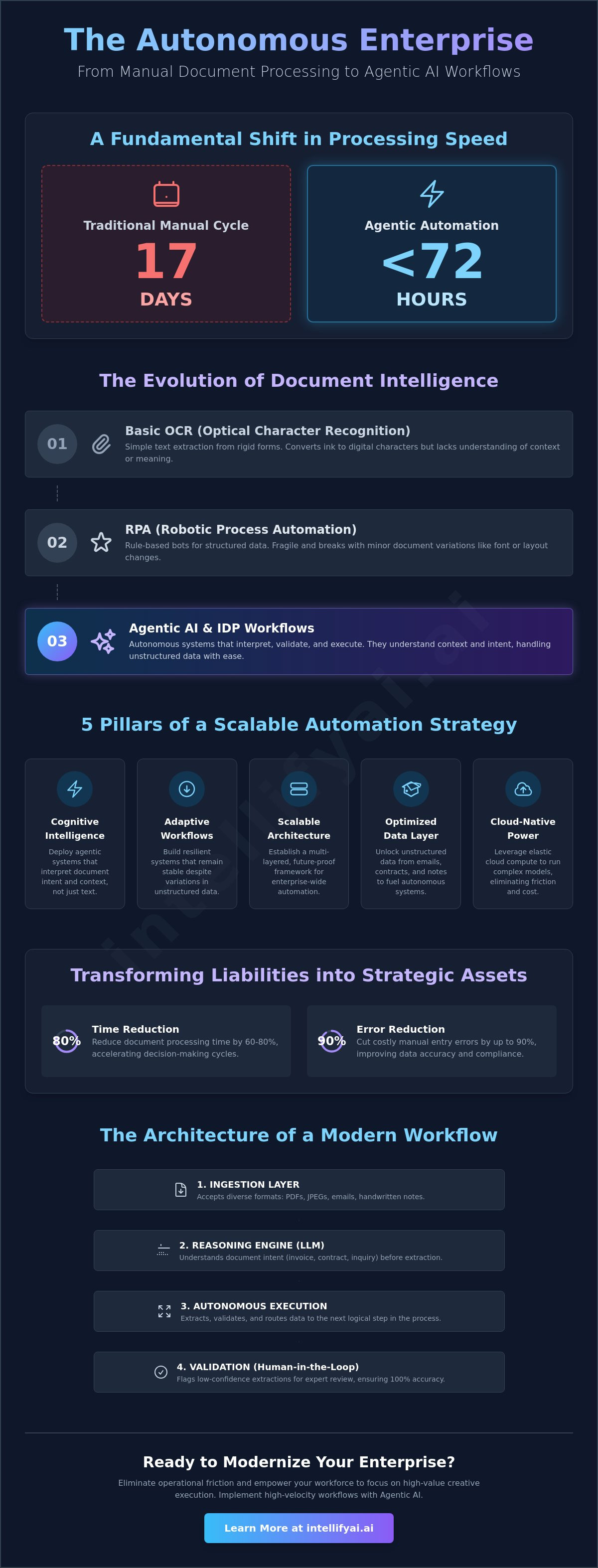
While the average manual invoice cycle still drags on for 17 days, enterprises leveraging advanced document processing workflow automation have slashed that timeline to under 72 hours. This isn't just about reading text faster. It's a fundamental shift in how your organization handles its most valuable asset: data. If your current systems break when a vendor changes a font or an email contains an unexpected attachment, you're losing more than time. You're losing the strategic intelligence buried within your unstructured contracts and correspondence.
You already know that rigid legacy tools and manual entry are no longer sufficient for the scale of modern business. They're expensive, error-prone, and act as a bottleneck to growth. This guide will show you how to master the transition to autonomous agentic workflows that extract high-level insights from every document your enterprise touches. We'll explore the architecture of cloud-native automation and how to build a future-proof system that liberates your team for high-value creative work while turning document processing into a measurable competitive advantage.
Key Takeaways
• Transition from basic digitization to cognitive intelligence by deploying agentic systems that interpret document intent rather than just text.
• Identify the limitations of traditional RPA and adopt adaptive workflows that remain stable despite variations in unstructured data.
• Implement the five pillars of modern document processing workflow automation to establish a scalable and resilient enterprise architecture.
• Optimize your unstructured data layer through precise engineering to fuel autonomous systems and accelerate decision-making cycles.
• Leverage cloud-native modernization to eliminate operational friction and empower your workforce to focus on high-value creative execution.
Beyond Basic OCR: The Era of Agentic Document Processing Workflow Automation
For decades, enterprises treated document processing as a simple translation task. The goal was to convert physical ink into digital characters. This era of basic digitization relied on Optical Character Recognition (OCR) to scrape text from rigid forms. While it moved data into systems, it lacked the cognitive ability to understand what that data actually meant. Today, we've entered a more sophisticated phase of Business process automation (BPA) driven by agentic intelligence.
Modern document processing workflow automation isn't just about reading; it's about reasoning. It represents a fundamental shift from tools that follow rigid rules to autonomous systems that navigate complex business lifecycles. These systems don't just extract data. They interpret it, validate it, and execute the next logical step in the process without manual intervention.
To better understand this concept, watch this helpful video:
The Evolution of Automation: From RPA to Agentic Workflows
Automation once meant Robotic Process Automation (RPA). These bots worked well for predictable, structured spreadsheets. However, they're notoriously fragile. They shatter when faced with minor document variations or layout changes. We're now moving from AI-powered tools, which are essentially legacy software with an AI plugin, to AI-driven architectures. These architectures are designed to operate independently. Agentic IDP is the core of modern digital transformation, enabling systems to make executive decisions about data routing and validation through Agentic AI Engineering Services.
Why Unstructured Data is the Final Frontier for Enterprise Efficiency
The vast majority of enterprise data remains dark. It's trapped in emails, handwritten notes, and non-standardized contracts that traditional software cannot parse. Processing these documents manually creates massive operational overhead and slows down decision-making cycles. Recent industry research indicates that modern IDP platforms can reduce document processing time by 60-80% while cutting errors by up to 90%. This is possible because Agentic AI interprets context rather than just identifying characters. It understands the intent of a legal clause or the urgency of a customer inquiry. By unlocking this unstructured layer, businesses transform a liability into strategic intelligence, directly impacting the bottom line through faster, more accurate execution.
The Architecture of Intelligence: How IDP and Agentic AI Transform Workflows
Modern document processing workflow automation relies on a multi-layered cognitive stack. It's no longer a single software application; it's a pipeline of specialized models working in concert. This architecture begins with an ingestion layer capable of handling diverse formats, from PDF and JPEG to raw email text. Unlike legacy systems, agentic architectures use Large Language Models (LLMs) as a reasoning engine to understand document intent. This semantic layer determines if a document is an invoice, a legal dispute, or a simple inquiry before any data extraction begins.
A cloud-native foundation is essential for this level of sophistication. It provides the elastic compute power required to run high-parameter models without sacrificing speed. Within this framework, Human-in-the-Loop (HITL) protocols serve as a strategic checkpoint. Rather than replacing humans, these systems flag low-confidence extractions for expert review. This ensures 100% accuracy for high-stakes compliance while maintaining high-velocity throughput for standard tasks. Recent academic research on IDP confirms that this hybrid approach is the most effective way to manage the transition from manual entry to full system autonomy.
i_Nova and the Future of Actionable Intelligence
Systems like i_Nova represent the next generation of enterprise tools. They don't just scrape characters; they extract actionable intelligence from multi-format documents. By converting unstructured inputs into structured, AI-ready data, i_Nova allows businesses to feed strategic insights directly into their decision-making engines. You can explore the technical specifications and integration capabilities on the IntellifyAi products page to see how this fits into your existing tech stack.
Integrating MLOps for Long-Term Workflow Stability
Deploying a model is only the beginning. Long-term stability requires a rigorous MLOps framework to monitor for model drift and performance degradation. Version control and continuous monitoring ensure that your document processing workflow automation remains accurate as document styles evolve over time. For a deeper technical context on building resilient systems, read our guide on MLOps pipelines. Maintaining these pipelines is what separates a temporary fix from a lasting investment in enterprise relevance. If you're ready to modernize your data layer, consider exploring our Agentic AI Engineering Services to build a custom solution tailored to your operational needs.
Strategic Comparison: Why Traditional RPA Fails Where Agentic Workflows Succeed
Many enterprises still rely on Robotic Process Automation (RPA) as the backbone of their document processing workflow automation. While RPA was a necessary bridge during the early stages of digitization, it's fundamentally a "rigid" technology. It operates on fixed coordinates and strict "if-then" rules. This approach works for standardized spreadsheets but collapses when faced with the inherent chaos of enterprise documentation. Agentic workflows represent a shift toward "adaptive" intelligence, where the system isn't just following a path, it's understanding the terrain.
The primary flaw in traditional systems is the "Value vs. Text" gap. Most legacy tools focus on character extraction, essentially acting as a digital photocopier. However, extraction is only the first step. The real business value lies in the subsequent decision. Agentic AI doesn't just copy an invoice number; it understands the context of the billing cycle, cross-references it with procurement data, and determines if the payment should be authorized. According to Gartner's analysis of Intelligent Document Processing solutions, the market is rapidly moving toward platforms that prioritize this kind of end-to-end cognitive execution over simple data capture.
The Fragility of Rules-Based Systems
Minor layout changes are the natural enemy of RPA. If a vendor moves a total amount field three inches to the left, a rules-based bot will likely break or, worse, pull the wrong data. This creates a massive maintenance overhead for IT teams who must constantly "retrain" the bots. Agentic AI uses semantic understanding to remain resilient. It looks for the concept of a "total amount" regardless of where it sits on the page or what font is used. This resilience slashes maintenance costs and ensures that your automation doesn't stop every time a document template evolves.
Decision-Making vs. Data Entry
We need to stop viewing automation as a way to copy data and start seeing it as a way to execute strategy. A traditional system copies an address; an agentic system flags a potential compliance risk based on that address. This shift from data entry to autonomous decision-making is what truly liberates human workers. By removing the burden of repetitive validation, your team can focus on high-value creative tasks that require genuine human intuition. To understand how this fits into your broader digital transformation, consult our What is Agentic AI? guide for a deeper look at autonomous enterprise workflows.
Addressing implementation risk is often the final hurdle for leadership. Monolithic, "all-or-nothing" builds are high-risk and slow to deliver ROI. We advocate for a modular approach. By deploying agentic layers on top of existing infrastructure, you can modernize your document processing workflow automation iteratively. This reduces the risk of system-wide failure and allows for measurable performance gains in weeks rather than years. If you're ready to move beyond the limitations of rigid bots, our AI Strategy & Consulting team can help you map out a transition to truly intelligent workflows.
5 Pillars of a Scalable Document Automation Strategy in 2026
Scaling document processing workflow automation requires more than a simple software purchase. It demands a holistic blueprint that aligns technological capability with enterprise goals. A Strategic Architect doesn't look for a quick fix; they build for long-term relevance. By following these five pillars, your organization moves from isolated pilot projects to a resilient, enterprise-wide automation ecosystem that delivers measurable financial returns.
Strategic Alignment
Identify high-impact bottlenecks where manual entry slows down high-value cycles. Focus on workflows where faster extraction directly correlates with revenue growth or risk mitigation.
Agentic Orchestration
Design autonomous agents that don't just extract data but execute specific business logic. This ensures the output of your automation is always actionable and integrated with your core systems.
Cloud-Native Modernization
Ensure your infrastructure scales instantly with document volume. Cloud-based architectures currently hold 65% of the market share because they provide the elasticity required for high-parameter AI models.
Building the Data Foundation
Data engineering is the non-negotiable prerequisite for any successful AI implementation. You can't deploy sophisticated agents on a foundation of messy, siloed data. Preparing the unstructured data layer involves cleaning, labeling, and structuring inputs so they're AI-ready from the moment of ingestion. This process transforms "dark data" into a strategic asset. Leveraging IntellifyAi engineering services ensures your data architecture is optimized for high-velocity workflows. A cloud-native foundation allow you to handle massive document volumes without the latency or maintenance burdens associated with legacy on-premise systems.
Ensuring Governance and Auditability
Automation must never come at the expense of security or transparency. Building transparent AI systems means creating clear, immutable audit trails for every decision an agent makes. This is essential for maintaining strict compliance with GDPR, SOC2, and the 2026 requirements of the EU AI Act. We treat regulatory safety as the baseline for any serious enterprise. However, the ultimate goal is a biologically optimal human-AI partnership. This approach frames technology as a liberating force, allowing human experts to oversee strategic direction while AI handles the repetitive execution. If you're ready to build a secure and scalable foundation, our AI Strategy & Consulting team can help you map out a future-proof modernization journey.
Governance is the final pillar that holds the entire strategy together. By building auditability into the automated workflow from day one, you ensure that as your document processing workflow automation scales, your risk profile remains controlled. This level of organization allows you to focus on high-value creative work while the system maintains the stability and security of your operations.
Modernizing Your Enterprise: Implementing High-Velocity Workflows with IntellifyAi
IntellifyAi serves as the essential bridge between these advanced technological fields and your practical operational needs. We don't offer off-the-shelf software with limited flexibility. Instead, we provide bespoke Agentic AI Engineering Services that transform how your enterprise interacts with its unstructured data layer. Our focus remains on creating a frictionless future where technology handles the burden of repetition while your human workforce leads the strategy.
To eliminate implementation friction, we utilize a rigorous Proof-of-Value (PoV) methodology. This approach allows leadership to see measurable impact in a controlled, high-impact environment before committing to full-scale deployment. It's a low-risk, high-return strategy that validates the financial returns of your automation investment. We ensure that every solution is dependable, secure, and perfectly aligned with your specific growth targets.
The Strategic Architect Approach
Our philosophy is rooted in long-term viability. We don't view technology as a temporary fix but as a central business pillar. By acting as your Strategic Architect, we ensure that every automated workflow is built on a cloud-native foundation that remains resilient as your document volume grows. Our IntellifyAi consulting services are designed to help you develop a roadmap that balances immediate performance gains with future-proof security. We focus intensely on the bottom line, ensuring that your digital transformation translates into tangible performance improvements and reduced operational overhead.
Next Steps for Your Digital Transformation
The window for adopting "AI-powered" tools as a novelty has closed. In 2026, the competitive advantage belongs to those who implement "AI-driven" strategies. This means moving beyond simple document processing workflow automation and toward a holistic modernization of your back office. Start by identifying your most significant data bottlenecks and allowing our team to engineer a solution that turns that friction into momentum. The path to a frictionless, automated future is a deliberate choice. Connect with our AI strategists to automate your document workflows and reclaim your team's potential today.
The Future of Autonomous Enterprise Intelligence
The transition toward cognitive autonomy is no longer a distant strategic goal. It's a current operational necessity for any organization looking to scale. By moving beyond the limitations of rigid RPA and adopting document processing workflow automation, your enterprise transforms unstructured data into a decisive competitive advantage. This shift requires a commitment to end-to-end cloud-native modernization and a focus on actionable intelligence rather than simple text extraction.
IntellifyAi provides the global expertise needed to navigate this modernization across the UK, USA, India, and the UAE. Through our i_Nova IDP Platform, we bridge the gap between abstract technological fields and your practical financial returns. We don't just implement software; we architect resilient systems that empower your workforce to focus on high-value creative execution. It's time to remove the burden of repetitive tasks and secure your place at the cutting edge of industry innovation.
Scale your enterprise with Agentic AI Document Automation. Your path to a frictionless, automated future starts with a single strategic realization.
Frequently Asked Questions
What is the difference between OCR and Intelligent Document Processing (IDP)?
OCR is a legacy tool for character recognition. Intelligent Document Processing (IDP) is a cognitive system that understands document intent. While OCR merely translates images into text, IDP uses machine learning to categorize information and extract strategic insights. It's the difference between a photocopier and a researcher. IDP handles complex layouts that would cause traditional OCR to fail.
Can Agentic AI handle handwritten or poorly scanned documents?
Agentic AI is highly effective at deciphering non-standard inputs. It utilizes advanced computer vision and large language models to interpret handwriting and low-resolution scans. Unlike template-based systems, it doesn't need perfect alignment to identify data. This resilience allows enterprises to process historical archives and physical correspondence that were previously considered dark data or unprocessable.
How long does it typically take to implement a document processing workflow automation?
Implementation generally spans 4 to 12 weeks. We begin with a high-impact Proof-of-Value phase that typically delivers results within 2 to 4 weeks. This allows leadership to validate the technology before a full-scale deployment. The timeline varies based on the number of document types and the complexity of your existing ERP or CRM integrations.
Is document automation secure enough for sensitive financial or legal data?
Security is a core pillar of modern automation. Enterprise-grade platforms utilize end-to-end encryption and adhere to global standards like GDPR and SOC2. By building document processing workflow automation on cloud-native foundations, you gain access to sophisticated identity management and immutable audit trails. These systems are often more secure than manual processes, as they eliminate the risk of human mishandling.
How does Agentic AI improve the customer experience (CX) in back-office operations?
What happens if the AI makes a mistake during document processing?
Modern systems utilize a Human-in-the-Loop architecture. If an agent encounters a document with a low confidence score, it flags the file for human review. This ensures that errors are caught before they impact financial or legal records. The system learns from these human corrections, continuously improving its accuracy and reducing the need for future manual intervention.
Do I need to replace my existing cloud infrastructure to use i_Nova?
You don't need to replace your current stack. i_Nova is built to be infrastructure-agnostic and integrates seamlessly with major cloud providers. It functions as a modular intelligence layer that enhances your existing environment. This allows you to modernize your document workflows without the risk and expense of a full platform migration or a rip-and-replace strategy.
What is the ROI of moving from RPA to Agentic AI for document workflows?
The ROI is driven by resilience and scale. RPA is fragile and requires constant maintenance when document layouts change. Agentic AI is self-healing, which slashes IT overhead. By increasing straight-through processing rates for unstructured data, businesses often see a first-year return on investment between 30% and 200%. This transformation moves document processing from a cost center to a strategic asset.








.svg)