
Most traditional contact centers manually review only 1 to 3% of customer interactions. This leaves 97% of your conversations, and the critical data they contain, entirely unevaluated. You likely recognize the limitations of this approach. Manual sampling leads to subjective scoring, creates unnecessary friction with agents, and fails to capture the true sentiment buried in unstructured voice logs. It is a reactive model that limits your ability to scale performance effectively.
By implementing CX auto QA, you can move beyond these constraints to achieve 100% coverage across every channel. This article will show you how to transform your contact center from a reactive monitoring unit into a center of proactive excellence. We will explore how autonomous quality assurance acts as a sensory layer for your enterprise, removing repetitive tasks so your team can focus on high-value work. You will learn the specific steps to turn raw interaction data into a strategic asset that drives long-term growth and operational stability. We are moving toward a frictionless future where technology unlocks human potential rather than replacing it.
Key Takeaways
• Transition from random sampling to 100% interaction visibility for total operational transparency.
• Leverage unstructured data across voice and chat channels to build a high-fidelity CX auto QA framework.
• Evaluate the strategic shift from manual audits to autonomous quality cycles to maximize your center's ROI.
• Master a two-step roadmap for auditing data infrastructure and defining quality through custom agentic engineering.
• Recognize why custom AI solutions offer superior long-term stability and performance compared to off-the-shelf software.
The Evolution of CX Auto QA: Beyond the 2% Sample Rate
Legacy manual systems are no longer sufficient for the scale of modern enterprise operations. For decades, contact centers relied on a sampling method that reviewed roughly 1% to 3% of total interactions. This approach was a necessary compromise in a pre-AI world, but in 2026, it represents a significant operational risk. Without 100% visibility, leadership teams lack the data required to make informed strategic decisions. Manual Quality Assurance was designed for oversight, but it often results in oversight of the wrong kind.
The emergence of CX auto QA marks a fundamental shift from simple auditing to comprehensive "Quality Intelligence." This technology doesn't just record data; it interprets it. By moving beyond basic keyword spotting, businesses can now understand the nuance, intent, and emotional state of every customer interaction. It's a liberating force that allows your team to focus on high-value creative work instead of the burden of repetitive transcript reviews.
To better understand this concept, watch this helpful video:
Why Manual QA Fails the Modern Enterprise
Manual auditing is statistically insignificant in high-volume environments. When you ignore 97% of your data, you ignore 97% of your opportunities for improvement. This creates a culture of "silent" compliance failures where violations of the Telephone Consumer Protection Act (TCPA) or Telemarketing Sales Rule (TSR) go undetected until they become legal liabilities. You can't manage what you don't measure, and you certainly can't measure what you don't see.
Subjective bias also erodes the relationship between management and staff. When two different supervisors score the same call differently, agent trust evaporates. This friction leads to high turnover and inconsistent customer experiences. Transitioning to an automated framework removes the human variability that often clouds performance metrics, creating a more equitable and transparent environment for your workforce.
Defining the Agentic QA Paradigm
Legacy tools relied on rigid "if-then" logic and keyword triggers. If a customer said "cancel," the system flagged it. Modern CX auto QA utilizes generative AI to understand semantic context. It recognizes that a customer saying "I'm not sure this is working for me" carries the same churn risk as a direct request to close an account. This level of sophistication is what separates a basic tool from a strategic asset.
Sentiment analysis now identifies customer frustration through tone and pacing, not just vocabulary. This allows for real-time interventions before a bad interaction escalates. Agentic QA is an autonomous feedback loop that continuously evaluates interactions, identifies performance gaps, and suggests immediate corrective actions without human intervention. This capability is a core part of our Agentic AI Engineering Services, ensuring your quality standards are enforced with mathematical precision.
The Architecture of Autonomous Quality Assurance
Building a modern CX auto QA framework requires a shift from viewing software as a tool to treating it as a comprehensive ecosystem. This architecture doesn't simply sit on top of your existing stack; it integrates deeply with your data infrastructure to provide a unified sensory layer. It's designed to ingest every interaction, regardless of the channel, and translate raw data into strategic intelligence. This level of integration is what allows a business to move from fragmented oversight to total operational transparency.
Unstructured Data: The New Gold Mine
Contact centers sit on an immense volume of unstructured data. Raw audio files, chat logs, and email threads contain the "why" behind customer churn and loyalty, yet much of this remains trapped in silos. A sophisticated architecture extracts actionable intelligence from these sources by converting them into a standardized format for analysis. It's about more than just transcription. It involves identifying patterns across thousands of simultaneous conversations to detect systemic issues before they escalate.
For non-voice interactions, Intelligent Document Processing (IDP) is essential. It enables the system to audit complex documentation, such as support tickets or contract updates, with the same precision applied to voice calls. By using i_Nova technology, enterprises can process these complex documents to ensure back-office accuracy matches front-end service levels. We eliminate the "black box" problem by providing transparent AI scoring. Every automated evaluation includes clear reasoning, allowing supervisors to see exactly why a specific score was awarded, which maintains trust across the organization.
Agentic AI vs. Traditional NLP
Traditional Natural Language Processing (NLP) often misses the broader context of a customer journey. It might flag a "frustrated" sentiment but fail to recognize that the frustration stems from a recurring technical bug rather than agent behavior. Autonomous agents go a step further by performing deep root cause analysis on failed interactions. They don't just score a call; they investigate the entire multi-step journey to identify where the process broke down. This allows leadership to fix the system, not just the symptom.
Contextual governance is the final pillar of this architecture. A real-time quality assurance system ensures that every interaction adheres to your specific brand rubrics and legal requirements. This isn't a generic off-the-shelf solution. It's a custom-engineered framework that mirrors the logic of your best human experts while operating at a scale humans can't reach. If you're ready to move beyond basic monitoring, our AI Strategy & Consulting team can help you design a roadmap for this transformation.
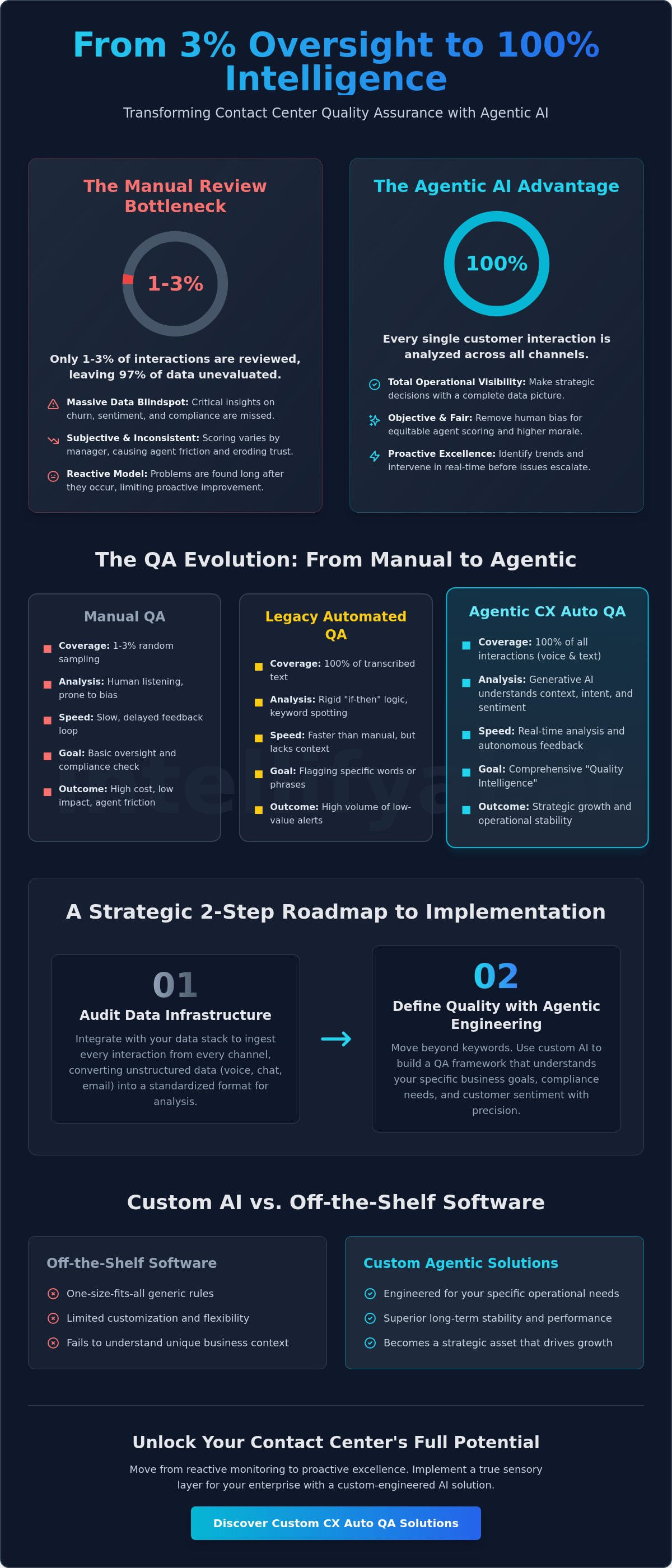
Manual vs. Automated vs. Agentic CX QA
Choosing a quality assurance methodology is no longer just a matter of operational efficiency. It is a decision about how your enterprise will scale its intelligence. Manual QA is a boutique process in a high-velocity world. It offers depth but lacks the breadth required to secure a modern contact center. While traditional automated systems improved coverage through keyword triggers, they often failed to capture the subtle nuances of human conversation. CX auto QA, specifically the agentic model, bridges this gap by providing both 100% visibility and the semantic depth previously reserved for human auditors.
This evolution is a critical component of enterprise modernization. By moving from human-led audits to autonomous quality cycles, businesses transform their QA department from a cost center into a value driver. This shift allows leadership to stop guessing about customer sentiment and start acting on verified, comprehensive data sets.
The ROI Comparison Framework
The financial impact of transitioning to an autonomous framework is immediate. Manual auditing carries a high cost per interaction because it consumes expensive human hours for repetitive data entry. In contrast, an agentic system reduces the cost per audit to a fraction of a cent while increasing the volume of insights by 50 or 100 times. This allows for a direct improvement in First Call Resolution (FCR) and Customer Satisfaction (CSAT) scores. When every call is analyzed, systemic friction points are identified and removed within hours rather than weeks.
Data-driven coaching also stabilizes your workforce. Agents often feel targeted by the subjective bias of manual sampling. CX auto QA provides a fair, transparent baseline for performance that agents can trust. This transparency reduces attrition, as feedback becomes a tool for professional growth rather than a source of workplace friction.
Human-in-the-Loop: The 2026 Strategic Balance
A common concern is the "Nuance Gap," or the perceived inability of AI to judge human empathy. However, agentic AI now interprets intent and emotional pacing with high fidelity. It identifies the "why" behind a customer's tone, distinguishing between genuine frustration and mere urgency. This doesn't replace human supervisors; it liberates them. Instead of hunting for errors in a haystack of audio, supervisors spend their time on strategic coaching and high-level problem solving.
Autonomous systems manage 80% of routine compliance and scoring, leaving the most complex 20% of interactions for high-level human intervention. This 80/20 balance ensures that your most talented people are focused on the interactions that truly require a human touch. It creates a collaborative environment where technology handles the volume and humans provide the strategic direction.
Implementing CX Auto QA: A Strategic Roadmap
Executing a successful transition to autonomous quality assurance is not a matter of simple software installation. It is a structural transformation that requires a disciplined, architectural approach. For serious enterprises, the goal is to build a sensory layer that doesn't just record interactions but actively accelerates performance. This roadmap moves your operation from fragmented data silos to a unified, intelligent ecosystem.
Step 1: Infrastructure Audit.
Evaluate your current telephony stack and data pipelines. Transitioning to CX auto QA requires high-fidelity data ingestion from every voice and digital channel.
Step 2: Defining Quality.
Move beyond generic rubrics. Use custom agentic engineering to define "quality" based on your specific brand values, complex compliance requirements, and high-value customer outcomes.
Step 3: MLOps Integration.
Deploy MLOps pipelines to ensure your models remain accurate. This stage focuses on continuous model refinement to prevent drift and maintain enterprise-grade precision.
Step 4: Real-Time Assistance.
Integrate your QA insights directly into the agent's desktop. This turns historical data into live guidance, preventing errors before they occur.
Step 5: Governance and Bias Monitoring.
Establish a rigorous framework for ethical AI. Continuous monitoring ensures that autonomous scoring remains fair, transparent, and compliant with evolving global regulations.
Modernizing the CX Infrastructure
The foundation of autonomous excellence is a cloud-native environment. Legacy on-premise systems often lack the processing power and connectivity required for real-time semantic analysis. Modernizing your stack ensures that you can maintain SOC2 and GDPR compliance while monitoring 100% of your interactions. This isn't just about technical capability; it's about the long-term stability and security of your operations. Engaging in professional AI strategy consulting can help you navigate these complexities, ensuring your roadmap aligns with broader corporate growth targets.
From Insights to Action: The Coaching Loop
Insights only provide value when they drive behavioral change. An agentic framework automates the delivery of personalized feedback, allowing agents to see their performance metrics in near real-time. When the system identifies a consistent struggle with a specific objection, it can automatically trigger relevant training modules. This creates a self-healing performance loop that operates without supervisor intervention.
Predictive analytics take this a step further by identifying churn risks before a customer even considers leaving. By analyzing sentiment trends and unresolved friction points across multiple interactions, the system alerts leadership to accounts that require high-level human intervention. This proactive stance protects your bottom line and strengthens customer loyalty. If you are ready to modernize your contact center, explore our Agentic AI Engineering Services to begin your transformation.
The IntellifyAi Advantage: Engineering Strategic CX
Off-the-shelf software often forces your business to adapt to its rigid limitations. At IntellifyAi, we believe your technology must adapt to your strategic objectives. Custom AI engineering provides a level of semantic fidelity and operational control that retail software cannot match. While generic tools offer basic scoring, our CX auto QA frameworks are built to understand the specific nuances of your industry and your unique customer journey. This bespoke approach ensures that your quality metrics reflect your actual business goals rather than arbitrary software presets.
A unified customer experience requires a unified evaluation framework. By integrating quality assurance with our Voice Agents, you ensure that both human and AI interactions meet the same rigorous standards. This synergy transforms your contact center into a profit-driving intelligence hub. It allows you to harvest insights from every conversation to refine your product offerings and marketing strategies. We treat your core methodology as a holistic philosophy, presenting technology as a liberating force for your workforce.
Success in digital transformation depends on aligning technical capabilities with financial returns. Our Strategic Consulting ensures that your AI implementation isn't just a technical exercise. We focus on measurable outcomes, such as reduced churn and increased customer lifetime value. We position advanced technology as a central pillar of your business growth, ensuring it remains a lasting investment in your company's relevance.
Custom Agentic Solutions for Global Enterprises
Large-scale operations require systems that can handle multiple languages and complex geographic regulations with ease. We build proprietary models that reside within your secure infrastructure, protecting your enterprise data from third-party exposure. Our implementation of i_Nova technology extends these capabilities into the back office. This allows for the automated audit of complex CX documentation, ensuring that your quality standards remain consistent across both front-end and back-end operations. We provide the stability and security serious enterprises need to modernize without friction.
Your Partner in Digital Transformation
Moving beyond the pilot phase to full-scale autonomous operations requires a partner who understands the architecture of the future. We are committed to ethical AI and transparent governance, ensuring your CX auto QA systems remain fair and accountable as they scale. This focus on long-term viability turns your quality process into a central business pillar. Your digital future deserves a strategic architect, not just a software vendor. Contact our AI strategists to architect your CX future and begin your journey toward proactive excellence today.
Architecting Your Autonomous CX Future
The transition from manual sampling to autonomous intelligence is the definitive step toward enterprise modernization. By implementing CX auto QA, you secure 100% visibility across every channel while liberating your human supervisors for high-value strategic work. This transformation requires more than a simple software implementation; it demands a custom-engineered sensory layer that understands your unique business logic and long-term goals. We move your operation from reactive monitoring to a state of proactive excellence.
IntellifyAi provides the technical depth and global reach necessary to lead this shift. With our expertise in custom Agentic AI engineering and the power of our proprietary i_Nova IDP platform for unstructured data, we deliver results for enterprises across the UK, USA, and UAE. We prioritize the stability of your operations and the ethical governance of your data, ensuring your technology remains a lasting investment in relevance rather than a temporary fix.
Schedule a Strategic CX Audit with our AI Architects to begin your journey toward a frictionless, proactive contact center. The future of customer experience is autonomous, and the time to architect that future is now.
Frequently Asked Questions
What is the difference between traditional speech analytics and CX auto QA?
Traditional speech analytics functions through rigid keyword triggers and basic pattern matching. In contrast, CX auto QA utilizes semantic understanding to interpret the underlying intent of a conversation. It doesn't just flag a specific word; it evaluates the entire context to determine if a customer's needs were met. This shift allows for a more sophisticated analysis of complex interactions that simple keyword spotting would miss.
Can automated quality assurance detect customer sentiment and empathy accurately?
Autonomous systems now analyze tonal pacing, linguistic patterns, and interruptions to measure emotional states with high precision. These platforms compare interactions against behavioral models derived from your best human agents. This ensures that empathy isn't just a subjective guess but a data-driven metric. It allows leadership to identify genuine customer frustration or agent rapport across thousands of simultaneous interactions without human intervention.
How does CX auto QA improve compliance in regulated industries like finance?
Automation provides 100% coverage, which is essential for meeting strict TCPA and TSR requirements. Manual teams can't monitor every interaction, leaving a massive gap where compliance violations often occur undetected. By auditing every call and chat, the system identifies potential legal risks in real time. This proactive approach protects the enterprise from the financial and reputational damage of "silent" regulatory failures.
Is it necessary to replace my entire contact centre stack to implement Auto QA?
You don't need to replace your existing infrastructure to implement these solutions. Modern architectures are built to integrate with your current telephony stack and CRM through secure APIs. This allows you to layer advanced intelligence on top of your legacy systems without the disruption of a full overhaul. It's a strategic modernization that respects your previous investments while preparing for an autonomous future.
What is the typical ROI timeframe for an enterprise CX auto QA implementation?
Enterprises typically realize a positive return on investment within three to six months of full deployment. The financial impact is driven by a drastic reduction in the cost per audited interaction and improved First Call Resolution (FCR) rates. Additionally, the system lowers recruitment costs by reducing agent attrition. Fairer, data-driven coaching creates a more stable work environment, which directly benefits the bottom line.
How does Agentic AI handle 'hallucinations' in quality scoring?
Agentic systems use MLOps pipelines and grounding techniques to ensure every score is anchored in the actual transcript. Unlike early generative tools, these models provide transparent reasoning for their evaluations. This allows human supervisors to review the AI's logic and adjust parameters if necessary. It maintains a high level of accuracy and prevents the "hallucinations" that can occur in less sophisticated, ungrounded AI applications.
Can Auto QA be used for non-voice channels like WhatsApp and Email?
CX auto QA
is channel-agnostic and processes WhatsApp, Email, and SMS with the same rigor as voice calls. It utilizes Intelligent Document Processing (IDP) to interpret unstructured text and ensure your quality standards are consistent everywhere. This unified approach prevents silos in your customer experience. It ensures that a customer receiving an email gets the same level of service excellence as one speaking to a live agent.
What role do human supervisors play once QA is automated?
Human supervisors move from the repetitive task of manual auditing to the high-value role of strategic coach. They use the data provided by the AI to focus their attention on the most complex 20% of interactions that require a human touch. This allows them to spend more time on professional development and high-level problem solving. Technology doesn't replace the supervisor; it empowers them to lead a more effective, data-informed team.








.svg)