
Relying on a base model for your enterprise voice agents is essentially renting a brain that doesn't speak your company's language. While flagship models like GPT-5.5 or Llama 4 offer incredible general intelligence, they lack the domain-specific precision required for high-stakes customer interactions. Strategic fine tuning is the bridge between a generic API call and a proprietary competitive advantage. It moves your AI strategy away from unpredictable prompt engineering toward a stable, high-performance architecture built on your own custom weights.
You've likely noticed that generic model API costs scale aggressively as your volume grows, often without a corresponding increase in accuracy for niche tasks. It's a common frustration for leaders managing complex MLOps pipelines. This guide demonstrates how to transform these massive models into lean, specialized enterprise assets that deliver higher accuracy at a fraction of the long-term inference cost. We'll examine the technical shift from RAG to custom weight optimization and show you how to engineer a voice AI system that functions as a permanent, high-value pillar of your business operations.
Key Takeaways
• Transition from generic AI performance to proprietary intelligence by mastering the process of adjusting pre-trained model weights for your specific business domain.
• Implement a strategic framework to determine when fine tuning provides a superior ROI compared to RAG or prompt engineering based on your data's volatility.
• Navigate the enterprise-grade lifecycle of model optimization, focusing on high-quality data curation and selecting the most efficient base architecture for your vertical.
• Secure your intellectual property by establishing robust MLOps pipelines and governance standards for hosting and versioning custom model weights.
• Leverage the trend of Small Language Models (SLMs) to build specialized agentic frameworks where AI agents execute complex tasks with surgical precision.
What is Fine-Tuning? Defining Proprietary Intelligence
Fine tuning is the technical process of adjusting the weights of a pre-trained Large Language Model (LLM) using a specific, high-quality dataset. While base models like GPT-5.5 or Llama 4 possess vast general intelligence, they remain generalists by design. They understand the mechanics of human language but lack the specialized context of your unique business environment. By applying Fine-tuning (deep learning), you transform these broad models into domain-specific experts that reflect your brand voice and operational logic.
This evolution typically involves two distinct layers of refinement. Supervised Fine-Tuning (SFT) uses instruction-based datasets to teach the model how to execute specific tasks. Reinforcement Learning from Human Feedback (RLHF) then aligns those outputs with human preferences and safety requirements. This structured approach ensures your voice agents don't just provide answers; they provide the right answers in the right tone while remaining compliant with standards like the EU AI Act.
To visualize how these technical layers translate into practical model performance, watch this breakdown:
The Core Mechanism of Transfer Learning
Transfer learning serves as the foundation for modern model optimization. It allows a model to retain its foundational general knowledge while it acquires specialized skills through targeted training. Technically, this involves deciding which parts of the neural network to adjust. Some teams choose full-parameter updates, which modify every weight in the model. Others prefer freezing layers, keeping the core intelligence intact while only training the final layers for specific tasks. In 2026, Parameter-Efficient Fine-Tuning (PEFT) methods like LoRA have revolutionized this balance. These techniques update less than 1% of the model's parameters, drastically lowering the GPU overhead and making custom weights accessible to serious enterprises.
Fine-Tuning vs. Pre-training from Scratch
The resource gap between pre-training and fine tuning is immense. Pre-training a base model requires petabytes of data and tens of millions in compute credits. For most organizations, this is an unnecessary investment. The goal is to address the knowledge delta, which is the specific information gap between a general model and your proprietary workflows. By focusing on this delta, you achieve specialized performance without the infrastructure burden of building a model from zero. Through our Agentic AI Engineering Services, we focus on this precise optimization. Fine-tuning is the strategic refinement of AI weights to capture unique enterprise nuance.
Strategic Framework: Fine-Tuning vs. RAG vs. Prompting
Selecting the right optimization path is a strategic decision that impacts both your technical debt and your bottom line. Prompt engineering and Retrieval-Augmented Generation (RAG) are ideal for high-volatility data that changes frequently. However, when your requirements demand specific reasoning patterns or a unique brand voice, fine tuning becomes the necessary choice. It moves beyond the limitations of fragile prompts and embeds expertise directly into the model's neural architecture. This creates a resilient system that doesn't rely on massive context windows to maintain its persona or operational logic.
Latency is the primary friction point in the customer experience, especially for voice agents. Every millisecond of delay in a conversation erodes user trust. Massive frontier models are often too slow for real-time verbal interaction due to their size and the network overhead of public APIs. Fine-tuning smaller, specialized models allows you to host them on dedicated, cloud-native infrastructure, cutting response times significantly. This high-velocity execution is essential for enterprises looking to replace traditional IVR systems with fluid, human-like automation that feels instantaneous.
The RAG Complement: Why It's Rarely Either/Or
A common industry misconception suggests that fine-tuning replaces the need for external data retrieval. In reality, the most effective systems use a hybrid approach. RAG provides the model with a library of factual knowledge, while fine-tuning dictates the style, tone, and formatting of the output. This relationship is a cornerstone of any professional guide to fine-tuning LLMs. Consider a legal firm: they might use a fine-tuned model to master complex legal terminology and reasoning structures, while relying on RAG to fetch the specific details of current case law. This division of labor ensures the model remains both factually accurate and stylistically precise.
Cost-Benefit Analysis for Enterprise Leaders
Leaders must balance upfront engineering investments against long-term operational costs. Fine-tuning requires initial capital for data curation and GPU compute, but it eliminates the recurring high fees associated with massive general-purpose APIs. Moving from a 70B model to a fine-tuned 7B model can reduce inference costs by orders of magnitude without sacrificing performance on niche tasks. Smaller models are more efficient to run and easier to scale across global regions. Success in this area depends on a clear roadmap. Engaging in AI strategy consulting allows you to identify which workflows will yield the highest ROI from custom weight optimization. Designing a deployment strategy that prioritizes both performance and fiscal responsibility is the first step toward a sustainable AI ecosystem.
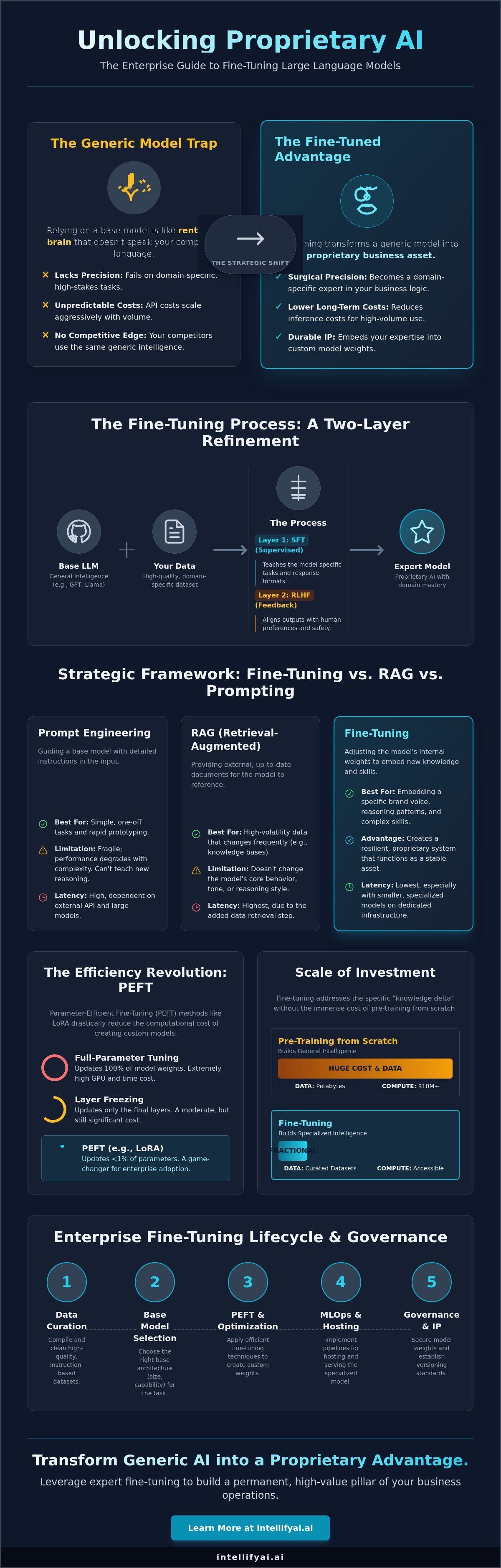
The Enterprise Fine-Tuning Lifecycle
Executing a successful model optimization project requires a disciplined sequence of engineering milestones. It isn't a one-off event but a rigorous lifecycle designed to move a model from general intelligence to specialized utility. The process begins with Data Curation. Here, raw organizational knowledge is distilled into high-quality instruction pairs. This stage focuses on the precision of the mapping between user intent and the desired model response. Following curation is Model Selection. Choosing a base architecture requires balancing parameter count against inference speed to ensure the foundation matches your vertical's specific requirements.
Once the foundation is set, the Training and Optimization stage utilizes techniques like LoRA and QLoRA to adjust weights efficiently. These parameter-efficient methods allow for high-performance customization without the prohibitive costs of full-parameter updates. Finally, the Evaluation stage moves beyond generic benchmarks like MMLU. You must establish domain-specific KPIs to ensure the model performs in real-world scenarios. Research into Fine-tuning Language Models for Factuality highlights that this stage is critical for reducing hallucinations and maintaining operational truth in enterprise environments.
Advanced Data Engineering for High-Quality Inputs
Success in fine tuning follows the 'Garbage In, Garbage Out' principle. If your training data is inconsistent or poorly structured, the resulting model weights will reflect those flaws. We utilize intelligent document processing to extract and structure data from complex, unstructured enterprise documents. This process includes rigorous cleaning and de-identification. Ensuring sensitive information is removed allows you to meet global compliance standards, such as the EU AI Act, while still capturing the necessary business nuance for your voice agents.
Validation and Benchmarking Strategies
Standard performance metrics often fail to capture the subtleties of niche business tasks. You need a 'Golden Dataset' which is a curated set of expert-verified inputs and outputs to serve as your internal performance benchmark. Evaluation should combine automated scoring with human-in-the-loop review to ensure the model's reasoning aligns with human expertise. It's also vital to monitor for catastrophic forgetting. This occurs when a model becomes so specialized in a new task that it loses its foundational reasoning capabilities. A balanced validation strategy ensures your agents remain intelligent generalists while functioning as surgical specialists.
Governance, Risk, and MLOps in Model Optimization
Transitioning from a prototype to a production-grade voice agent requires more than just technical accuracy; it demands a rigorous framework for governance and risk management. When you engage in fine tuning, you are creating a unique intellectual property asset. Protecting this asset involves securing the custom model weights that define your system's behavior. Unlike using a public API where you are at the mercy of a provider's updates, owning your weights provides a critical defense against vendor lock-in and ensures long-term operational stability.
Effective management of these assets depends on sophisticated MLOps pipelines. These pipelines provide the necessary version control to track model iterations and roll back changes if performance degrades. Without this structure, enterprises face the risk of model drift, where an agent's performance slowly declines as real-world data evolves away from the training set. Continuous monitoring and periodic retraining cycles are essential to maintain the precision of your specialized agents.
Financial oversight is equally critical. Applying FinOps principles to your AI strategy helps manage the GPU compute costs, which for hardware like NVIDIA A10G GPUs can range from $1.50 to $2.50 per hour on major cloud platforms. By optimizing resource allocation and utilizing specialized cloud platforms, you can scale your operations without runaway expenses. If you are ready to secure your AI infrastructure, our team can help you build a resilient foundation through Agentic AI Engineering Services.
Securing Proprietary Model Weights
Ownership of model weights is a strategic imperative for the modern enterprise. It allows for full control over encryption and access protocols, ensuring that your custom LLM artifacts are protected from unauthorized access. Compliance is another vital factor. Fine tuning on datasets containing Personally Identifiable Information (PII) requires strict adherence to global standards like GDPR and the EU AI Act, which begins full enforcement for high-risk systems on August 2, 2026. Implementing robust data de-identification and secure hosting environments ensures that your proprietary intelligence remains an asset rather than a liability.
Scaling with Automated MLOps
Integrating model refinement into your existing CI/CD workflows enables rapid, reliable deployment. Automated testing frameworks must be established to validate model reliability before any update reaches the production environment. These tests evaluate the agent against your expert-verified 'Golden Dataset' to prevent regressions in reasoning or tone. MLOps is the bridge between a laboratory experiment and a scalable enterprise asset. By automating the lifecycle of your models, you ensure that your voice agents remain high-performance tools that evolve alongside your business.
Beyond Chatbots: Fine-Tuning for Agentic AI
Agentic AI represents the strategic shift from conversational assistants to autonomous digital workers. While general models often struggle with reliable multi-step reasoning, fine tuning equips them with the cognitive muscle memory needed for complex decision-making. Through Agentic AI engineering, we refine a model's ability to navigate ambiguous instructions and choose the correct sequence of actions. This transformation turns a passive chatbot into a functional extension of your professional workforce, capable of executing tasks rather than just describing them.
We are currently observing a significant pivot toward the Small Language Model (SLM) trend. Instead of relying on one massive, expensive model to manage every task, forward-thinking enterprises are deploying a fleet of specialized agents. Each agent is fine tuned for a specific sub-task, such as technical troubleshooting or customer sentiment analysis. This multi-agent architecture ensures high-velocity execution and reduces the operational risk of a single point of failure. It allows your infrastructure to scale horizontally, with each component optimized for surgical precision in its distinct role.
Fine-Tuning for Reliable Tool and API Use
Precision is the non-negotiable requirement for system integration. Fine tuning allows models to generate perfectly structured JSON or function calls without the conversational fluff that often confuses legacy software. It significantly reduces hallucinations in autonomous workflows by narrowing the model's focus to valid parameters and specific API schemas. This level of technical control is a primary driver of enterprise modernization. It creates a frictionless bridge between advanced intelligence and your existing back-office systems, ensuring that agents can check inventory, update CRM records, or process payments with absolute reliability.
The Intelligent Transformation Roadmap
Digital transformation is a journey, not a single deployment. We recommend starting with a Proof of Value (PoV) to validate your technical assumptions before committing to full-scale model training. This iterative approach ensures your model optimization aligns with long-term business growth and measurable financial returns. As you scale, your proprietary weights become a lasting competitive advantage that competitors cannot simply replicate with a generic prompt. Your AI strategy should be a central pillar of your business, evolving as your data matures and your market needs shift. To begin building your proprietary intelligence, Partner with IntellifyAi for custom AI engineering and strategy.
Securing Your Position in the Agentic Economy
Fine tuning is no longer a luxury for the experimental; it's a strategic necessity for enterprises aiming to own their intelligence. By moving beyond generic APIs, you reduce long-term costs and eliminate the friction of high-latency responses in voice interactions. This technical shift allows your agents to function as reliable tool users within an autonomous framework. It transforms your AI from a rented service into a permanent, proprietary pillar of your business operations.
We specialize in this transition. With a global presence across the UK, USA, and UAE, our team provides the end-to-end MLOps and cloud-native modernization expertise required to scale custom weights securely. We leverage our specialized i_Nova IDP platform and deep knowledge of Agentic AI to ensure your models are both factually accurate and operationally resilient. Scale your proprietary intelligence with IntellifyAi's Agentic AI Engineering Services.
The path to modernization is clear. Start building a future where your technology works for you, unlocking human potential through precision automation and dependable results.
Frequently Asked Questions
How much data do I really need to fine-tune an LLM in 2026?
Quality has superseded quantity in modern model optimization. While early benchmarks suggested massive datasets, you can often achieve significant results with 100 to 1,000 expert-curated instruction pairs. The focus is on the diversity and accuracy of the samples rather than the raw volume. High-quality data ensures the model learns specific reasoning patterns without the noise associated with larger, unrefined datasets.
Is fine-tuning better than RAG for reducing model hallucinations?
Fine tuning and RAG solve different aspects of the hallucination problem. RAG provides the model with a factual library to reference, while model refinement teaches the agent how to interpret that data and when to admit it doesn't have an answer. Using custom weights allows the model to better follow negative constraints, which is essential for maintaining accuracy in high-stakes enterprise environments.
What are the primary costs associated with fine-tuning enterprise models?
The primary expenses include data engineering, compute resources, and human evaluation. Renting high-performance GPUs like NVIDIA A100s or H100s currently costs between $4 and $8 per hour. However, the most significant investment is often the time required for domain experts to curate and validate the training sets. These upfront costs are balanced by the long-term reduction in inference fees compared to using massive frontier model APIs.
Can I fine-tune a model to follow specific brand guidelines and tone?
Yes, this is one of the most effective applications of the technology. By training a model on your specific brand corpus, you can embed your corporate voice, terminology, and formatting preferences directly into the model's weights. This ensures your voice agents maintain a consistent persona that aligns with your customer experience framework without relying on overly long and complex system prompts.
How long does the fine-tuning process typically take for a corporate project?
A standard enterprise project usually spans four to eight weeks. This timeline accounts for the complete lifecycle, including data extraction, de-identification, training iterations, and rigorous benchmarking. While the actual compute time for fine tuning might only take a few hours or days, the surrounding engineering and validation phases are critical to ensuring the model is production-ready and compliant with global regulations.
Does fine-tuning a model make it less capable at general reasoning tasks?
It can lead to a phenomenon known as catastrophic forgetting if not managed correctly. This happens when a model becomes so specialized in a new task that it loses its foundational intelligence. We mitigate this risk by using Parameter-Efficient Fine-Tuning (PEFT) or by including a small percentage of general knowledge tasks in the training set. This maintains the agent's broad reasoning capabilities while it masters its specialized domain.
What is the difference between LoRA and full-parameter fine-tuning?
LoRA (Low-Rank Adaptation) only updates a tiny fraction of the model's parameters, making it significantly faster and less hardware-intensive. Full-parameter training modifies every weight in the neural network, which requires massive memory and compute power. For most enterprise use cases, LoRA provides a superior ROI by delivering nearly identical performance at a fraction of the cost and infrastructure overhead.
How often should an enterprise model be re-fine-tuned?
Retraining frequency depends on the rate of model drift and changes in your underlying business logic. Most organizations conduct quarterly performance reviews to determine if the agent's accuracy has declined relative to new real-world data. If your industry experiences rapid regulatory shifts or product updates, more frequent iterations may be required to keep your proprietary weights aligned with current operational realities.








.svg)