
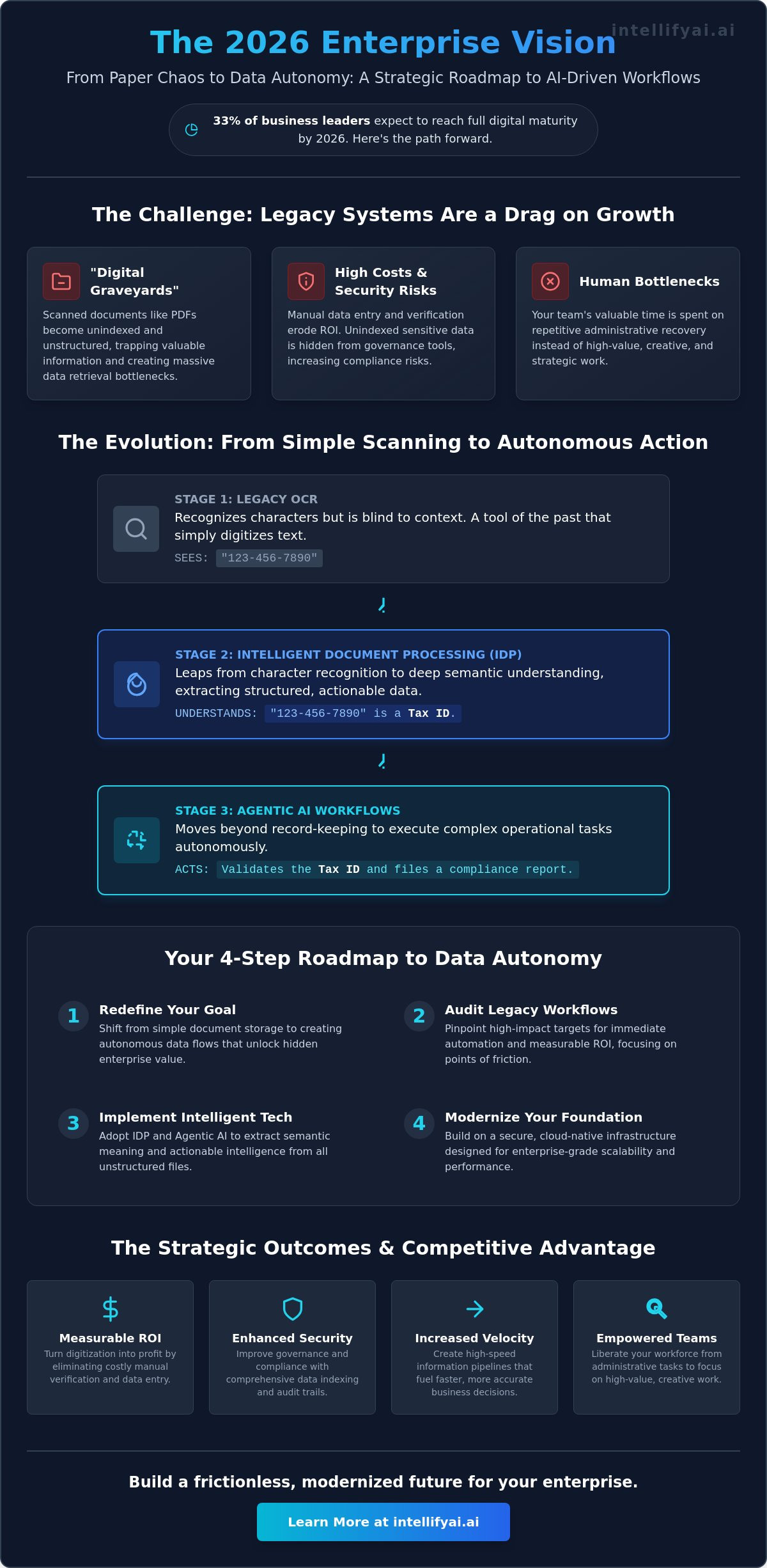
Thirty-three percent of business leaders expect to reach full digital maturity by 2026, yet many remain tethered to the high costs and security risks of manual document handling. You've likely realized that simply scanning a page doesn't solve the problem of unstructured data or the friction of manual entry. Understanding how to achieve a paperless office in the current enterprise climate requires a fundamental shift in perspective. It's not just about removing physical clutter. It's about engineering a system where information flows autonomously.
We agree that your team's time is better spent on high-value creative work rather than administrative recovery. This article promises to show you how to transition from legacy paper-based processes to AI-driven workflows that establish true data autonomy. We'll preview a strategic roadmap for 2026 that covers everything from Agentic AI document processing to navigating new regulations like California's SB 513. You'll discover the exact steps to turn document digitization into a measurable ROI and a long-term competitive advantage for your enterprise.
Key Takeaways
• Redefine your digital transformation by shifting from simple document storage to a system of autonomous data flows that unlock hidden enterprise value.
• Move beyond traditional OCR limitations and adopt Intelligent Document Processing to extract semantic meaning and actionable intelligence from unstructured files.
• Discover how to achieve a paperless office by implementing Agentic AI that moves past record-keeping to execute complex operational tasks autonomously.
• Build a sustainable roadmap by auditing legacy workflows to pinpoint high-impact targets for immediate automation and measurable ROI.
• Ensure long-term scalability and security by modernizing your data foundation with cloud-native infrastructure designed for enterprise-grade performance.
The 2026 Definition of a Paperless Office: From Storage to Intelligence
Modern enterprises view data as their most valuable asset, yet many still struggle with the mechanics of The 2026 Definition of a Paperless Office. Achieving this state isn't a matter of buying scanners or filling cloud folders. It requires a transition from static storage to autonomous data flows. In this new era, document digitization is not a filing task; it's a strategic engineering initiative. You aren't just capturing characters. You're capturing intent. When information is liberated from physical or static digital formats, it becomes fuel for growth.
Traditional Optical Character Recognition (OCR) is no longer sufficient for enterprise scale. While legacy tools identify letters, they fail to grasp the semantic relationships within a document. Learning how to achieve a paperless office in 2026 means building a foundation where every digitized file is immediately actionable. This shift from "digitizing for storage" to "digitizing for execution" allows your business to deploy high-value AI agents. These agents read, understand, and act upon information without human intervention. The result is a system that works for you, rather than a system you have to manage.
To better understand this concept, watch this helpful video:
The Limitations of Legacy Scanning
Simple PDFs often become "digital graveyards" for enterprise data. They're technically digital, but they remain unindexed and unstructured. This creates a massive bottleneck. Your team ends up performing manual data entry to bridge the gap between the document and your ERP or CRM. The high cost of manual verification in traditional setups erodes the ROI of your digital transformation. Unindexed files also represent significant security vulnerabilities. Sensitive information remains hidden from governance tools and audit trails, making compliance a moving target.
The Strategic Architect Approach
We approach document workflows as a central pillar of enterprise modernization. It's about creating a composed, authoritative digital ecosystem where technology serves as a liberating force. By removing the burden of repetitive administrative tasks, you allow your workforce to focus on high-value creative work. This isn't just about efficiency; it's about long-term viability. Our AI Strategy & Consulting focuses on building systems that are innovative, dependable, and intensely focused on your bottom line. We bridge the gap between abstract technical concepts and your practical business needs. A modern paperless strategy is a lasting investment in relevance.
Beyond OCR: Leveraging Intelligent Document Processing (IDP)
Legacy OCR is a tool for the past. It recognizes characters but remains blind to context. If you want to know how to achieve a paperless office that actually scales, you must look at Intelligent Document Processing (IDP). This technology represents the leap from simple character recognition to deep semantic understanding. While OCR sees a string of numbers, IDP understands those numbers represent a specific tax ID or a line-item total. This intelligence allows for the extraction of actionable data from unstructured formats like handwritten notes, complex tables, and non-standard invoices.
Integrating IDP into cloud-native infrastructures ensures that your document workflows grow alongside your business. Scalability is no longer hindered by the volume of paper entering your system. By automating high-volume document ingestion, you significantly reduce the need for manual oversight and the high professional service fees associated with data entry. The goal is to create a high-velocity information pipeline. This system turns every incoming document into a structured data point ready for immediate analysis.
We view this transition as a fundamental modernization of your back-office operations. It's a shift that replaces human bottlenecks with machine precision. To explore the tools that drive this change, consider our enterprise AI products designed for seamless integration.
i_Nova: Understanding the Engine of Data Extraction
The i_Nova platform serves as a sophisticated engine for document intelligence. It handles diverse formats across multiple sectors, from legal contracts to medical records, with equal precision. By using tiered processing based on document complexity, i_Nova ensures efficiency. Simple forms move through the system instantly, while complex, unstructured files receive deeper semantic analysis. This approach facilitates a frictionless transition from physical mailrooms to digital intelligence. It turns a manual burden into a strategic asset.
The Role of Data Engineering
Success in a paperless environment depends on data integrity. You cannot feed low-quality data into high-performance models and expect accurate results. Our focus on Data Engineering ensures that every piece of information extracted from paper is structured, validated, and ready for use in downstream AI models. We design pipelines that maintain the lineage and security of your data throughout the transition. This rigorous engineering foundation is what makes enterprise-grade automation possible. It provides the stability required for long-term data autonomy.
Implementing Agentic AI for Autonomous Document Workflows
Storing data is a passive act. To truly master how to achieve a paperless office, your organization must transition from digital record-keeping to autonomous execution. This is where Agentic AI changes the equation. Unlike traditional automation that follows rigid scripts, agentic systems possess the reasoning capabilities to navigate complex business logic. They don't just read a file. They understand its purpose and trigger the next logical step in the workflow without human intervention.
Consider the lifecycle of a paperless invoice. In a legacy setup, a human still reviews the digital scan to authorize payment. In an agentic workflow, the AI agent receives the document, extracts the data via IDP, and cross-references it with existing purchase orders and delivery receipts. If the data aligns, the agent executes the payment through your financial system. If a discrepancy arises, it flags the specific error for human review. This level of system autonomy removes the burden of repetitive tasks, allowing your team to focus on strategic financial planning and high-impact decision-making.
This transformation fosters a collaborative relationship between technology and human workers. We don't view AI as a replacement for labor. Instead, we see it as a liberating force that unlocks human potential. By automating the mechanical aspects of document management, you empower your staff to engage in high-value creative work. This shift is essential for the long-term viability of any enterprise looking to remain competitive. It turns your digitized documents into active participants in your business growth.
Voice Agents and Document Intelligence
Customer experience (CX) is often limited by the speed of back-office retrieval. When voice agents are integrated with your paperless data, they provide instant answers to complex queries. An agent can retrieve a specific clause from a digitized contract or verify a shipping status from a scanned bill of lading in seconds. This bridges the gap between front-office interaction and back-office automation. It creates a frictionless environment where information is always available at the point of need.
Custom Agentic AI Engineering
Generic software rarely solves specific enterprise challenges. Our Agentic AI Engineering Services focus on building scalable, tailored workflows that address your unique operational hurdles. This involves more than just deployment. We utilize rigorous MLOps practices to maintain and optimize document agents over time. Continuous model optimization ensures that your autonomous systems adapt to changing document formats and evolving business rules. This focus on engineering excellence guarantees that your investment in data autonomy remains a central business pillar for years to come.
A Strategic Roadmap to Enterprise Data Autonomy
Transitioning to a truly digital ecosystem requires more than just software. It demands a structured blueprint that aligns technological capability with business objectives. Understanding how to achieve a paperless office at an enterprise level means executing a multi-phase strategy that prioritizes long-term viability over quick fixes. We view this roadmap as an architectural journey toward full data autonomy.
Audit legacy workflows
Begin by identifying high-impact automation targets. Focus on departments like HR or finance where manual data entry creates the most significant bottlenecks.
Modernize the foundation
Establish a cloud-native infrastructure. This provides the scalability and security required for advanced AI operations.
Deploy Intelligent Document Processing
Use IDP to eliminate manual entry. This turns static documents into structured, machine-readable data.
Integrate Agentic AI
Move beyond storage by deploying agents that drive autonomous decision-making from your digital records.
Implement FinOps
Optimize the cost of your digital processing. Ensure that your automated workflows deliver a measurable ROI.
This phased approach ensures that every step builds upon the previous one. It creates a momentum that carries the organization through the complexities of digital transformation without disrupting core operations. To begin your modernization, contact our team for professional AI Strategy & Consulting.
Navigating the Agentic Frontier
Strategic success depends on moving from abstract technical concepts to measurable financial returns. Our AI strategy consulting accelerates this journey by providing a clear path to implementation. We help you manage the transition while maintaining the stability of your current enterprise operations. This ensures that your move toward autonomy is both innovative and dependable, focusing on the bottom line at every stage.
Governance and Compliance in 2026
An automated paperless office must remain a secure and compliant one. In 2026, navigating GDPR, SOC2, and specific state mandates like California SB 513 is non-negotiable. We integrate version control and MLOps directly into your document governance framework. This provides a clear audit trail and ensures the security of your modernized digital estate. By treating compliance as an engineering requirement rather than an afterthought, we safeguard your operations against evolving regulatory risks.
Partnering for a Frictionless, Modernized Future
Achieving a state of data autonomy is not a solo endeavor. It requires a partner that moves beyond the role of a software vendor to act as a Strategic Architect. While a traditional vendor might offer a tool for document storage, a Strategic Architect designs the entire ecosystem of autonomous data flows. This distinction is critical for leaders determining how to achieve a paperless office that delivers measurable ROI. We focus on the bottom line, ensuring that every technological implementation serves your broader corporate strategy and operational goals.
Our end-to-end services cover the entire lifecycle of digital transformation. We guide you from the initial audit of legacy paper-heavy workflows to the deployment and maintenance of managed MLOps for your autonomous agents. This holistic approach ensures that your systems remain accurate and secure as your business scales. By removing the burden of repetitive administrative tasks, we allow your workforce to engage in high-value creative work. This shift is a lasting investment in relevance rather than a temporary fix for physical clutter.
Custom AI Engineering and Modernization
A successful transition relies on Enterprise Modernization that prioritizes cloud-native architecture. This foundation is necessary for the processing speeds required in 2026. Legacy systems often struggle with the latency of high-volume document ingestion, creating digital bottlenecks that hinder growth. Cloud-native designs eliminate these issues, providing a frictionless experience for both employees and customers. While professional service fees are a necessary consideration, they represent high-value strategic gains. You're not just buying code. You're building a lasting competitive advantage that positions your firm at the cutting edge of your industry.
Next Steps for Enterprise Leaders
Initiating a proof-of-value (PoV) engagement is the most effective way to validate document automation within your specific environment. This focused approach allows you to witness the efficiency of Agentic AI on a high-priority workflow without the risk of a full-scale immediate rollout. We define success through measurable impact on the bottom line, tracking variables like cycle time reduction and data accuracy. This data-driven validation provides the confidence needed for broader enterprise adoption. If you're ready to discover how to achieve a paperless office that scales with your ambition, we're prepared to lead the way. Consult with our AI Strategists to begin your modernization journey.
Securing Your Position in the Autonomous Enterprise Era
The transition to a digital workspace is no longer about clearing desks; it's about unlocking the latent value within your data. You've seen how moving beyond OCR to Intelligent Document Processing and Agentic AI transforms documents into active participants in your business logic. This roadmap provides the definitive answer on how to achieve a paperless office that is both scalable and secure. By treating digitization as a strategic asset, you establish a foundation for long-term data autonomy and operational excellence.
Success requires a partner with deep technical expertise and a global perspective. With a presence across the UK, USA, India, and the UAE, we offer the high-value enterprise consulting and Agentic AI engineering needed to modernize your operations. Our flagship i_Nova IDP platform ensures your data foundation is built for precision and speed. Begin your journey to data autonomy with IntellifyAi strategy consulting. We bridge the gap between abstract technology and the practical needs of your growing company.
The future of work is frictionless. By removing the burden of repetitive tasks, you empower your team to focus on the high-value creative work that drives growth. Embrace the liberation of an automated enterprise today and build a legacy of innovation.
Frequently Asked Questions
How long does it typically take to achieve a paperless office at the enterprise level?
Achieving a full digital transformation typically requires a timeline of six to eighteen months for most large enterprises. This period allows for a phased rollout that begins with high-impact pilot programs before scaling across the entire organization. Success depends on the complexity of your legacy workflows and the speed of your data engineering initiatives. We focus on delivering measurable ROI at each milestone to ensure the project remains strategically viable.
What is the difference between OCR and Intelligent Document Processing (IDP)?
OCR is a legacy tool that identifies individual characters; while Intelligent Document Processing (IDP) understands the semantic context of a document. IDP platforms like i_Nova use advanced machine learning to extract actionable intelligence from unstructured data. This allows your systems to interpret the intent behind a file rather than just recognizing letters. Understanding this technical distinction is vital for leaders learning how to achieve a paperless office that actually scales.
How does a paperless office improve regulatory compliance like GDPR or SOC2?
Digital ecosystems strengthen governance by providing granular access controls and comprehensive audit trails that physical files cannot match. Automated systems ensure that sensitive data is encrypted and handled according to GDPR or SOC2 requirements. This reduces the risk of human error in document retention and disposal. By centralizing your information, you make regulatory audits a frictionless, high-velocity process rather than an administrative burden.
Can Agentic AI handle handwritten or non-standard document formats?
Agentic AI excels at interpreting handwritten notes and non-standard layouts by moving beyond rigid, template-based extraction. It utilizes computer vision and semantic reasoning to understand the structure of any document. This capability is essential for processing diverse inputs like medical records or field notes. It ensures that your autonomous workflows remain resilient even when faced with high variability in document quality or format.
What are the primary cost drivers when moving to a paperless office?
The primary investments include cloud-native modernization, custom data engineering, and the deployment of IDP platforms. While these represent initial capital expenditures, they are the engines that drive long-term financial returns. You must also account for the cost of training models to handle your specific business logic. Most organizations find that the reduction in manual labor provides a clear path to how to achieve a paperless office with a positive bottom-line impact.
How do we manage legacy paper archives while transitioning to an AI-driven workflow?
Managing legacy archives requires a tiered strategy that prioritizes active operational data for immediate digitization. You don't need to scan every historical page at once. We recommend a scan-on-demand model for older records combined with a systematic back-file conversion for documents required by retention laws. This approach minimizes initial costs while ensuring that your most valuable historical data is integrated into your new AI-driven workflows.
Is a paperless office more secure than a traditional paper-based system?
Digital systems are significantly more secure because they utilize end-to-end encryption and multi-factor authentication. Physical paper is susceptible to environmental damage, theft, and unauthorized access that leaves no audit trail. Modern digital estates include version control and automated backup protocols to ensure data integrity. This creates a dependable environment where your intellectual property is protected by enterprise-grade security layers.
What role does cloud-native modernization play in document automation?
Cloud-native architecture provides the elastic infrastructure necessary to process high-volume document ingestions without latency. It allows your AI models to scale their compute power based on real-time demand. This modernization ensures that your document automation is resilient and globally accessible. By building on the cloud, you ensure the long-term viability of your digital transformation and its ability to integrate with future technological advancements.








.svg)