
The conversation around autonomous agents is deafening, yet the path from a promising proof-of-concept to a scalable, enterprise-ready system remains unclear for most leaders. This ambiguity creates paralysis, leaving valuable opportunities for intelligent automation on the table while legacy systems strain under new demands. The critical question is no longer if you should leverage AI agents, but precisely how to build an agentic workflow that integrates with your core infrastructure and delivers a measurable return on investment.
Move beyond the theoretical. This article provides the definitive enterprise framework for 2026, designed to deliver strategic clarity and actionable results. We will deconstruct the process into a clear, repeatable methodology-from defining essential architectural components to orchestrating a successful pilot project that proves value to stakeholders. You will gain the confidence to transform your operations, future-proof your business, and unlock a new tier of operational excellence through intelligent, seamless automation.
Key Takeaways
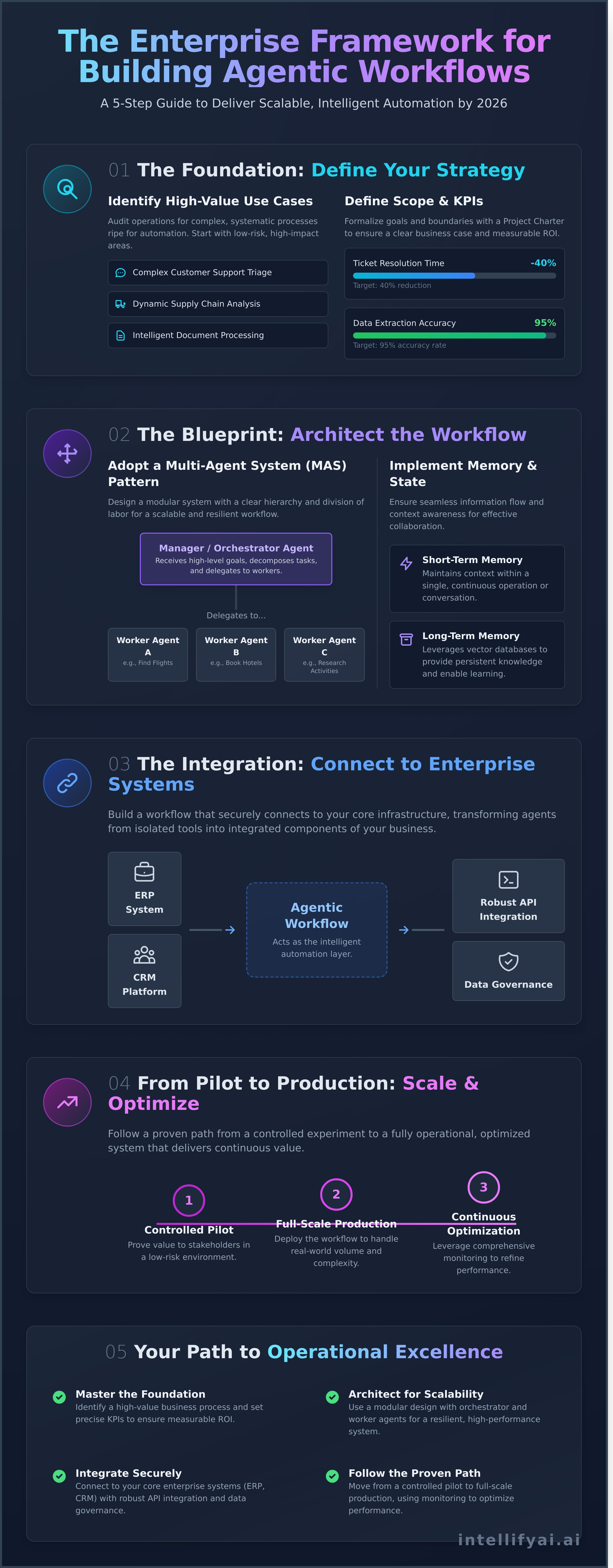
- Master the foundational step of identifying a high-value business process and setting precise KPIs to ensure your workflow delivers measurable ROI.
- Learn to architect for scalability using a modular design with orchestrator and specialized worker agents for a resilient, high-performance system.
- Understand how to build an agentic workflow that securely connects to your core enterprise systems (ERP, CRM) with robust API integration and data governance.
- Uncover the proven path from a controlled pilot to full-scale production, leveraging comprehensive monitoring to optimize performance and ensure operational excellence.
The Foundation: From Business Problem to Agentic Strategy
The journey to intelligent automation begins not with code, but with strategy. Before you can harness the power of autonomous agents, you must first identify a precise, high-value business challenge that is ripe for transformation. The core of how to build an agentic workflow is rooted in this initial diagnostic phase: pinpointing a complex process where human effort is consumed by repetitive decisions and data handling. This foundational step ensures that your investment in AI delivers measurable operational excellence.
To better understand the core concepts of agentic design, this overview provides a practical starting point:
Identifying the Right Use Case
Begin by auditing your current operations for processes that are both complex and systematic. Ideal candidates for agentic automation involve multiple steps, conditional logic, and the interpretation of unstructured data. These workflows are powered by coordinated intelligent agents, each designed to handle a specific task within the larger process. It is critical to assess the cost of failure; start with a low-risk, high-impact area to build momentum and demonstrate value. Prime examples include:
- Complex Customer Support Triage: Automatically routing inquiries based on sentiment, urgency, and historical context.
- Dynamic Supply Chain Analysis: Monitoring real-time data to predict disruptions and suggest alternative logistics.
- Intelligent Document Processing: Extracting and validating information from invoices, contracts, and reports.
These principles also apply to consumer-facing services, simplifying what were once time-consuming processes. For a clear example of this in the financial services sector, you can visit LifeInsure.com to see how automation is used to provide instant insurance quotes without demanding personal contact information upfront.
Defining the Scope and Objectives
Once a use case is selected, you must formalize the initiative. A project charter is essential for outlining the workflow’s goals, boundaries, and required resources. This document codifies the "why" behind the automation. Establish clear Key Performance Indicators (KPIs) to measure success-such as a 40% reduction in ticket resolution time or a 95% accuracy rate in data extraction. This data-driven approach is fundamental to securing stakeholder buy-in, transforming the concept of an agentic workflow from a technical project into a strategic business case with a clear and compelling ROI.
The Blueprint: Designing Your Agentic Workflow Architecture
Effective intelligent automation begins with intelligent design. A successful agentic workflow is not a monolithic entity; it is a carefully architected system of specialized components working in concert. To achieve operational excellence, you must adopt a modular approach, breaking down complex processes into discrete, manageable tasks. This blueprint serves as the foundation for a scalable, resilient, and truly autonomous system.
The Multi-Agent System (MAS) Pattern
The most robust framework for agentic workflows is the Multi-Agent System. This pattern establishes a clear hierarchy and division of labor, mirroring an efficient human team. It consists of two primary roles:
- Manager/Orchestrator Agent: This agent acts as the strategic director. It receives a high-level goal, decomposes it into a logical sequence of sub-tasks, and delegates them to the appropriate worker agents.
- Worker Agents: These are specialized units, each designed for a single responsibility. For instance, in a travel booking workflow, one worker agent finds flights, another secures hotel reservations, and a third researches local activities. This specialization ensures high performance and simplifies maintenance.
Memory and State Management
For agents to collaborate effectively, they require a sophisticated understanding of context. This is where memory and state management become critical. A key challenge in learning how to build an agentic workflow is ensuring information flows seamlessly and accurately between tasks. Your architecture must account for:
- Short-Term Memory: This maintains context within a single, continuous operation or conversation, ensuring immediate tasks are coherent.
- Long-Term Memory: Leveraging technologies like vector databases, this provides agents with persistent knowledge from past interactions, enabling them to learn and improve over time.
Proper state management prevents data conflicts and ensures each agent acts on the most current information, which is vital for process integrity.
Finally, your design must define a robust toolset and anticipate failure. This involves identifying the specific APIs, databases, and knowledge bases each agent needs to perform its function. Understanding these core components of agentic workflows is crucial for enabling seamless integration and future scalability. Just as important is building in comprehensive error handling and fallback mechanisms. A truly transformative autonomous system is one that can intelligently recover from unexpected issues, ensuring unwavering reliability and delivering consistent, high-value results.
The Core Components: The Technology Stack for Agentic Systems
Architecting a robust agentic system begins with strategic decisions about its underlying technology. This stack is not merely a collection of tools; it is the foundation that dictates your system's intelligence, scalability, and real-world utility. Making the right choices here is the first critical step in understanding how to build an agentic workflow that delivers transformative results.
Selecting Your LLM and Framework
The Large Language Model (LLM) serves as the cognitive core of your agent, providing the reasoning and decision-making capabilities. Your selection requires a careful balance of factors:
- Proprietary Models: Systems like OpenAI's GPT-4 and Anthropic's Claude 3 offer state-of-the-art performance and are ideal for complex, multi-step reasoning tasks.
- Open-Source Models: Alternatives like Llama 3 or Mistral provide greater control over data privacy and can be fine-tuned for specialized domain knowledge, achieving operational excellence at a lower cost.
To accelerate development, leverage frameworks such as LangChain or LlamaIndex. These tools provide pre-built components for prompt engineering, memory management, and seamless tool integration, abstracting away low-level complexity and allowing you to focus on business logic.
Building the Orchestration Layer
The orchestration engine is the central nervous system that manages task execution between agents. This layer dictates the workflow's structure and efficiency. A key decision is the execution model: sequential, parallel, or hierarchical. For complex operations, a hierarchical structure is often superior, where a manager agent delegates sub-tasks to specialized agents. This layered approach, which aligns with the UK government's view on agentic workflows, enables sophisticated problem decomposition and dramatically increases the system's capability. While you can build custom routing logic, dedicated orchestration tools like Conductor can manage state and dependencies more effectively. Implement comprehensive logging and tracing from day one to ensure full visibility into the workflow's execution path, which is critical for debugging and optimization.
Finally, connecting your agents to tools and APIs-such as a CRM, a database, or an email client-is what grounds them in reality. This bespoke integration transforms your agent from a reasoning engine into a productive, autonomous worker capable of executing tasks and delivering measurable business value.
The Integration: Connecting Agents to Your Enterprise Reality
An autonomous agent is only as effective as the systems it can access and the data it can leverage. A critical step in learning how to build an agentic workflow is moving beyond isolated sandboxes and into your live enterprise environment. This integration must be executed with a relentless focus on security, governance, and control. The goal is not just connection, but a seamless and secure extension of your operational core.
True intelligent automation requires that agents interact directly with your sources of truth-your ERP, CRM, and proprietary databases. This demands a robust architecture that protects data integrity while empowering agents to act on real-time information. Without this foundational work, even the most advanced agent remains a theoretical asset rather than a transformative one.
Enterprise System Integration
Securely connect your agents to internal services using a dedicated API gateway as a centralized management and security layer. Implement industry-standard protocols like OAuth 2.0 to handle authentication and authorization, ensuring agents only access what they are explicitly permitted to. For legacy systems, a well-architected data transformation layer is essential to translate older data formats into a structure your modern agentic workflow can understand and utilize effectively.
Governance, Risk, and Compliance (GRC)
Trust is the cornerstone of enterprise automation. This focus on GRC is non-negotiable for any organization serious about how to build an agentic workflow that is both powerful and trustworthy. To establish operational integrity from day one, you must:
- Create detailed audit trails of every decision, action, and data point accessed by your agents for complete transparency and accountability.
- Implement role-based access control (RBAC) to strictly define which tools, APIs, and data sources each agent or agent-group can interact with.
- Define clear data handling policies that align with regulatory requirements like GDPR and SOC2, ensuring compliance is built into the workflow, not added as an afterthought.
Finally, engineer a sophisticated human-in-the-loop interface. This is not a bottleneck; it is a strategic control point. This interface allows your team to review, approve, or intervene in high-stakes decisions, creating a powerful Human-AI Synergy. It ensures that automation scales your team's capabilities without sacrificing final human authority. At IntellifyAi, we design systems where intelligent automation and human oversight work in perfect concert.
From Pilot to Production: Scaling & Optimizing Your Workflow
Transitioning an autonomous agent from a promising prototype to a core business process is the final, critical stage. This phase determines the true ROI of your automation efforts. A disciplined, phased approach is essential to de-risk deployment and ensure your workflow operates with precision at scale.
Begin with a limited pilot to validate your workflow in a controlled, real-world environment. This initial phase is crucial for gathering baseline performance data, identifying potential failure points, and understanding the nuances of how to build an agentic workflow that truly aligns with user needs before a full-scale rollout. This step ensures your investment is secure and your outcomes are predictable.
Monitoring and Observability
Operational excellence in agentic systems is impossible without robust observability. To maintain control and ensure reliability, you must implement a comprehensive monitoring strategy. This provides the visibility needed to diagnose issues, measure performance, and drive continuous improvement.
- Key Performance Indicators (KPIs): Track critical metrics such as latency, token consumption, error rates, and task completion success. These data points provide a clear view of both efficiency and reliability.
- Advanced Tooling: Implement platforms like LangSmith or build bespoke dashboards for granular tracing and debugging. This visibility is essential for diagnosing issues within complex agent interactions.
- Proactive Alerts: Configure automated alerts for performance anomalies or critical failures. This allows your team to address issues before they impact business operations.
Continuous Improvement and Scaling
An agentic workflow is not a static deployment; it is a dynamic system that evolves through feedback and iteration. Establish a clear feedback loop for human operators, whose insights are invaluable for refining prompts and enhancing the agent's decision-making logic. As you prepare to scale, architect your cloud infrastructure to manage increased load and support parallel task executions. Proactive planning prevents performance bottlenecks and ensures seamless service delivery as demand grows.
To ensure your intelligent automation initiatives achieve enterprise-grade reliability and are future-proofed for tomorrow's challenges, expert partnership is key. Ready to scale? Partner with IntellifyAI's engineering experts to build your production-grade agentic workflows.
Architecting Your Autonomous Future
The journey to an autonomous enterprise is not a singular project but a strategic evolution. It begins by grounding your vision in a core business problem, progresses through the design of a scalable and integrated architecture, and culminates in a deliberate transition from pilot to production. Mastering how to build an agentic workflow is the critical link between this high-level strategy and tangible operational excellence, creating systems that liberate your team for high-value work.
Executing this vision requires a partner with deep technical and strategic expertise. IntellifyAI delivers enterprise-grade Agentic AI engineering, strategic consulting for complex workflow automation, and a proven track record in cloud-native integration. We build the bridge from concept to reality. Architect your enterprise AI future. Contact IntellifyAI for a strategic consultation. Let's build the intelligent, autonomous framework that will define your business for 2026 and beyond.
Frequently Asked Questions
What is the difference between an AI agent and an agentic workflow?
An AI agent is a single, autonomous program designed to perform a specific function, such as analyzing data or generating code. In contrast, an agentic workflow is a more complex system that orchestrates multiple, specialized AI agents. This workflow defines how agents collaborate, pass information, and execute a sequence of tasks to achieve a high-level business objective. Think of an agent as a specialist and the workflow as the strategic project plan they follow.
What programming languages are best for building agentic workflows?
Python is the dominant language for building agentic systems due to its extensive ecosystem of AI and machine learning libraries, including LangChain, LlamaIndex, and TensorFlow. Its clear syntax accelerates development. For enterprise applications requiring maximum performance and concurrency, languages like Go or Rust can be strategically employed. The optimal choice depends on the specific requirements for scalability, integration, and operational speed within your existing tech stack.
How do you handle errors and unexpected situations in an autonomous agentic workflow?
Robust error handling is fundamental to enterprise-grade automation. Our workflows are designed with comprehensive exception management, stateful checkpoints, and automated retry logic to self-correct minor issues. For complex failures or ambiguous situations, the system automatically escalates the task to a designated human expert for review. This ensures operational continuity and maintains a critical layer of oversight for mission-critical processes, blending autonomy with control.
Can agentic workflows work with unstructured data like PDFs and emails?
Absolutely. Agentic workflows excel at transforming unstructured data into actionable intelligence. By deploying specialized agents equipped with Natural Language Processing (NLP) and Optical Character Recognition (OCR) tools, the system can accurately read, interpret, and extract key information from documents like PDFs, emails, and reports. This capability enables the complete automation of processes such as invoice reconciliation, contract analysis, and customer support ticket routing.
How much does it cost to build and maintain an enterprise-grade agentic workflow?
The cost is a strategic investment in operational excellence and should be evaluated against its projected ROI. The total investment varies based on the complexity of the business process, the number of required system integrations, and the desired level of autonomy. A simple, single-purpose workflow is a modest investment, while a deeply integrated, cross-departmental system is more significant. We focus on delivering a clear and compelling return by targeting high-value automation opportunities.
What is the role of a human-in-the-loop in agentic systems?
The human-in-the-loop is a vital component for governance and strategic oversight, embodying the principle of Human-AI Synergy. This role is not about manual execution but about high-level supervision. The human operator validates critical decisions made by the workflow, manages exceptions that require nuanced judgment, and refines agent behavior over time. This elevates human team members from repetitive task execution to strategic system management, ensuring alignment with business goals.
How do you ensure the security of an agentic workflow connected to sensitive company data?
Security is a foundational element of our architecture. We secure agentic workflows using a multi-layered strategy that includes end-to-end data encryption, strict role-based access controls (RBAC), and sandboxed environments to isolate processes. All agent actions are meticulously logged to create a transparent audit trail for compliance. By adhering to the principle of least privilege, we ensure agents only access the specific data required to complete their designated tasks, safeguarding your sensitive information.
What are some popular open-source frameworks for building AI agents?
Several powerful frameworks provide the foundation for developers learning how to build an agentic workflow. LangChain is an industry leader, offering extensive tools for creating applications powered by large language models. Microsoft's AutoGen is purpose-built for orchestrating conversations between multiple agents to solve complex problems. For collaborative tasks, CrewAI is an emerging framework designed to make autonomous agents work together seamlessly toward a unified goal.









.svg)