
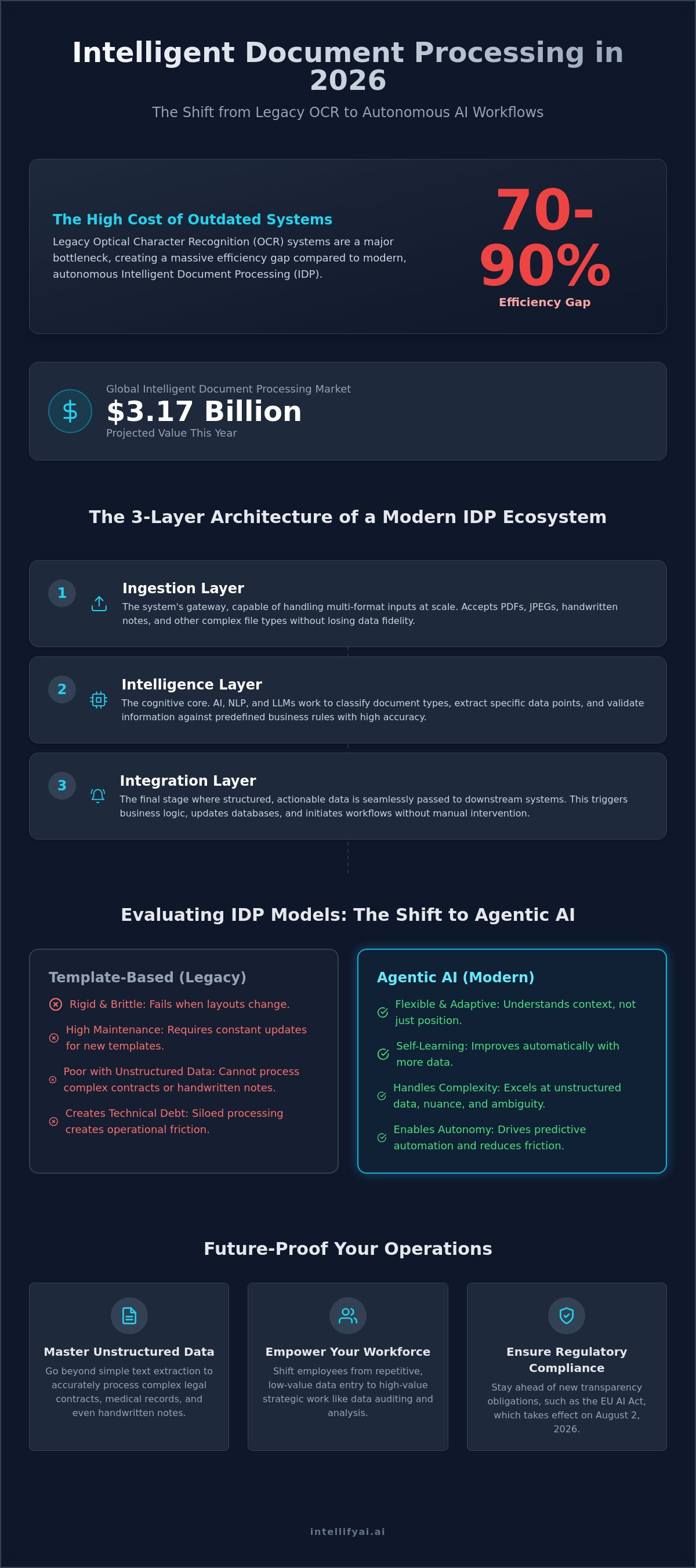
Your legacy OCR system isn't just slow; it is likely costing you a 70% to 90% efficiency gap compared to modern autonomous workflows. While the global market for intelligent document processing is projected to reach $3.17 billion this year, many organizations remain trapped by high error rates in unstructured formats like handwritten notes or complex legal contracts. Mastering idp implementation best practices in 2026 requires moving beyond simple data extraction toward agentic AI that integrates directly with your downstream business logic.
It's frustrating when document extraction remains siloed from the rest of your enterprise operations, creating friction where there should be momentum. We understand that the transition to automated intelligence feels like a high-stakes evolution, particularly with new transparency obligations under the EU AI Act taking effect on August 2, 2026. This article promises to equip you with an enterprise-grade framework to bridge the gap between abstract technology and practical, results-oriented execution. We'll break down the shift from reactive processing to predictive automation, ensuring your document strategy becomes a central pillar of long-term operational stability.
Key Takeaways
• Understand how Intelligent Document Processing (IDP) has evolved from simple data extraction into a sophisticated ecosystem of AI, NLP, and Machine Learning.
• Master the three-layer architectural model—Ingestion, Intelligence, and Integration—to ensure document data flows seamlessly into your downstream business logic.
• Transition from rigid, high-maintenance template-based systems to flexible Agentic AI models that handle complex, unstructured formats with precision.
• Deploy a high-velocity roadmap based on idp implementation best practices to move from a Proof of Value to full-scale enterprise optimization.
• Discover how the i_Nova platform leverages autonomous intelligence to future-proof your back-office operations against evolving regulatory and data challenges.
What is IDP Implementation? Defining Intelligent Document Processing in 2026
In the context of enterprise automation, IDP stands for Intelligent Document Processing. It is the sophisticated application of AI, NLP, and Machine Learning to extract, classify, and validate data from unstructured documents. Unlike legacy systems that merely "read" text, modern Intelligent Document Processing understands context. This evolution from basic Optical Character Recognition (OCR) to context-aware AI models is the foundation of modern digital transformation.
The core value of this technology lies in reducing operational friction across your back office. By removing the burden of repetitive manual entry, businesses unlock human potential for high-value strategic work. This isn't just about efficiency; it's about shifting your workforce from data entry to data auditing. Success in this field requires a deep understanding of idp implementation best practices to ensure that technology serves the bottom line rather than adding layers of technical debt.
To better understand how these systems secure and process information, watch this helpful video:
The Shift from Extraction to Intelligence
Traditional OCR frequently fails when encountering unstructured data like legal contracts, medical records, or handwritten notes. It relies on rigid templates that break when a single line item shifts or a document layout changes slightly. Natural Language Processing (NLP) fundamentally changes this dynamic by analyzing the semantic meaning and intent of the text. In 2026, IDP leverages Large Language Models (LLMs) to handle nuance, sentiment, and ambiguity that previously required human intervention. This shift ensures that your data extraction is both autonomous and accurate, even across highly diverse and unpredictable document formats. It transforms documents into actionable data streams that trigger downstream business logic without manual oversight.
The Strategic Architect Perspective
Leaders must position IDP as a central pillar of enterprise modernization. It is not a tactical software purchase; it is a long-term investment in organizational relevance and operational scale. A strategic AI implementation focuses on system autonomy and custom integration rather than off-the-shelf fixes that fail to handle edge cases. Following established idp implementation best practices ensures that your organization remains ahead of the curve, treating document automation as a central business pillar rather than a temporary fix. This approach guarantees the stability and security of your operations as you scale toward a fully autonomous enterprise.
The Architecture of an Intelligent Document Processing Ecosystem
A high-performance IDP ecosystem functions through three distinct yet interdependent layers: Ingestion, Intelligence, and Integration. Success depends on how these layers communicate. Ingestion serves as the gateway, requiring the capacity to handle multi-format inputs at scale. Whether your organization processes high-resolution PDFs, smartphone-captured JPEGs, or complex handwritten notes, the system must ingest this data without losing fidelity. This stage is where many legacy systems fail, as they lack the elasticity to manage fluctuating volumes or diverse file types.
The Intelligence layer acts as the cognitive core of the system. It goes beyond simple text recognition to perform classification, extraction, and validation. In this phase, the AI identifies the document type, extracts specific data points, and validates them against pre-defined business rules. This level of sophistication is highlighted in recent research on IDP in public administration, which demonstrates how autonomous validation significantly reduces the burden on human auditors. Adhering to idp implementation best practices at this stage ensures that your AI core remains accurate even as document complexity increases.
Integration is the final, critical step where extracted data becomes actionable intelligence. A visionary architecture doesn't just store data; it pushes it directly into ERPs, CRMs, or custom Agentic workflows. This creates a frictionless loop where a document arrival triggers a sequence of business events without manual intervention. If your integration layer is weak, the efficiency gained in earlier stages is lost to manual data movement. To avoid this, consider engaging in strategic AI consulting to align your document architecture with your broader digital goals.
Data Engineering: The Foundation of IDP
High-quality data engineering is the non-negotiable prerequisite for AI accuracy. You can't build a reliable extraction model on a foundation of messy, unnormalized data. Robust engineering pipelines are required to clean and normalize document inputs before they reach the intelligence layer. This involves managing the entire data lifecycle from the moment of capture to long-term archival. By prioritizing data integrity, you ensure that the AI has the cleanest possible signal to work with, which directly translates to higher straight-through processing rates.
MLOps and Model Governance
Governance is what separates a temporary fix from a central business pillar. Implementing MLOps pipelines allows your team to monitor model performance in real time. It's common for document formats and business requirements to evolve, leading to "model drift" where accuracy slowly declines. Version control and continuous monitoring are essential idp implementation best practices that allow you to catch these declines early. This proactive approach maintains the stability and security of your operations, ensuring your investment remains relevant for the long term.
Evaluating IDP Models: Template-Based vs. Agentic AI Approaches
The traditional approach to document processing relied on rigid templates. These systems functioned by mapping specific coordinates on a page to data fields. While effective for standardized forms, template-based models are notoriously fragile. A minor shift in layout or a change in font can cause the entire extraction process to fail, leading to high manual intervention rates. This "Old Way" creates a hidden tax on your operations, requiring constant IT maintenance to update templates as vendor formats evolve.
Modern The Future of AI-Powered Document Processing is defined by Agentic AI. This approach moves beyond coordinate-based extraction to true contextual understanding. Instead of looking for data in a specific spot, Agentic models understand the semantic intent of the document. They can identify a "due date" regardless of where it appears or how it is labeled. One of the core idp implementation best practices in 2026 is recognizing that documents are no longer just static files; they are triggers for wider autonomous workflows.
The Rise of the Agentic IDP
Agentic AI fundamentally changes the extraction paradigm by executing complex business logic. Unlike basic models, AI agents can autonomously verify extracted data against external databases or internal CRMs. For example, an agent processing a shipping manifest can cross-reference tracking numbers with a logistics provider's API in real time. If a discrepancy is found, the agent doesn't just flag an error; it can initiate a clarification request to the vendor. This level of self-correcting logic reduces the "Prompt Janitor" problem and allows your team to focus on resolving high-level strategic exceptions rather than fixing minor data mismatches.
Decision Matrix for Enterprise Leaders
Choosing the right model depends on your document variety and the desired level of autonomy. If your organization handles a low variety of highly standardized forms, simple extraction might suffice for an initial pilot. However, for enterprises managing complex contracts or high-volume, multi-format inputs, Agentic workflows are essential for long-term scalability. Leaders must balance implementation speed with the need for a system that doesn't break under the weight of unstructured text. Aligning your choice with idp implementation best practices ensures that your architecture remains a lasting investment in operational relevance rather than a temporary fix.
The 2026 IDP Implementation Roadmap: 5 Best Practices for Scale
Scaling document intelligence requires a transition from isolated pilots to a structured enterprise lifecycle. This roadmap follows a logical progression through four critical stages: Strategy, Proof of Value (PoV), Scaling, and Optimization. Leaders must move beyond the "software purchase" mindset and adopt a framework that treats document processing as a dynamic data pipeline. Adhering to idp implementation best practices ensures that your system remains resilient as document volumes and formats inevitably shift.
Prioritize high-impact, high-volume document types
Start your PoV with document categories that create the most significant manual bottlenecks. This demonstrates immediate financial returns and builds internal momentum for wider deployment.
Implement Human-in-the-Loop (HITL) for high-stakes validation
Total autonomy is a long-term goal, but immediate accuracy requires human oversight for complex exceptions. This collaborative relationship allows AI to handle the bulk of repetitive tasks while humans focus on auditing and training the system.
Ensure strict AI governance and GRC compliance
Governance must be a design requirement from day one. Your architecture should account for evolving regulations and provide transparent decision-making logs for every processed document.
Design for API-First integration
Avoid creating new data silos by ensuring your IDP ecosystem communicates seamlessly with your existing ERP and CRM systems. Actionable data should trigger downstream business logic without manual handoffs.
Commit to continuous MLOps monitoring
Use automated pipelines to track model performance and catch accuracy declines early. This proactive maintenance prevents technical debt and ensures the long-term viability of your automation investment.
To build a roadmap tailored to your specific operational needs, explore our AI Strategy & Consulting services.
Security and Compliance in IDP
Handling Sensitive Personal Information (SPI) and PII within document pipelines requires a sophisticated security posture. Modern IDP frameworks must adhere to SOC2 and GDPR standards to maintain the integrity of automated workflows. Data residency is a critical consideration for global enterprises, necessitating localized processing to meet regional legal requirements. Robust encryption at rest and in transit provides the foundational security needed to protect your organization's most sensitive data assets from capture to archival.
Measuring Success and ROI
Success in document automation is measured by KPIs that go beyond simple extraction accuracy. Leaders should track the Straight-Through Processing (STP) rate, which monitors the percentage of documents handled without any human intervention. Additionally, cycle time reduction and the cost per document provide a clear picture of operational efficiency gains. ROI in the context of IDP is the delta between the total expenditure on manual document labor and the significantly lower cost of high-velocity automated throughput at scale.
Future-Proofing with i_Nova: The IntellifyAi Approach to IDP
Mastering idp implementation best practices requires more than just selecting a tool; it demands a partnership with a strategic architect who understands the nuances of autonomous intelligence. i_Nova is the premier platform designed for the 2026 enterprise landscape, where the variety and complexity of data are the norm rather than the exception. By moving beyond simple coordinate-based extraction, i_Nova treats every document as an autonomous business trigger. This approach allows your organization to move from manual workflows to a state of liberated, high-value creative focus.
IntellifyAi operates as a strategic partner rather than a traditional software vendor. We recognize that technology is most effective when it serves as a central business pillar, integrated deeply into your operational philosophy. Our team ensures that your deployment adheres to the highest idp implementation best practices, from initial data engineering to long-term MLOps governance. We don't just provide tools; we build the bridge between abstract technical capability and your tangible bottom line. This collaborative relationship ensures that your investment remains relevant as market conditions and regulatory requirements evolve.
Why Enterprise Leaders Choose i_Nova
Scalability is a core requirement for any modern enterprise processing millions of documents annually. i_Nova features a cloud-native architecture that scales elastically with your demand, ensuring performance never dips during peak volumes. We achieve unmatched precision by leveraging generative AI to handle the nuances of complex, unstructured text that traditional systems ignore. Furthermore, our platform is designed for frictionless integration with your existing ecosystem. Through our consulting services, we align document intelligence with your broader digital transformation goals, ensuring that actionable data flows directly into your ERP or CRM without manual handoffs.
The Next Step in Your AI Journey
The transition to autonomous document intelligence begins with a targeted Proof of Value (PoV) project. This allows your leadership team to witness the measurable impact of Agentic AI on your specific document types before committed scaling. In a high-velocity market, the cost of delay is the loss of competitive relevance. Organizations that fail to modernize their back-office operations will find themselves burdened by the very manual bottlenecks that their competitors have already automated. The stability and security of your future operations depend on the strategic decisions you make today. Contact our AI Strategy Consultants to begin your IDP implementation and secure your position at the cutting edge of industry efficiency.
Architecting Your Autonomous Future
The transition to intelligent document processing represents a fundamental shift in how modern enterprises manage information. Success requires moving beyond fragile, template-based systems toward the contextual power of Agentic AI. By adopting a structured roadmap that prioritizes high-volume document types and integrates strict governance, your organization can eliminate manual bottlenecks and unlock human potential for strategic growth. Adhering to these idp implementation best practices ensures that your document workflows remain resilient in an increasingly complex and unstructured data environment.
IntellifyAi serves as your Strategic Architect in this digital transformation. With our i_Nova platform and a global presence spanning the UK, USA, India, and UAE, we provide the technical expertise and visionary leadership required for enterprise-grade modernization. We don't just implement software; we build lasting business pillars that secure your operational relevance for the long term. It's time to move past the burden of repetitive tasks and focus on the high-value innovation that drives your bottom line.
Transform your unstructured data into actionable intelligence; contact IntellifyAi today.
The journey toward a frictionless, automated future is well within reach. We look forward to helping your business realize its full potential through the power of intelligent autonomy.
Frequently Asked Questions
What is the difference between OCR and IDP?
OCR is a foundational technology that converts images into raw text, while IDP is a cognitive system that understands and extracts semantic meaning. While OCR reads characters, IDP uses AI and NLP to classify, validate, and transform that text into structured business intelligence. It moves beyond simple recognition to provide context-aware data that triggers autonomous enterprise workflows.
How long does a typical IDP implementation take?
A typical enterprise implementation ranges from three to six months, depending on document variety and integration complexity. Most organizations begin with a Proof of Value project that reaches completion within 4 to 6 weeks. This high-velocity start allows leaders to validate the strategic architecture and measure initial impact before scaling the solution across the broader ecosystem.
Can IDP handle handwritten documents and low-quality scans?
Modern IDP systems leverage advanced deep learning models to process handwritten notes and low-quality scans with high precision. These models analyze the semantic context of surrounding text to resolve ambiguities where visual clarity is compromised. Incorporating these capabilities is a core part of idp implementation best practices for enterprises managing physical archives or field-captured documents.
Is IDP implementation secure for highly regulated industries like finance or healthcare?
IDP implementation is highly secure and specifically engineered to meet SOC2, GDPR, and HIPAA compliance standards. Advanced platforms utilize end-to-end encryption and localized data residency to protect sensitive personal information. This robust security posture ensures that automated document workflows remain fully compliant with the stringent regulatory requirements faced by finance and healthcare institutions in 2026.
What is the role of Human-in-the-Loop (HITL) in document processing?
Human-in-the-Loop (HITL) serves as a critical audit layer for documents that fall below pre-defined confidence thresholds. Instead of performing manual data entry, human workers focus on exception handling and model training. This collaborative relationship maintains total accuracy for high-stakes documents while allowing the AI to learn from human corrections, driving long-term system autonomy and performance.
How do I calculate the ROI of an IDP project?
ROI is calculated by measuring the delta between manual processing costs and the high-velocity throughput of an automated pipeline. You must also factor in the financial impact of reduced error rates and accelerated cycle times. Organizations that adhere to idp implementation best practices typically achieve a full return on their investment within a 3 to 6 month window.
Does IDP replace existing RPA (Robotic Process Automation) tools?
IDP doesn't replace RPA; it serves as the cognitive intelligence layer that allows RPA to handle unstructured data. RPA is excellent for moving data between systems, but it cannot "read" a complex contract. By integrating IDP, you provide your RPA bots with the actionable intelligence they need to execute document-heavy processes without requiring constant human intervention.
What are the most common pitfalls in IDP implementation?
Common pitfalls include neglecting data engineering and attempting to automate too many complex document types simultaneously. Many organizations also fail by ignoring model governance or underestimating the need for human oversight during the initial scaling phase. Success requires a phased roadmap that prioritizes high-impact document categories and establishes a robust MLOps pipeline to manage evolving data formats.








.svg)