
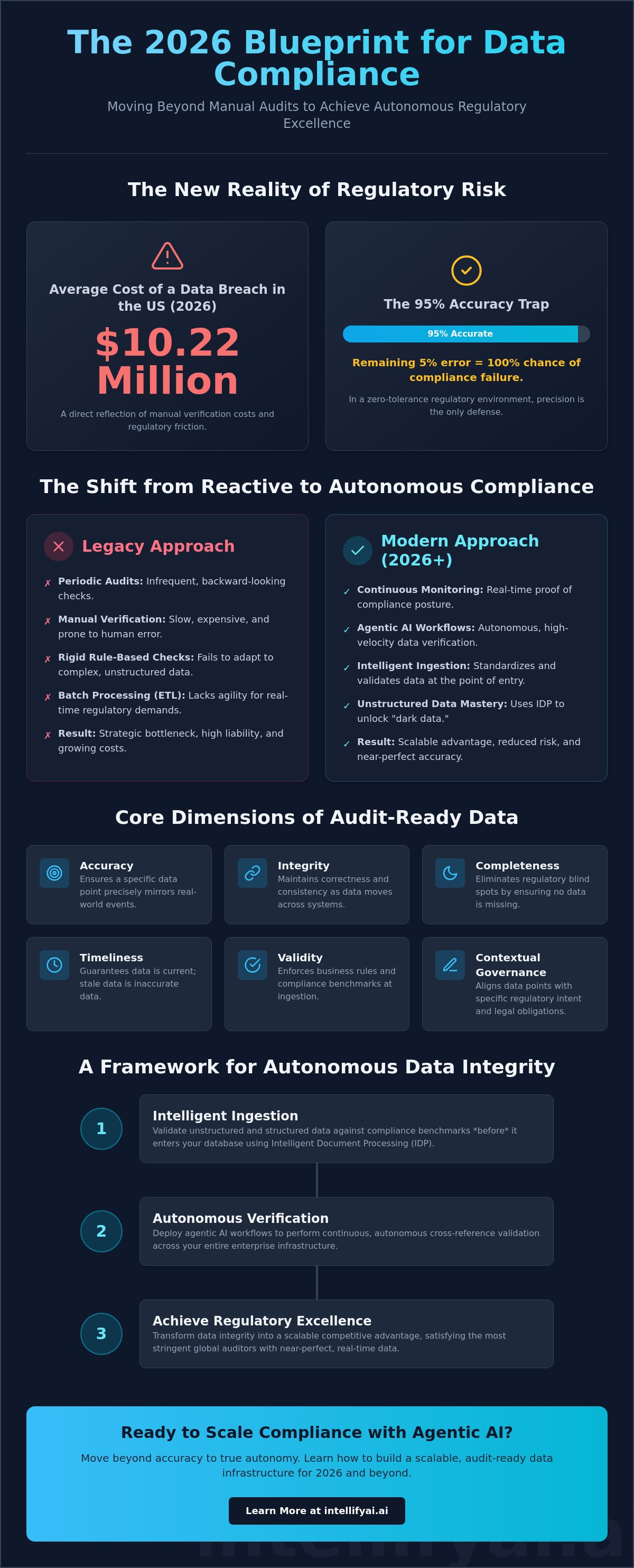
In 2026, the average cost of a data breach in the United States has reached a record-high $10.22 million. For the modern enterprise, this isn't just a security metric; it's a direct reflection of the mounting costs associated with manual data verification and regulatory friction. You've likely found that legacy silos and "dark data" inaccuracies create a liability that grows every time a new state regulation goes live. Relying on human-led audits for improving data accuracy for compliance is no longer just expensive. It's a strategic bottleneck that prevents your team from focusing on high-value work.
This strategy provides the blueprint to move beyond reactive cleanup. You'll master the frameworks and agentic technologies required to achieve near-perfect data accuracy for regulatory excellence. We will examine how to deploy autonomous verification workflows that reduce audit cycle times, eliminate inconsistency, and transform data integrity into a scalable competitive advantage for 2026 and beyond. By the end of this guide, you'll have the confidence to lead an automated reporting structure that satisfies the most stringent global auditors.
Key Takeaways
• Understand why continuous monitoring has replaced periodic audits as the standard for improving data accuracy for compliance in 2026.
• Master the core dimensions of data quality to ensure your datasets mirror real-world events and eliminate high-risk regulatory blind spots.
• Shift from rigid rule-based checks to agentic AI workflows that perform autonomous cross-reference validation across your entire enterprise infrastructure.
• Apply a scalable framework for data integrity that prioritizes intelligent ingestion and standardizes inputs at the point of entry.
• Learn how to scale your compliance operations by integrating agentic AI with robust data engineering for near-perfect regulatory excellence.
The Regulatory Landscape in 2026: Why Accuracy is the New Perimeter
The year 2026 marks a definitive end to the era of the annual audit. Regulators have moved toward continuous monitoring, requiring enterprises to prove their compliance posture in real-time. This shift demands a fundamental re-evaluation of how you approach improving data accuracy for compliance. Within this high-stakes environment, we define data accuracy as the precise degree to which digital records mirror real-world enterprise events. It isn't just about clean spreadsheets; it's about an exact reflection of reality across every transaction and interaction.
To better understand how these dynamics are shifting, watch this helpful video:
Traditional ETL (Extract, Transform, Load) pipelines are failing this modern test. These systems were built for batch processing and structured inputs, but they lack the agility to validate data against the core dimensions of data quality at the speed of current regulatory demands. For a modern enterprise, 95% accuracy is no longer a passing grade. In a zero-tolerance regulatory environment, that remaining 5% of error represents a 100% chance of compliance failure. Precision is the only viable defense.
The Escalating Complexity of Unstructured Data
The volume of "dark data" trapped in contracts, email threads, and voice logs has exploded. While legacy Optical Character Recognition (OCR) could digitize text, it often failed to capture the nuance required for regulatory precision. Simple digitization is not enough. Enterprises now rely on intelligent document processing to extract baseline data with surgical accuracy. This technology ensures that even the most complex unstructured files are converted into reliable, audit-ready assets.
To further bolster trust in these assets, especially when dealing with potentially synthetic content, amige. provides an essential layer of security by detecting whether text, images, or videos were created by artificial intelligence.
Compliance Standards as Accuracy Benchmarks
Regulatory frameworks like GDPR, SOC2, and Sarbanes-Oxley now serve as the primary benchmarks for data integrity. Improving data accuracy for compliance requires mapping every data point to its specific legal obligation. This is where "Contextual Governance" becomes essential. Contextual Governance is the alignment of data points with specific regulatory intent. It ensures that your data doesn't just look correct, but that it actually satisfies the underlying logic of the law. Achieving this level of excellence requires a move away from manual verification toward autonomous, high-velocity systems.
Core Dimensions of Data Quality for Compliance Excellence
Achieving regulatory excellence requires you to look far beyond basic data cleaning. Improving data accuracy for compliance is a multi-dimensional effort that demands a rigorous focus on the core attributes making data audit-ready. It isn't enough for a record to be correct in isolation. It must be part of a cohesive, high-fidelity ecosystem that regulators can trust without hesitation.
You must first distinguish between accuracy and integrity. Accuracy ensures a specific data point is correct. Integrity ensures that correctness remains consistent as the data moves through your enterprise lifecycle. Without integrity, an accurate record becomes a liability the moment it is transferred between systems. This distinction is critical for 2026, where the flow of data is as important as the data itself.
Completeness and timeliness are the next pillars of this strategy. Completeness eliminates regulatory blind spots. If a transaction record is missing a timestamp or a specific geo-tag, it becomes an audit risk. Timeliness is equally vital. In a high-velocity market, stale data is effectively inaccurate data. Regulators now expect transparency at the speed of business. A report based on week-old data fails the modern test of real-time compliance monitoring.
Validity enforces business rules at the exact point of ingestion. This is where legacy systems often fail. By implementing Intelligent Document Processing (IDP), enterprises can validate unstructured data against compliance benchmarks before it ever touches the database. This proactive approach prevents "dirty" data from polluting your downstream analytics. If you are ready to modernize your approach, you can explore specialized AI strategy and consulting to build these guardrails into your architecture.
Consistency Across Siloed Systems
Consistency is the primary challenge in multi-cloud environments. Data drift occurs when different departments use conflicting versions of the same record. Through strategic enterprise modernization, you can eliminate these silos. This ensures every regulatory report is synchronized, preventing the red flags raised by conflicting data sources across your back office.
Uniqueness and De-duplication Frameworks
Uniqueness is the foundation of KYC and AML protocols. Duplicate identities create massive compliance risks and inflate manual verification costs. Modern data engineering services provide automated entity resolution to solve this. By establishing clear thresholds for acceptable duplication, you can maintain a lean, high-fidelity dataset that stands up to the most intense scrutiny.
Agentic AI: The Modern Engine for Real-Time Data Verification
Static rules are no longer sufficient for the complexities of 2026. Traditional systems rely on rigid "if-then" logic. If a field is empty, flag it. This approach is inherently reactive. It lacks the nuance required for improving data accuracy for compliance in a multi-cloud environment where data is constantly in motion. Agentic AI represents a paradigm shift. These autonomous systems don't just follow pre-defined rules; they reason through data challenges to find the truth behind a record.
Agents perform cross-reference validation by checking data points against multiple internal and external sources simultaneously. An agent can verify a vendor's tax ID against a government database while checking the invoice against a purchase order in your ERP and a shipping log in your warehouse management system. This happens without human intervention. This speed is essential for maintaining the timeliness dimension required for modern audits. When a discrepancy requires subjective judgment, the agent flags it for a human strategist. This human-in-the-loop model ensures that technology handles the volume while your experts handle the complexity.
Trust is the currency of compliance. Black-box AI models are a liability in a regulatory audit. We prioritize explainable AI (XAI) to ensure every verification action is transparent. Your accuracy reports should not just state that a record is correct. They must provide the logical path the agent took to reach that conclusion. This transparency builds confidence with auditors and internal stakeholders alike. It transforms your compliance function from a cost center into a source of verified truth.
Traditional Validation vs. Agentic Verification
Traditional SQL checks are brittle. They break when a document format changes or a new data source is added. Agentic verification uses dynamic reasoning to interpret the intent behind unstructured data. Agents can understand that "Street" and "St." represent the same entity without needing a manual mapping rule. This capability significantly reduces false positives in compliance flagging. Your team stops chasing ghosts and starts focusing on genuine risks that actually impact the bottom line.
Autonomous Audit Trails
Every action taken by an agent is logged in real-time. These autonomous audit trails provide an immutable record of how data was validated, which sources were consulted, and when the verification occurred. To understand the broader implications of these systems, it is essential to explore what is agentic ai and how it reshapes the modern back office. Agentic audit trails provide a continuous, verifiable chain of custody that satisfies the rigorous traceability requirements of SOC2.
A Strategic Framework for Improving Data Integrity
Transitioning from manual verification to an autonomous system requires a structured blueprint. Improving data accuracy for compliance is no longer a localized IT project; it's a fundamental enterprise transformation. This five-step framework ensures your data remains audit-ready, scalable, and resilient against the shifting regulatory demands of 2026.
Step 1: Audit the Source.
Map your entire data lineage to identify high-risk entry points. Focus on legacy imports and manual entry fields where human error or formatting inconsistencies are most likely to corrupt the stream.
Step 2: Deploy Intelligent Ingestion.
Replace traditional forms with Intelligent Document Processing (IDP). This standardizes inputs at the point of entry, ensuring that unstructured data is validated against your compliance benchmarks before it reaches your core systems.
Step 3: Implement MLOps Pipelines.
Accuracy is not a static achievement. Use MLOps pipelines to govern your verification models. This ensures your AI remains precise as data patterns evolve.
Step 4: Establish Version Control.
Implement a rigorous versioning system for your datasets. Tracking the evolution of data is a core requirement for SOX compliance, providing a transparent history of every change made to your financial records.
Step 5: Continuous Monitoring.
Set performance thresholds and automated alerts. If your accuracy metrics dip below your defined baseline, the system must trigger an immediate notification to your compliance leads.
This framework creates a self-healing data ecosystem. It reduces the burden on your team while providing the board with verifiable proof of regulatory excellence. If you're ready to design a custom implementation for your enterprise, our team can help you build the architecture. Explore our Agentic AI Engineering Services to begin your modernization journey.
The Role of MLOps in Data Accuracy
Data drift is the silent killer of compliance. When the nature of your incoming data changes, your verification models can lose their precision. MLOps pipelines solve this by automating the retraining process. This governance structure ensures that your models aren't just fast, but consistently accurate. By automating model monitoring, you eliminate the risk of "model decay" leading to regulatory failure.
Promoting a Culture of Data Literacy
Technology is a liberating force, but its success depends on the people who use it. You must educate stakeholders on the direct relationship between data input and regulatory risk. Assigning clear data ownership at the departmental level ensures accountability. Engaging in specialized AI strategy consulting can help bridge the gap between your technical infrastructure and your organizational culture, ensuring that every employee understands their role in the compliance ecosystem.
Scaling Compliance with IntellifyAi: Beyond Accuracy to Autonomy
Enterprise compliance in 2026 is no longer a human-scale challenge. It is a machine-speed requirement. Improving data accuracy for compliance requires a fundamental shift from reactive data cleaning to a self-healing ecosystem. This is where IntellifyAi bridges the gap between abstract strategy and operational reality. We architect the autonomous infrastructure that allows your data to validate itself, ensuring your organization remains ahead of the regulatory curve.
The true power of this transition lies in the synergy between our Agentic AI Engineering Services and modern enterprise data engineering. We don't just fix existing errors; we build systems that prevent them. By integrating autonomous agents directly into your cloud-native environment, we create a continuous feedback loop. This infrastructure identifies anomalies, cross-references disparate sources, and updates records in real-time. It transforms compliance from a recurring organizational headache into a silent, high-performance background process that protects your bottom line.
Investing in autonomous compliance infrastructure offers a long-term ROI that extends beyond avoiding fines. It reduces the operational drag of manual verification and provides your leadership with a single, verified source of truth. This clarity allows for faster decision-making and a more agile response to market shifts. When your data is inherently accurate, your enterprise is free to focus on growth rather than remediation.
This focus on growth extends to how organizations manage professional standards; for instance, those overseeing technical assessments can discover more about Usage-based exam security session fees to ensure scalable integrity and security.
i_Nova: The Intelligent Document Processing Advantage
i_Nova represents our commitment to near-perfect accuracy in Intelligent Document Processing. This technology extracts actionable intelligence from the most complex unstructured formats, including legal contracts and multi-layered financial statements. It integrates seamlessly with your existing cloud-native architecture to ensure data integrity from the moment of ingestion. In practical enterprise applications, this approach has allowed organizations to reduce manual verification time by 80%. This efficiency liberates your workforce, allowing them to focus on high-value creative and strategic work.
Partnering for the Agentic Future
Every enterprise faces a unique set of regulatory hurdles and legacy constraints. We provide custom AI engineering services to meet these bespoke compliance requirements. Whether you are navigating the specific thresholds of the Indiana Consumer Data Protection Act or the complex deletion requests of the California Delete Act, we develop a strategic roadmap for your global transformation. This is more than a temporary fix; it is a lasting investment in your company's relevance and security. Contact IntellifyAi to secure your data's integrity and lead your industry into the agentic era.
Architecting Your Autonomous Compliance Future
The transition from manual verification to autonomous governance is the defining shift of 2026. You've seen how precision has become the new perimeter and why agentic workflows are essential for maintaining a high-fidelity data ecosystem. By implementing a structured framework and leveraging intelligent document processing, your enterprise can move beyond reactive remediation toward a self-healing infrastructure.
Our flagship i_Nova IDP platform and global expertise in Agentic AI Engineering provide the foundation for this transformation. We combine deep technical leadership in Enterprise Modernization with a results-oriented approach to improving data accuracy for compliance. This is your opportunity to unlock human potential by removing the burden of repetitive tasks and securing your long-term regulatory relevance.
Are you ready to modernize your compliance architecture? Schedule an AI Strategy Consultation with IntellifyAi to build a dependable, future-proof strategy. The path to regulatory excellence starts with a partner who understands the intersection of strategic vision and technical execution.
Frequently Asked Questions
What is the primary cause of data inaccuracy in compliance reporting?
Manual data entry and siloed legacy systems remain the primary drivers of inaccuracy. Human error during ingestion or conflicting records across disconnected cloud environments create inconsistencies that lead to regulatory failure. When data is trapped in silos, it loses the context required for precise reporting. Strategic architects solve this by centralizing data flows and automating high-risk entry points to ensure a single, verified source of truth across the entire enterprise.
How does Intelligent Document Processing (IDP) improve data accuracy?
Intelligent Document Processing improves accuracy by automating the extraction and standardization of data from unstructured formats. It eliminates the transcription errors common in manual processes. By using advanced reasoning to interpret complex documents like legal contracts, IDP ensures that baseline data is captured with surgical precision. This technology is a critical pillar for improving data accuracy for compliance by turning messy inputs into audit-ready assets.
Can Agentic AI replace manual compliance audits entirely by 2026?
Agentic AI won't replace human auditors entirely, but it will fundamentally redefine their role. By 2026, autonomous agents will handle the high-volume task of continuous verification and cross-referencing across multi-cloud systems. This liberation allows human professionals to focus on high-value strategic work and complex ethical judgments. The result is a collaborative model where technology ensures speed and precision while humans provide the necessary governance and oversight.
What are the six dimensions of data quality for regulatory standards?
The six dimensions include accuracy, completeness, consistency, timeliness, validity, and uniqueness. These metrics provide a holistic framework for improving data accuracy for compliance by ensuring every record is precise and audit-ready. Accuracy reflects reality, while completeness ensures no regulatory blind spots exist. Consistency prevents conflicting reports across silos, and timeliness ensures data remains relevant. Validity and uniqueness prevent duplicates and business rule violations at the point of ingestion.
How do MLOps pipelines contribute to long-term data integrity?
MLOps pipelines contribute to integrity by governing the lifecycle of the AI models used for data verification. They monitor for "model decay" or data drift, which occurs when incoming data patterns shift away from the original training set. By automating the retraining and deployment process, MLOps ensures that your compliance infrastructure remains precise and dependable. This long-term viability is essential for maintaining a stable and secure regulatory posture.
What is the difference between data accuracy and data validity in a GRC context?
Accuracy measures how closely a data point mirrors real-world events, while validity ensures that the data conforms to specific formats or business rules. In a GRC context, a record can be valid but inaccurate. For example, a tax ID might be formatted correctly but belong to the wrong entity. Both dimensions are essential. Validity acts as the first line of defense at ingestion, while accuracy is the ultimate goal.
How can enterprises handle unstructured data for GDPR compliance?
Enterprises must use agentic discovery and IDP to shine a light on "dark data" trapped in unstructured formats like voice logs or emails. These tools identify and classify personal data automatically, ensuring it's handled according to GDPR's transparency and deletion requirements. By automating the classification process, you reduce the risk of manual oversight and ensure that your privacy protocols are applied consistently across every byte of enterprise data.
What role does version control play in AI-driven compliance?
Version control provides an immutable audit trail for both your raw datasets and the AI models that process them. It allows your team to trace the evolution of a record back to its source, satisfying the rigorous lineage requirements of frameworks like SOX. By maintaining a transparent history of every change, you build a dependable chain of custody that simplifies audit cycles and increases confidence in your automated reporting.








.svg)