
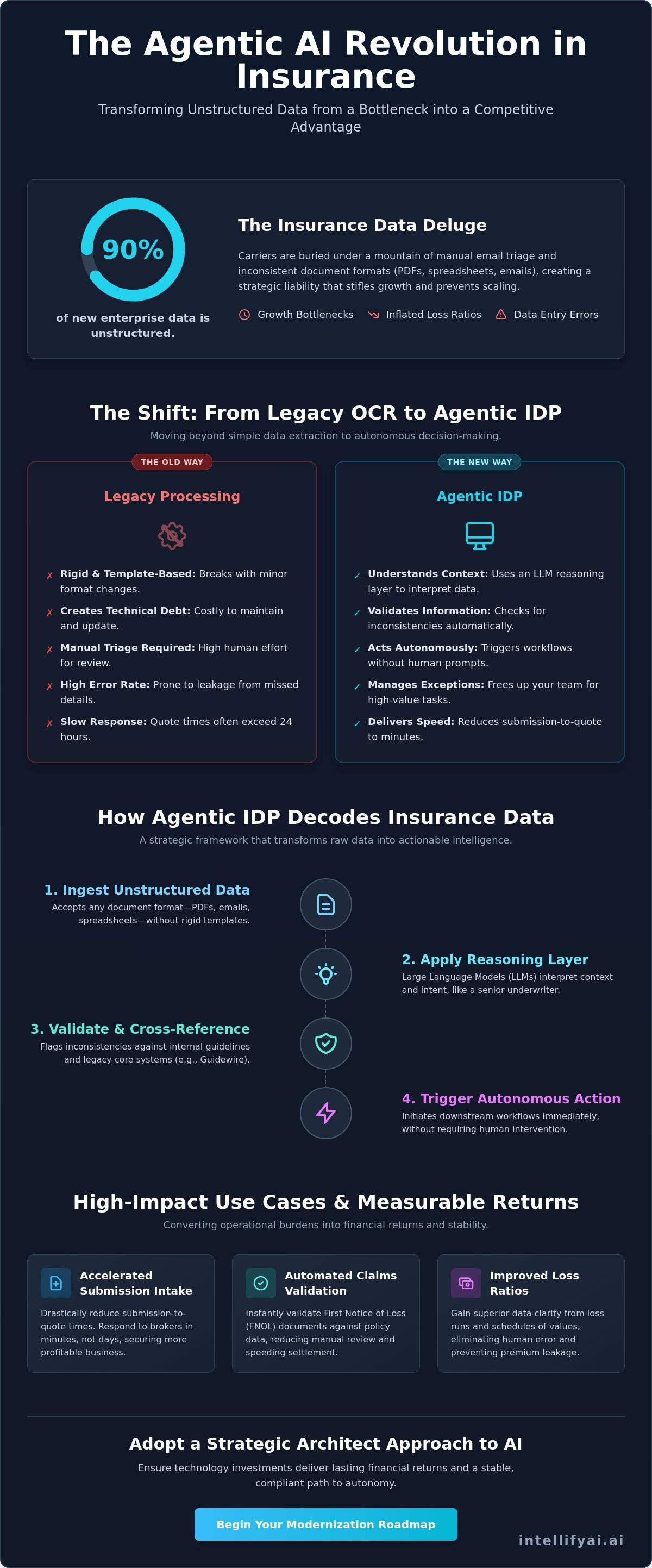
Ninety percent of newly generated enterprise data is currently unstructured, leaving most carriers buried under a mountain of manual email triage and inconsistent document formats. It's a bottleneck that stifles growth and inflates loss ratios. To remain competitive in a market where North America holds nearly half the global share, firms are shifting toward agentic intelligent document processing for insurance. This isn't just about reading text. It's about deploying systems that understand, validate, and act on complex information autonomously.
You understand the friction caused by manual triage and the limitations of legacy core systems. We'll demonstrate how Agentic AI engineering services and cloud-native modernization convert these operational burdens into a measurable competitive advantage. This guide provides a roadmap to reduce submission-to-quote times and improve loss ratios through superior data clarity. We also examine the 2026 regulatory shift, including the NAIC AI Systems Evaluation Tool pilot, to ensure your path to autonomy is both stable and compliant.
Key Takeaways
• Shift from legacy OCR to a document-first strategy to eliminate the technical debt associated with rigid, template-based systems.
• Integrate Agentic AI into your document workflows to provide the reasoning layer necessary for interpreting complex, unstructured policy language.
• Discover how intelligent document processing for insurance accelerates submission intake and automates First Notice of Loss validation.
• Develop a modernization roadmap that bridges the gap between advanced AI capabilities and legacy core systems such as Guidewire or Duck Creek.
• Adopt a Strategic Architect approach to AI engineering to ensure your technology investments deliver lasting financial returns and operational stability.
The Insurance Data Deluge: Why Traditional Processing Fails in 2026
Commercial insurance carriers are drowning in a document-first reality. In lines like excess and surplus or complex property, the standard application form is often secondary to the dozens of PDFs, spreadsheets, and emails that accompany a submission. Traditional systems struggle because they were built for a world of structured data. Today, roughly 80% to 90% of newly generated enterprise data is unstructured. Relying on manual entry or basic templates is no longer just an inefficiency; it's a strategic liability that prevents carriers from scaling. With North America expected to hold 48.1% of the global market share in 2026, the pressure to modernize has never been higher.
Legacy OCR and template-based systems have become the new technical debt. These tools are rigid. They break when a broker changes a font or a column header moves. This creates silent friction in your broker relationships as they wait days for a response that your competitors, powered by more agile systems, deliver in minutes. Understanding What is Intelligent Document Processing? is the first step toward reclaiming that lost time and building a foundation for autonomous operations.
To visualize how these technologies are reshaping the industry, watch this analysis of document processing at scale:
The Hidden Cost of Manual Document Triage
Slow submission response times directly degrade quote-to-bind ratios. If a broker doesn't hear back within 24 hours, they've likely already moved to a more responsive carrier. Beyond speed, human error in data entry remains a primary driver of leakage. Subtle details in loss runs or schedules of values are frequently missed during the manual grind. During high-volume periods, such as January 1st renewals, this manual triage becomes a catastrophic bottleneck that forces underwriters to cherry-pick submissions, often leaving profitable business on the table.
Why 2026 Demands More Than Just OCR
Basic digitization is a solved problem, but converting pixels to text isn't enough in a dynamic market. Carriers need to understand intent and context. Moving from simple data capture to true intelligence allows systems to validate information against internal guidelines and legacy core systems automatically. Intelligent document processing for insurance is a strategic framework that transforms raw, unstructured data into validated, actionable intelligence that triggers immediate downstream workflows without human intervention. By leveraging Agentic AI engineering services, firms can move beyond read-only automation and toward a future where systems reason through complex policy language just as an experienced adjuster would.
Beyond Extraction: How Agentic IDP Decodes Unstructured Insurance Data
Traditional extraction tools act as digital photocopiers. They record data but lack the cognitive framework to understand it. In 2026, the industry has moved toward agentic ecosystems that go beyond simple pattern matching. These systems use Large Language Models (LLMs) to provide a reasoning layer, allowing the software to "read" complex policy language with the same scrutiny as a senior underwriter. This shift ensures that intelligent document processing for insurance remains a tool for decision-making, not just data storage. Agents don't just record; they interpret.
The Evolution to Agentic Workflows
A standard parser identifies a field, such as a premium amount, and moves it to a database. An agent behaves differently. It understands the goal of the workflow. If an agent identifies inconsistencies in loss runs, such as a missing year of data or a claim total that doesn't align with a summary page, it flags the discrepancy without human prompts. This transition to autonomous enterprise workflows allows your team to manage exceptions rather than performing the initial review. It's the difference between a tool that follows a script and one that achieves an outcome.
These agentic systems are inherently multi-modal. They can simultaneously process:
• Handwritten notes on adjuster reports or medical records.
• Nested tables within complex Statement of Values (SOV) spreadsheets.
• Images of property damage or scanned legal correspondence.
Contextual Understanding in Complex Risk
Broker emails are rarely tidy. A single thread might contain multiple, conflicting versions of a submission or outdated loss runs. Traditional intelligent document processing in insurance often fails here, either stalling or producing inaccurate data. Agentic AI solves this by evaluating the context of the entire communication. It determines which attachment is the most recent and relevant, then standardizes that data across your global operations, regardless of the original document standards.
This level of nuance is critical when extracting data from legal correspondence or complex medical reports in casualty lines. The agent identifies the intent of the document. It recognizes when a legal letter signifies a formal demand versus a routine update. By cross-referencing this extracted data against external risk databases in real-time, the system validates the information before it even reaches your core system. If you're ready to move beyond basic automation, our Agentic AI engineering services can help you architect these sophisticated, reasoning-based workflows.
High-Impact Use Cases: From Underwriting to Claims Settlement
Applying intelligent document processing for insurance across the enterprise isn't just an IT upgrade. It's a strategic realignment of how a carrier interacts with risk. By 2026, the banking, financial services, and insurance sector is expected to account for 32.7% of the total IDP market share. This dominance is driven by the need to convert massive volumes of unstructured data into immediate, actionable decisions. When you move from manual triage to agentic workflows, you aren't just saving time. You're building a more resilient, data-driven organization.
Accelerating the Underwriting Submission Lifecycle
Underwriting teams often spend 40% of their day simply organizing documents. Agentic IDP transforms this submission intake from hours of manual labor into seconds of automated precision. The system automatically classifies Statements of Values (SOVs), loss runs, and applications as they arrive in a broker's email. It doesn't just extract data; it ranks and prioritizes submissions based on their alignment with your specific risk appetite. Agentic IDP improves the loss ratio by surfacing hidden risks and historical loss patterns buried deep within unstructured data that manual reviews often overlook. This allows your most experienced underwriters to focus on complex pricing strategy rather than administrative sorting.
Streamlining Claims and Fraud Detection
In the claims department, speed is the primary driver of customer satisfaction. Automating the First Notice of Loss (FNOL) and subsequent invoice validation removes the friction that typically delays settlements. The system compares claim details against policy coverage automatically, flagging discrepancies in real-time. It identifies patterns of fraud across thousands of unstructured invoices by spotting anomalies that a human eye would miss. This reduces the burden on adjusters, letting them focus their expertise on high-complexity cases that require human empathy and nuanced judgment. It's a collaborative model where technology handles the volume so people can handle the value.
Beyond these core functions, IDP is essential for policy administration and compliance. Managing mid-term adjustments and renewals becomes a zero-touch process when the system can interpret a broker's request and update the core system without intervention. For compliance officers, automated KYC/AML and regulatory reporting ensure accuracy across multiple jurisdictions, even as standards change. This is especially critical as regulators increase scrutiny through programs like the NAIC AI Systems Evaluation Tool pilot. To ensure your implementation meets these rigorous standards, our AI Strategy & Consulting team provides the architectural oversight necessary for long-term viability.
The Modernization Roadmap: Implementing IDP for Long-Term Viability
Successful implementation begins with a shift in perspective. Avoid treating intelligent document processing for insurance as a plug-and-play software purchase. Instead, view it as a core pillar of your enterprise architecture. Start with a Proof-of-Value (PoV) that targets a specific high-friction workflow, such as broker email triage. This focused approach demonstrates immediate financial return and builds the internal momentum necessary for a wider rollout across the organization. It allows you to test the technology against real-world document messiness before scaling.
Modernization requires seamless connectivity between new AI agents and legacy core systems like Guidewire or Duck Creek. Without this, you merely create a new island of data. Our methodology prioritizes building robust, cloud-native APIs and middleware that ensure extracted intelligence flows directly into your system of record without manual intervention. This creates a closed-loop system where data moves from a PDF attachment to an underwriting decision in seconds. We focus on long-term viability, ensuring your investment remains relevant as underlying models evolve.
Trust is the currency of insurance. Every automated decision must be auditable. As the NAIC pilot program for its AI Systems Evaluation Tool runs through September 2026, carriers must prepare for increased regulatory scrutiny. We implement a human-in-the-loop (HITL) framework for high-stakes decisions. This ensures technology augments human expertise rather than operating in an unmonitored vacuum. It's a collaborative relationship that maintains the security of your operations while unlocking human potential.
Navigating GRC and Auditability
Audit trails are mandatory in a regulated environment. Each extraction requires a transparent log showing the source document, the logic used by the agent, and the confidence score of the AI. This level of detail is essential for maintaining GDPR and SOC2 compliance within automated document flows. Engaging in professional AI strategy consulting helps you build these guardrails into the system from day one, preventing costly compliance failures later.
The Role of Data Engineering in IDP Success
AI is only as effective as the data it consumes. Success depends on a clean data substrate and a high-velocity ingestion pipeline. Transitioning to cloud-native modernization provides the scalability required to process thousands of documents per minute during peak renewal cycles. This architectural foundation allows for an MLOps pipeline that continuously improves model accuracy based on real-world feedback. If you're ready to architect a more efficient future, contact our Agentic AI Engineering Services team today.
Unlocking Insurance Intelligence with i_Nova and IntellifyAi
Modernizing your document workflows requires more than a software subscription. It demands a partnership with a Strategic Architect who understands the deep intersection of insurance logic and advanced engineering. At IntellifyAi, we provide that bridge. Our approach to intelligent document processing for insurance centers on long-term viability and measurable financial returns. We don't just sell tools. We engineer autonomous systems that evolve with your business. This ensures your enterprise remains ahead of the curve while maintaining the stability and security of your operations.
Why Leaders Choose the i_Nova Platform
i_Nova is not a generic extraction tool. It's an enterprise-grade platform built specifically for the unique complexities of the insurance sector. It excels at processing multi-format, unstructured documents that traditional systems simply ignore. From handwritten adjuster notes to nested tables in global schedules of values, i_Nova ensures data integrity across every touchpoint. The platform's built-in agentic capabilities allow for end-to-end workflow automation, significantly reducing the need for manual intervention. This allows your team to focus on high-value creative work. Visit our products page to explore i_Nova's capabilities in detail.
Your Partner in Strategic Transformation
Technology alone cannot solve the silent friction in broker relationships or the leakage in claims processing. Real transformation happens when AI strategy aligns with operational reality. Our AI Strategy & Consulting services bridge the gap between high-level vision and technical execution. We focus on building operational resilience, ensuring your systems can handle the high-velocity demands of 2026. This isn't just about digitizing text. It's about unlocking human potential by removing the burden of repetitive tasks and allowing your experts to focus on complex risk assessment. We position our services as a lasting investment in relevance rather than a temporary fix.
Moving beyond the limitations of off-the-shelf retail software, we offer Agentic AI Engineering Services that provide ongoing model optimization and custom implementation. This managed approach ensures your intelligent document processing for insurance remains accurate as document standards and regulatory requirements shift. We treat your core methodology as a central business pillar. This holistic philosophy ensures that every extraction and decision contributes to your bottom line. Contact our strategic AI consultants to begin your modernization roadmap today.
Architecting the Future of Autonomous Insurance
The transition from manual triage to autonomous intelligence is no longer a distant goal. It's a strategic necessity for carriers looking to secure their market position. By evolving beyond legacy OCR and embracing agentic workflows, you eliminate the silent friction that hampers broker relationships and inflates loss ratios. This guide has detailed how intelligent document processing for insurance serves as the foundation for this transformation, bridging the gap between unstructured data and core system execution.
Success requires a partner who combines cloud-native modernization expertise with an Agentic AI-ready architecture. Our global presence and strategic consulting ensure your modernization roadmap delivers measurable financial returns while maintaining strict auditability. It's time to reclaim your team's potential by removing the burden of repetitive data entry. Scale your underwriting capacity with the i_Nova IDP platform and build a resilient, data-driven enterprise today. The path to a frictionless future starts with a deliberate strategic choice.
Frequently Asked Questions
What is the difference between OCR and IDP in insurance?
OCR is a legacy technology that simply converts images of text into machine-readable characters without understanding context. Intelligent document processing for insurance uses machine learning and natural language processing to interpret the actual meaning and intent behind the data. It identifies complex relationships, such as linking specific losses to policy years, which allows the system to validate information rather than just recording it.
How does intelligent document processing improve the underwriting process?
It transforms the submission lifecycle by reducing document intake time from hours to seconds. By automatically classifying loss runs and Statements of Values, the system allows underwriters to focus only on submissions that align with the carrier's specific risk appetite. It surfaces hidden risks buried in unstructured data, which leads to more accurate pricing and improved loss ratios across the entire portfolio.
Can IDP handle handwritten claims or medical reports?
Modern multi-modal AI models are specifically engineered to decode handwriting and complex document layouts. This is essential for processing medical reports and legal correspondence in casualty lines where structured forms aren't always available. The technology recognizes various handwriting styles and nested tables within scans, ensuring that critical details in claims files aren't missed during the initial digitization process.
Is IDP for insurance compliant with data privacy regulations like GDPR?
Compliance is a core pillar of any enterprise-grade implementation. Systems are built with transparent audit trails that document every extraction and decision, satisfying both regulators and internal GRC teams. With the 2026 NAIC AI Systems Evaluation Tool pilot currently underway, these tools prioritize data privacy and SOC2 standards to ensure that automated document flows remain secure and legally sound across all jurisdictions.
How long does it take to implement an IDP platform for a large carrier?
Implementation timelines vary based on the complexity of your legacy environment and the specific workflows targeted. Most carriers begin with a Proof-of-Value focusing on a single high-impact area, which typically takes a few weeks to establish. A full enterprise rollout follows a phased approach to ensure stable integration with core systems and proper model training without disrupting ongoing operations.
What are the typical cost savings associated with insurance document automation?
Savings are primarily realized through the elimination of manual data entry and the reduction of operational leakage. By automating the triage of broker emails and invoice validation, carriers significantly lower their cost-per-claim and submission-to-quote times. These efficiencies allow businesses to scale their capacity without a linear increase in headcount, driving stronger financial performance and long-term relevance.
Does IDP replace human underwriters or claims adjusters?
Advanced technology acts as a liberating force rather than a replacement for human expertise. Intelligent document processing for insurance removes the burden of repetitive administrative tasks, allowing adjusters and underwriters to focus on complex, high-value work. It facilitates a collaborative relationship where AI handles the data volume so your professionals can apply their nuanced judgment to high-stakes decisions.
How does IDP integrate with legacy insurance core systems?
Integration is achieved through cloud-native APIs and sophisticated middleware that connects AI agents to systems like Guidewire or Duck Creek. This ensures that extracted intelligence flows directly into your system of record without manual intervention. A Strategic Architect approach focuses on building these bridges to prevent data silos and ensure the long-term viability of your technological infrastructure.









.svg)