
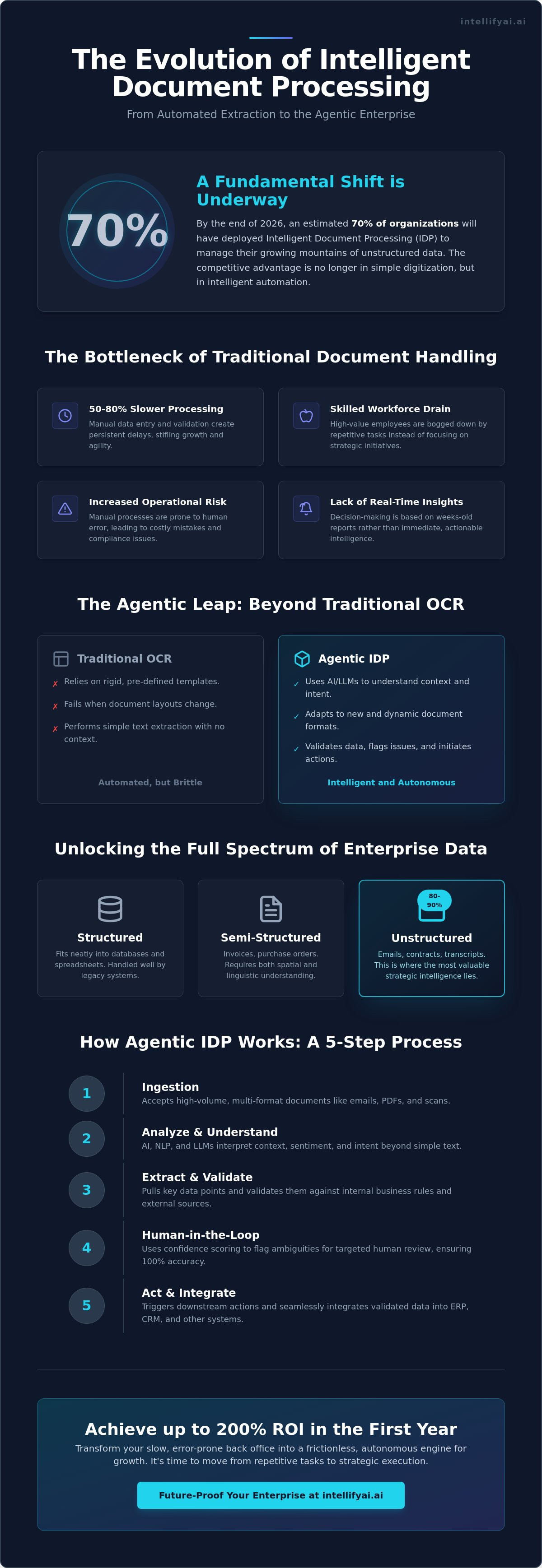
By the end of 2026, approximately 70% of organizations will have deployed intelligent document processing idp to manage their growing mountains of unstructured data. However, the true competitive advantage no longer lies in simple digitization. IDP has evolved into the sensory layer of the agentic enterprise, moving from basic OCR to systems that understand, reason, and act. You likely recognize the drain that manual data entry and document bottlenecks place on your operations. It's a persistent friction point that limits your team's ability to focus on high-value strategic initiatives.
Implementation costs vary based on document complexity, processing volume, and the depth of integration required. A custom solution tailored to unique business logic involves different investment levels than a standardized pilot. You should evaluate the total cost of ownership against the projected operational savings, and you can discover more about Project-based consulting and recurring service fees to determine the best financial approach for your rollout. Most enterprises focus on the long-term ROI rather than initial setup fees to ensure a sustainable automation strategy.
We agree that managing disconnected silos of PDFs and contracts shouldn't be a full-time job for your skilled workforce. This guide promises to show you how to transition from traditional extraction to autonomous workflows that deliver a first-year ROI of up to 200%. We'll examine the rise of agentic automation, navigate the strict requirements of the EU AI Act, and outline a future-proof AI strategy. You'll discover how to leverage these technological shifts to eliminate errors and build a scalable, frictionless back office that prioritizes growth over repetitive tasks.
Key Takeaways
• Understand the strategic shift from automated to agentic systems and how they serve as the sensory layer for the modern enterprise.
• Identify the technical limitations of traditional OCR and why intelligent document processing idp is essential for handling dynamic, unstructured data.
• Learn a precise framework for auditing high-friction workflows and defining a clear proof-of-value for your automation roadmap.
• Discover how natural language processing identifies intent and sentiment to transform raw documents into actionable intelligence.
• Explore how the i_Nova platform enables the scaling of enterprise intelligence while removing the burden of repetitive manual tasks.
What is Intelligent Document Processing (IDP) in the Agentic Era?
Intelligent document processing idp has moved beyond the simple conversion of physical paper into digital pixels. In 2026, the definition has expanded to represent the convergence of Artificial Intelligence, Optical Character Recognition (OCR), and Natural Language Processing (NLP). While previous iterations focused on "automated" extraction, the current era demands "intelligent" processing. This means systems no longer just read text; they understand the semantic intent behind it. This shift is critical for enterprises dealing with the 80-90% of new data that remains unstructured.
To better understand how these technologies work together, watch this helpful overview:
Traditional document automation relied heavily on rigid templates and basic OCR. If a vendor changed their invoice layout by a single centimeter, the system failed. Modern IDP eliminates this fragility by using Large Language Models to interpret context and intent. We call this "Agentic IDP." These systems don't just extract data; they validate it against external sources and initiate downstream actions, such as flagging a contract discrepancy or triggering a payment. This autonomy allows your team to stop acting as data entry clerks and start acting as strategic overseers.
The Three Pillars of Document Intelligence
Enterprise data typically exists in three states. Legacy systems handle structured data well, as it fits neatly into databases and spreadsheets. However, the real value lies in unstructured data, which includes emails, legal contracts, and meeting transcripts. This information is often the most valuable for risk assessment and strategic planning. Semi-structured data, such as invoices and purchase orders, sits in the middle. It requires both spatial awareness and linguistic understanding to process accurately without manual intervention.
Why IDP is Central to Enterprise Transformation
The manual processing of documents creates a persistent bottleneck that stifles growth and increases operational risk. High-volume environments often suffer from 50% to 80% slower processing times when humans remain in the loop for basic data entry. By deploying Agentic AI Engineering Services, businesses can transform these slow, error-prone tasks into frictionless workflows. This creates a composed, authoritative view of your entire data landscape. Leadership can finally make decisions based on real-time intelligence rather than weeks-old reports. Intelligent document processing idp serves as the essential bridge between raw, fragmented documents and high-level strategic execution.
How IDP Transforms Unstructured Data into Actionable Intelligence
Transformation begins at the point of ingestion. Modern intelligent document processing idp handles high-volume, multi-format inputs with surgical precision. It ingests emails, contracts, and transcripts, converting them into a standardized format for deep analysis. This isn't just about reading text. It's about preparing data for a reasoning engine that identifies intent and sentiment. By the time information reaches your ERP or CRM, it has already been validated against your internal business rules.
Accuracy remains the primary concern for serious enterprises. To address this, current systems use sophisticated confidence scoring. If the AI detects an ambiguity in a legal clause or a financial figure, it flags the item for a specific human review. This hybrid approach allows you to transform enterprise processes with IDP while maintaining 100% data integrity. The integration of intelligent document processing idp into your custom MLOps pipelines ensures that every document processed contributes to the long-term learning of your enterprise model.
The Role of LLMs and Generative AI in IDP
Generative AI has eliminated the need for rigid, brittle templates. In 2026, Large Language Models (LLMs) understand the nuances of language, allowing them to process documents that vary significantly in structure. These models handle the risk of hallucinations through multi-step validation and grounding against your proprietary datasets. For a deeper look at these technologies, read our guide on Generative AI enterprise applications. This shift allows the system to handle complex reasoning tasks that were previously impossible for software to manage.
From Extraction to Agentic Action
The most significant leap in 2026 is the move toward agentic workflows. An agentic system doesn't stop at extraction; it acts as an autonomous worker within your ecosystem. Consider these capabilities:
Autonomous Verification
Cross-referencing an incoming invoice against a purchase order and a delivery receipt without human intervention.
Proactive Compliance
Identifying a potential contract breach and automatically notifying the legal team while pausing related workflows.
Dynamic Routing
Analyzing the sentiment of a customer complaint and routing it to the appropriate executive with a drafted response.
Removing these manual checkpoints is a liberating force for your organization. It allows your staff to focus on high-value creative work rather than the burden of repetitive administrative tasks. If you're looking to implement these capabilities, our Agentic AI Engineering Services provide the technical expertise required to build these autonomous systems. This approach ensures your technology remains a lasting investment in your company's operational relevance.
Beyond OCR: Why Traditional Document Automation Fails the Modern Enterprise
Many executives believe they've already solved document management because they utilize Optical Character Recognition (OCR). This is a strategic misunderstanding. OCR is a vision technology; it simply recognizes shapes and converts them into text. It lacks the cognitive ability to understand what that text means within a business context. Relying on legacy OCR for high-stakes decisions is like hiring someone who can read a language but doesn't understand the words. This gap between recognition and comprehension is where intelligent document processing idp becomes indispensable.
Template-based systems are inherently brittle. They rely on fixed coordinates and rigid rules. If a vendor updates their layout or a scan is slightly skewed, the automation fails. These failures often result in "silent errors," where the system misidentifies a field but proceeds as if the data is correct. In a high-velocity enterprise, these inaccuracies compound. They lead to financial discrepancies and compliance risks that manual audits struggle to catch. Modernizing your infrastructure requires a move away from these fragile, legacy frameworks.
Legacy OCR vs. Agentic IDP: A Comparison
Template-driven vs. Context-aware
Legacy tools need a specific map for every document type. Agentic IDP uses reasoning to understand the document's purpose regardless of its layout.
Static data points vs. Dynamic intelligence
OCR extracts raw strings of text. IDP extracts meaning, identifying the complex relationships between entities, dates, and financial obligations.
Human-dependent vs. Human-in-the-loop (HITL)
Older systems stop entirely when they encounter an unknown format. Modern IDP manages the workflow autonomously, only involving human experts for high-level validation when confidence scores dip.
The Modernization Gap in Document Workflows
Legacy document management systems often act as data graveyards. They store images and text but keep the underlying intelligence locked away in disconnected silos. This fragmentation prevents you from building a cohesive AI strategy. Modernizing your stack requires viewing IDP as a foundational pillar of Enterprise Modernization. This transition ensures that every piece of data flowing through your organization is accessible, actionable, and ready for agentic execution. Template-based systems fail in 2026 because they cannot adapt to the fluid nature of modern unstructured data without constant, costly manual reconfiguration.
By closing this modernization gap, you transform your back office from a cost center into a source of competitive intelligence. You're no longer just storing documents; you're fueling a reasoning engine that scales with your business. This is the difference between simply digitizing a process and truly evolving it for the agentic era. Our Agentic AI Engineering Services help bridge this gap, ensuring your document workflows are resilient, scalable, and future-proof.
Implementing IDP: A Strategic Framework for 2026
Transitioning to intelligent document processing idp at an enterprise scale requires a departure from impulsive software purchasing. You need a structured, architectural approach that treats document intelligence as a central business pillar. This process begins with a comprehensive document audit to identify high-impact, high-friction workflows. Focus on areas where manual intervention creates the most significant drag on your operational velocity. Once these targets are identified, the next phase involves rigorous AI Strategy & Consulting to define a clear Proof-of-Value. This ensures that every technical implementation is anchored in measurable financial returns and long-term viability.
The engineering phase follows, where your team builds scalable, cloud-native pipelines. These aren't standalone tools; they're integrated components of your broader data ecosystem. High-velocity enterprises must also prioritize MLOps and continuous optimization. Document formats change and language evolves. Without a dedicated optimization layer, your model's performance will inevitably degrade. By maintaining a human-in-the-loop oversight model, you ensure that your autonomous workflows remain accurate and dependable over time. This collaborative relationship between technology and human workers is what allows for true enterprise modernization.
Choosing the Right IDP Partner
Selecting the right partner is a strategic decision that separates leaders from laggards. While off-the-shelf SaaS products offer quick setup, they often fail to handle the complexity of specialized enterprise documents. Custom AI engineering provides a level of precision and security that generic tools cannot match. This approach allows for deeper integration into your existing ERP and CRM systems, creating a frictionless flow of intelligence throughout the organization. If you're ready to modernize your back office, you can schedule a strategy session with our expert architects to discuss your specific requirements.
Risk Management and Compliance (GRC)
In 2026, compliance is the foundation of any AI implementation. The EU AI Act is now fully enforced as of August 2, 2026, with penalties for non-compliance reaching up to €35 million or 7% of global turnover. Additionally, the implementation of CIRCIA in May 2026 mandates strict incident reporting for critical infrastructure, requiring reports within 72 hours. Your intelligent document processing idp framework must incorporate robust GRC (Governance, Risk, and Compliance) features. This includes end-to-end encryption, detailed audit trails, and transparent version control. By prioritizing these ethical and legal considerations, you protect your enterprise's reputation while unlocking the liberating power of agentic automation.
i_Nova: Scaling Enterprise Intelligence with Agentic IDP
i_Nova represents the pinnacle of the agentic enterprise. It's not merely a piece of software; it's a flagship platform designed to orchestrate complex data environments. By leveraging advanced machine learning, i_Nova extracts actionable intelligence from the most chaotic unstructured data. It serves as a central nervous system for your information, transforming raw inputs into strategic assets. This goes far beyond the capabilities of entry-level tools. It provides the high-fidelity data foundation required to power Agentic AI Voice Agents and comprehensive back-office automation.
When you deploy i_Nova, you're installing a strategic architect for your data. It organizes, validates, and routes information with a level of precision that eliminates the need for manual oversight. This level of intelligent document processing idp ensures that your enterprise remains agile and data-driven. It bridges the gap between abstract technical potential and the practical, results-oriented execution your business demands. Every document processed becomes a building block for a more intelligent, autonomous organization.
Custom Engineering for Unique Business Challenges
Off-the-shelf SaaS products often fail when they encounter the specific nuances of your industry. Bespoke AI solutions are the only way to ensure long-term viability and relevance. Through our Agentic AI Engineering Services, we customize i_Nova to solve your unique business challenges. We systematically break down your specific document types and workflow requirements to build a custom implementation. The impact is measurable. Enterprises using these tailored solutions report significant gains in processing speed and employee satisfaction. By removing the burden of repetitive tasks, you allow your team to focus on high-value creative work that drives performance and financial returns.
Your Roadmap to a Frictionless Future
Advanced technology is a liberating force. It's not a replacement for human labor but a means for unlocking human potential. By automating the extraction and validation of complex documents, you create a frictionless future for your enterprise. You remove the bottlenecks that stifle growth and increase operational risk. This is a lasting investment in your company's relevance. The transition to an agentic model is a holistic philosophy that positions your business at the cutting edge of the industry.
Don't let manual document processing hold your organization back. The path to a modernized, autonomous back office starts with a clear strategic realization. Connect with our strategists to begin your IDP transformation and discover how intelligent document processing idp can scale your enterprise intelligence. Our approach ensures your technology remains a stable, secure, and highly productive asset for years to come.
Architecting a Frictionless Data Future
The transition from manual data entry to autonomous workflows is a strategic imperative for the modern enterprise. We've defined how intelligent document processing idp serves as the sensory foundation for the agentic era. By moving beyond the limitations of legacy OCR and embracing context-aware reasoning, your organization can finally unlock the value trapped in unstructured data silos. This evolution allows your workforce to step away from repetitive administration and focus on the high-value creative tasks that drive long-term performance.
Our flagship i_Nova platform is engineered to turn this vision into a practical reality. We combine deep expertise in Agentic AI and cloud-native modernization with a global presence across the UK, USA, India, and UAE. We don't just provide software; we act as your strategic partner in navigating the complexities of digital transformation. It's time to build a back office that operates with the velocity and precision your business demands. Modernize your enterprise workflows with i_Nova IDP. The future of your enterprise is autonomous, secure, and ready for scale.
Frequently Asked Questions
What is the difference between OCR and Intelligent Document Processing?
OCR is a vision technology that digitizes text, while IDP is a cognitive solution that interprets meaning. While OCR recognizes characters, IDP uses machine learning to extract specific data fields and understand the relationship between them. This allows the system to process unstructured documents like contracts or emails without relying on rigid templates. It transforms raw text into actionable intelligence for your enterprise.
How much does it cost to implement an IDP solution?
Implementation costs vary based on document complexity, processing volume, and the depth of integration required. A custom solution tailored to unique business logic involves different investment levels than a standardized pilot. You should evaluate the total cost of ownership against the projected operational savings. Most enterprises focus on the long-term ROI rather than initial setup fees to ensure a sustainable automation strategy.
Can IDP handle handwritten documents or low-quality scans?
Modern intelligent document processing idp handles handwriting and degraded scans with high accuracy through advanced computer vision models. These systems use noise reduction and enhancement algorithms to clarify text before extraction. While absolute accuracy on every scan isn't guaranteed, the system uses confidence scoring to flag difficult items for human review. This ensures that even suboptimal inputs don't break your automated workflows.
Is IDP secure enough for sensitive financial or legal documents?
IDP platforms are engineered with enterprise-grade security protocols, including end-to-end encryption and robust access controls. Compliance with regulations like GDPR and the EU AI Act is a standard feature of modern implementations. Detailed audit trails ensure every action is tracked and verifiable. These systems provide a more secure environment than manual processing, where human error and physical document handling pose higher risks.
How long does it take to see ROI from an IDP implementation?
Many organizations report a positive return on investment within the first 12 months of implementation. Some report first-year ROI between 30% and 200% depending on the scale of the deployment. The speed of these returns is driven by the immediate reduction in manual labor costs and the elimination of expensive data entry errors. As the system learns and optimizes, the financial benefits continue to compound over time.
What happens if the AI makes a mistake in data extraction?
When a system detects low confidence in an extraction, it routes the document to a human expert through a Human-in-the-loop interface. This collaborative relationship ensures that errors are caught before they enter your core databases. The system then learns from these manual corrections to improve its future performance. This feedback loop is essential for maintaining the high accuracy levels required for complex legal or financial tasks.
Does IDP require a complete overhaul of our existing IT infrastructure?
Implementing intelligent document processing idp doesn't require a complete infrastructure overhaul because most modern solutions are cloud-native and API-driven. These systems are designed to integrate seamlessly with your existing ERP, CRM, and legacy databases. You can modernize your document workflows incrementally, starting with high-impact areas before scaling across the enterprise. This modular approach minimizes operational disruption while delivering immediate efficiency gains.
How do I choose between an off-the-shelf IDP tool and a custom solution?
Off-the-shelf tools work well for standardized forms like basic invoices, but custom solutions are necessary for complex, unique document types. A custom implementation allows you to bake your specific business rules and proprietary logic directly into the extraction engine. This architectural choice is often the difference between a temporary fix and a lasting investment in your company's operational relevance. Custom engineering ensures the system scales with your specific strategic needs.







.svg)