
The rigid templates that once defined your automation strategy have now become the primary bottlenecks stifling your enterprise growth. Traditional OCR was designed for a predictable world. It lacks the agility required for the complex, unstructured data streams of 2026. If your system fails whenever a vendor adjusts an invoice layout or a claimant submits an email, you aren't truly automated. Adopting sophisticated ai for claims processing is the only way to move beyond fragile scripts and toward context-aware systems that adapt to change in real time.
You likely feel the strain of high manual verification costs and the fragility of systems that require constant patching. This article explains why these rigid limitations are a strategic liability, especially as 65 percent of insurers move toward scaling AI agents this year. You will discover how to transition to context-aware Intelligent Document Processing to build a resilient, autonomous workflow. We will outline the steps to reduce manual intervention and scale your processing capacity without increasing headcount, allowing your team to focus on high-value strategic execution.
Key Takeaways
• Identify the structural weaknesses of coordinate-dependent extraction and why minor document shifts lead to systemic automation failures.
• Quantify your "Automation Debt" to reveal the hidden financial impact of legacy systems that require constant manual correction and developer oversight.
• Discover how context-aware ai for claims processing eliminates scalability bottlenecks by accurately handling unstructured data from thousands of unique vendors.
• Execute a phased modernization plan that targets high-failure zones first to maximize immediate ROI and operational resilience.
• Explore how Agentic IDP platforms like i_Nova extract actionable intelligence rather than just raw text to drive truly autonomous decision-making.
Understanding Template-Based OCR: The Legacy of Rigid Claims Automation
Template-based Optical Character Recognition (OCR) served as the initial bridge between paper-heavy workflows and the digital era. For decades, it provided a necessary, albeit rigid, framework for digitizing claims. This method relies on Zonal OCR, a technique that extracts data based on static document geometry. It treats every document as a fixed map where information always resides in the exact same spot. While this was a breakthrough for early enterprise digitization, it lacks the cognitive flexibility required for modern operations.
To better understand how modern technology is moving beyond these rigid foundations, watch this helpful video:
How Coordinate-Based Extraction Works
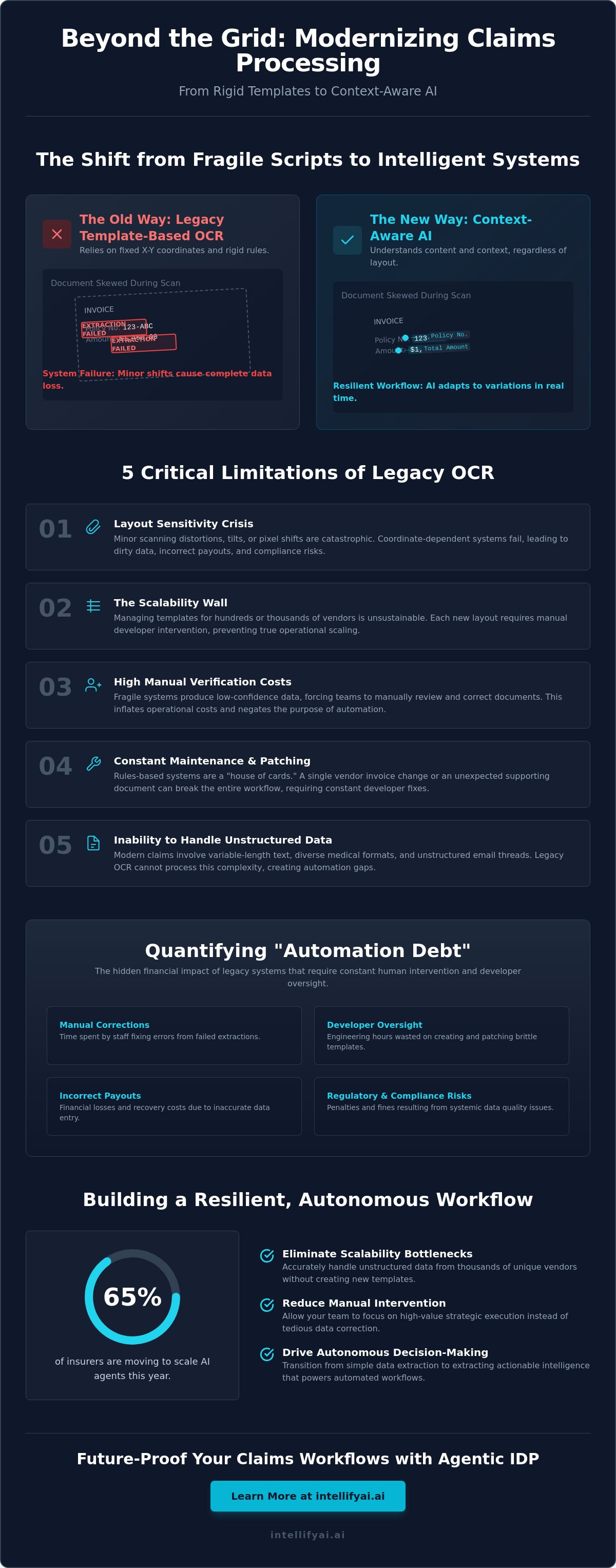
At its core, template-based systems function through X-Y coordinates. You define a "zone" on a page, such as a specific box for a policy number, and the software extracts whatever text lands in those coordinates. This process depends entirely on anchor points, such as logos or specific header lines, to orient the software. If a document is scanned at a slight angle or a vendor moves a table by just a few millimeters, the anchor points fail. The system effectively becomes "blind" because it doesn't understand the document's content; it only follows a geometric script. This is why many organizations are upgrading to Intelligent Character Recognition (ICR) and other context-aware technologies that interpret meaning rather than just mapping pixels.
The Fragility of Rules-Based Systems
Legacy OCR isn't just limited by physical layout; it's also bound by restrictive "if-then" logic. These rules-based systems are built like a house of cards. A single variation in a multi-page claim or the addition of an unexpected supporting document can cause the entire workflow to collapse. Modern insurance claims are rarely uniform. They include variable-length legal descriptions, diverse medical billing formats, and unstructured email threads. Rigid systems can't adapt to these natural evolutions. Every time a vendor updates their invoice format, a developer must manually rewrite the template rules.
This creates a cycle of constant maintenance that prevents true scalability. Transitioning to advanced ai for claims processing allows your system to understand the semantic context of a document. Instead of looking for a specific coordinate, the AI identifies a "Total Amount Due" because it understands the relationship between the words and the numbers, regardless of where they appear on the page. This shift from rigid rules to intelligent understanding is what separates legacy players from modern, resilient enterprises. Adopting ai for claims processing ensures your workflow remains functional even as your data sources evolve.
The 5 Critical Limitations of Legacy OCR in Modern Claims Processing
Legacy OCR systems act as rigid frames in an increasingly fluid data environment. While they served a purpose in early digitization, the inherent limitations of template-based OCR have become strategic liabilities. Enterprises now require more resilient ai for claims processing to overcome five critical failure points that stall growth and inflate costs.
The Layout Sensitivity Crisis
Minor scanning distortions are inevitable in high-volume environments. A slight tilt during paper feeding or a resolution change during a vendor's PDF export can shift document elements by a few pixels. For coordinate-dependent systems, this shift is catastrophic. It results in "dirty" data entering your ERP and CRM systems, often leading to incorrect payouts or regulatory compliance risks.
Layout sensitivity is the primary killer of legacy automation.
The Scalability Wall
Beyond physical mapping, legacy systems suffer from semantic blindness. They don't read; they map. If a vendor swaps the position of "Tax" and "Total Amount Due," a coordinate-based system extracts the wrong figure. It lacks the semantic intelligence to distinguish between financial terms based on meaning rather than location.
Templates thrive on boxes and lines but fail when faced with the "messy" data of modern insurance. Legal letters, adjustor emails, and handwritten medical reports have no static geometry to map. Without the ability to process unstructured data, your automation remains incomplete and reliant on human intervention.
Hidden within the budget is the high cost of maintenance intensity. You need a dedicated team to tune, update, and fix templates every time a document changes. This "automation debt" negates the very efficiency you sought to achieve. Strategic leaders are moving toward Agentic AI Engineering Services to replace these fragile scripts with autonomous intelligence. Implementing modern ai for claims processing ensures your workflow remains resilient even as your data sources grow more complex.
Quantifying Automation Debt: The Hidden Cost of Fragile Systems
Don't mistake a legacy OCR license for a one-time expense. It's a recurring tax on your operational speed. Automation debt represents the compounded liability built when enterprises rely on fragile, coordinate-dependent systems. Every manual fix and every hour developers spend re-mapping templates adds to this debt. Recent AI-driven claims processing research shows these methods struggle as document variety grows, leading to a Total Cost of Ownership (TCO) that often outpaces modern solutions.
Employees don't wait for a patch when automation fails. They turn to "Shadow IT," using unmanaged spreadsheets or manual workarounds to keep operations moving. This fragmentation hides your data history and raises security risks. Slow processing cycles also hit your bottom line through missed early-payment discounts and strained vendor trust. Moving to ai for claims processing isn't just a technical swap. It's a strategic move to clear your debt and free your team's creative energy.
The Maintenance Burden of Legacy Systems
Success in automation relies on the Straight-Through Processing (STP) rate. Legacy systems often hit a ceiling with STP rates between 10 and 15 percent, forcing a high "Verification Rate" where humans check nearly every page. This constant oversight causes automation fatigue. Workers become desensitized to errors when they have to fix the same layout failures repeatedly. High-performing ai for claims processing changes this dynamic, letting your staff focus only on complex exceptions rather than routine data entry.
Comparison: Template OCR vs. Intelligent Document Processing (IDP)
Modern IDP systems move from "data extraction" to "intelligence extraction." By understanding what is agentic ai, you can use workflows that adapt to document changes without human help. The table below shows the strategic gap between these two choices:
| Feature | Template-Based OCR | Agentic IDP |
|---|---|---|
| Accuracy | High (if layout is exact) | Superior (context-aware) |
| Setup Time | Weeks (per template) | Days (pre-trained models) |
| Maintenance | Constant manual tuning | Self-learning and adaptive |
| Flexibility | Rigid and fragile | Resilient to layout shifts |
Beyond Coordinates: A Strategic Roadmap for Claims Modernization
Transitioning from rigid templates to dynamic intelligence requires a disciplined framework. You cannot simply flip a switch; you must engineer a path that accounts for legacy constraints while building for future autonomy. Modernizing your approach to ai for claims processing involves a five step progression that moves beyond coordinates and into the realm of semantic understanding.
First, audit the automation debt you've accumulated. Identify the specific document types where manual intervention is highest. These high failure zones are your primary targets for replacement. Second, prioritize unstructured and high variance documents. These are the emails, legal letters, and medical reports where legacy OCR consistently fails. Third, implement a Human-in-the-loop framework. This ensures that every human correction feeds back into the system, allowing the model to learn and improve over time. Fourth, integrate with MLOps pipelines to monitor performance proactively. Finally, scale toward agentic workflows where the AI doesn't just extract data but makes preliminary decisions based on that information.
The Role of LLMs and Computer Vision
While computer vision has become a commodity, the true value lies in how you interpret visual data. Large Language Models provide the cognitive brain necessary for deep document understanding. They don't just see text; they comprehend intent. The synergy between generative ai and data extraction allows for a level of accuracy that was previously impossible. This combination enables the system to handle nuances like complex legal jargon and varying formats in claims documentation without needing a new template for every change.
Establishing an AI Strategy for Modernization
True modernization requires moving away from tactical patches toward a comprehensive enterprise ai strategy. This strategy must prioritize robust data engineering. High quality data is the fuel for Intelligent Document Processing models. Without clean, well structured data, even the most advanced AI will struggle to deliver measurable ROI. It's about building a foundation that supports long term viability rather than temporary fixes.
Selecting the right partner is critical. An experienced ai strategy consultant can help you navigate the technical complexities of integration while ensuring your roadmap aligns with long term business goals. This partnership bridges the gap between abstract technical potential and practical, bottom line results. By focusing on the collaborative relationship between technology and workers, you unlock human potential rather than just replacing labor. Implementing sophisticated ai for claims processing is the most direct path to a frictionless, automated future.
Ready to eliminate your automation debt and scale your operations? Partner with our Agentic AI Engineering team to build a resilient, context aware workflow.
Future-Proofing Claims Workflows with IntellifyAi i_Nova
i_Nova represents the definitive shift from rigid mapping to autonomous understanding. As an Agentic IDP platform, it completely eliminates the need for templates, allowing your enterprise to bypass the technical debt of the past. It doesn't just extract text; it identifies actionable intelligence within every claim. This capability ensures that your ai for claims processing functions as a cognitive asset rather than a fragile script. By integrating these capabilities with our Agentic AI Engineering Services, we build custom workflows that adapt to your unique business logic.
The i_Nova Advantage: Context Over Coordinates
Context is the only reliable anchor in a shifting document landscape. i_Nova handles 99% variance in document layouts with zero manual retraining. It processes unstructured data across global claims formats with the same precision it applies to standard forms. In large enterprise environments, this level of autonomy can reduce manual verification by up to 85%. This allows your skilled adjustors to move away from repetitive data entry and toward high-value decision-making. We treat your document workflow as a strategic architecture, not just a series of technical tasks.
Seamless Integration into Your AI Roadmap
Modernization is a journey, not a destination. IntellifyAi partners with leading firms to drive enterprise modernization by moving from cloud-native foundations to agentic intelligence. We implement custom MLOps pipelines to ensure your models remain reliable and compliant with emerging regulatory standards. This proactive monitoring guarantees long-term stability and a clear path to ROI. Stop managing templates and start scaling intelligence. Contact IntellifyAi for a Proof-of-Value (PoV) engagement today to see how modern ai for claims processing can transform your operations.
Mastering the Shift to Autonomous Intelligence
The transition from rigid, coordinate-dependent OCR to context-aware intelligence is no longer a tactical option; it's a strategic necessity for survival in 2026. You've seen how legacy templates accumulate automation debt and stifle your ability to scale. By prioritizing semantic understanding over physical mapping, you reclaim the operational velocity lost to manual verification. Implementing advanced ai for claims processing allows your enterprise to transform messy, unstructured data into a stream of actionable intelligence.
IntellifyAi stands as a global partner with a presence in the UK, USA, India, and the UAE. We are specialists in Agentic AI and Enterprise Modernization, dedicated to helping you build a resilient, future-proof workflow. Our i_Nova platform handles unstructured documents with over 90 percent accuracy, ensuring your automation remains dependable regardless of document variance. It's time to move beyond the fragility of templates and unlock the full potential of your workforce.
Explore the i_Nova IDP Platform and eliminate template maintenance today.
Embrace the liberating force of autonomous technology and focus your team on the high-value work that drives real financial returns. Your journey toward a frictionless future starts here.
Frequently Asked Questions
What is the main difference between template-based OCR and AI-driven IDP?
Template-based OCR relies on fixed geometric coordinates to find text, while AI-driven IDP uses semantic understanding to interpret document content. Traditional systems fail when a layout shifts by even a few pixels. IDP uses Large Language Models and computer vision to identify data points like policy numbers or claim amounts regardless of where they appear on the page. This shift from mapping pixels to understanding meaning is fundamental for modern enterprises.
Is template-based OCR still useful for any business use cases in 2026?
Template-based OCR remains effective only for high-volume, static documents that never change in format or layout. If you process thousands of identical forms from a single internal source, legacy systems can be cost-effective. However, for any external-facing workflow involving diverse vendors or claimants, the rigidity of templates becomes a significant operational bottleneck. Most businesses find that the maintenance costs for these systems quickly outweigh their initial value.
How much manual effort is required to maintain a legacy template-based system?
Legacy systems require constant manual intervention because every layout change necessitates a new template or rule update. Developers often spend dozens of hours per month simply fixing broken extraction paths for a mid-sized vendor list. This maintenance cycle prevents your technical team from focusing on strategic innovation. It keeps your straight-through processing rates low while increasing the burden on your administrative staff.
Can Intelligent Document Processing handle handwritten text or low-quality scans?
Yes, modern IDP platforms use advanced neural networks to accurately transcribe handwritten notes and interpret data from skewed or low-resolution scans. These systems analyze the context of surrounding text to fill in the gaps where a scan might be illegible to traditional OCR. This capability is essential for processing medical reports and field adjustor notes that are often submitted in non-standard formats.
What is "automation debt" and how does it affect my claims processing ROI?
Automation debt is the cumulative financial and technical cost of maintaining fragile, legacy systems that require frequent manual fixes. It erodes your ROI by forcing you to hire more verification staff as your volume grows. By shifting to ai for claims processing, you liquidate this debt. You transition to a system that scales without a proportional increase in headcount, protecting your long-term margins.
How long does it take to transition from legacy OCR to an IDP platform like i_Nova?
A typical transition to a sophisticated IDP platform can be completed in weeks rather than months. Because systems like i_Nova are pre-trained on diverse document types, they don't require the lengthy, template-by-template configuration of the past. Most enterprises start with a Proof-of-Value engagement to identify high-impact zones. This allows for a structured rollout that delivers measurable results almost immediately.
Do I need a dedicated data engineering team to implement AI document processing?
You don't need a massive internal team, but partnering with specialists in ai for claims processing ensures your data infrastructure is optimized. Our engineering services provide the necessary expertise to integrate IDP into your existing cloud-native environment. This collaborative approach allows your internal IT staff to maintain oversight without needing deep, niche expertise in model training or agentic architecture.
How does Agentic AI improve the accuracy of claims data extraction?
Agentic AI improves accuracy by acting as an autonomous reasoning layer that validates extracted data against known business rules. Instead of just pulling text, an agentic system can cross-reference an invoice amount with a policy limit or flag a date that precedes the incident. This self-correcting logic ensures that only high-confidence, verified data enters your downstream systems. It mimics the reasoning of a human adjustor at machine speed.









.svg)