
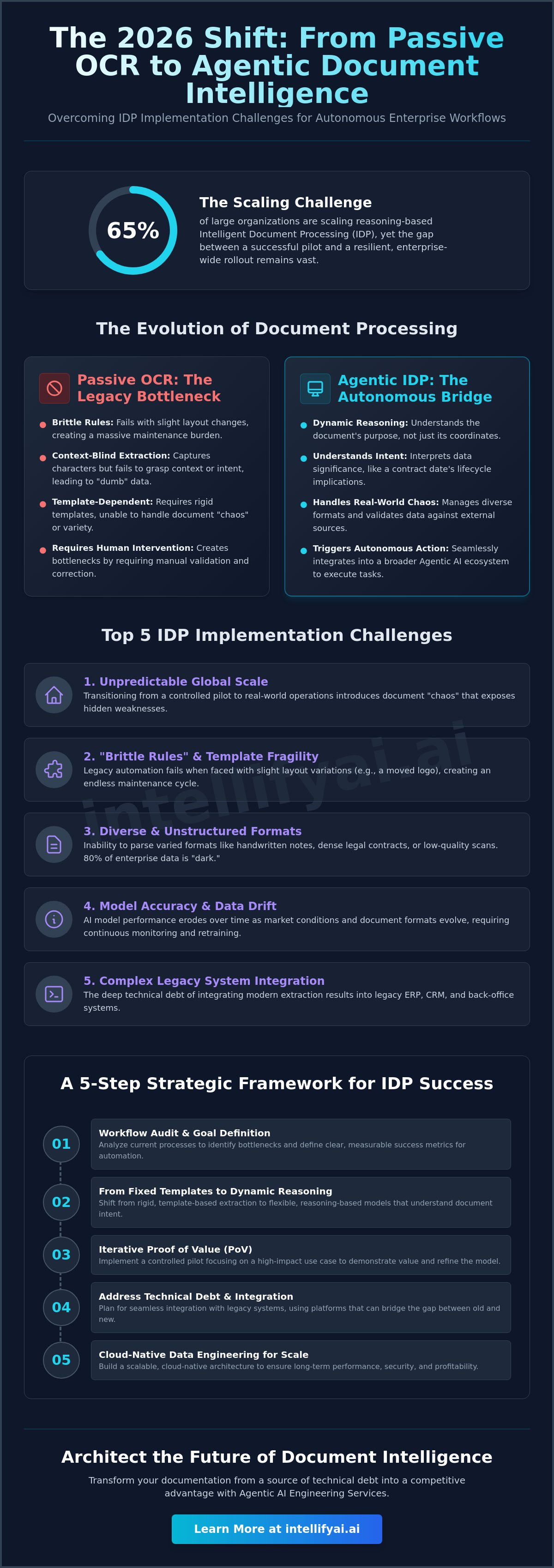
65% of large organizations are currently scaling reasoning-based IDP, yet the gap between a successful pilot and a resilient, enterprise-wide rollout remains vast. If you've struggled with high error rates in unstructured document processing or the weight of technical debt from legacy OCR, you're facing the modern reality of IDP implementation challenges. The primary hurdle in 2026 isn't just reading data. It's the transition from passive extraction to autonomous execution through Agentic Intelligence.
You already know that legacy ERP and CRM integrations shouldn't be a bottleneck for your digital evolution. This guide provides a strategic roadmap to overcome these structural obstacles and transform your documentation into a source of competitive advantage. We'll examine how Agentic AI Engineering Services and sophisticated data engineering can eliminate the cognitive burden on your team. You'll learn to build a scalable, autonomous workflow that integrates seamlessly into a broader Agentic AI ecosystem, ensuring your enterprise modernization remains both profitable and secure.
Key Takeaways
• Understand why traditional OCR is a legacy bottleneck and how modern Intelligent Document Processing acts as the critical bridge to autonomous action.
• Identify the core IDP implementation challenges that cause most projects to stall and learn how to overcome the "brittle rules" of old-generation automation.
• Discover the shift from fixed-template extraction to dynamic reasoning, enabling your systems to handle real-world document chaos without constant human intervention.
• Master a five-step strategic framework for success, moving from a workflow audit to cloud-native data engineering for long-term scalability.
• Explore how the i_Nova platform addresses deep technical debt to integrate document intelligence into a broader, high-performance Agentic AI ecosystem.
Defining IDP Implementation Challenges in the Agentic Era
In the 2026 enterprise ecosystem, Intelligent Document Processing (IDP) isn't just a digitization tool. It's the critical bridge between raw, unstructured data and autonomous business action. While many organizations view IDP implementation challenges as tactical software bugs, strategic architects recognize them as foundational hurdles to enterprise intelligence. Traditional OCR has become a legacy bottleneck. It captures characters but fails to grasp context, leaving businesses stranded with "dumb" data that requires manual intervention.
To better understand the friction points often encountered during these transitions, watch this helpful overview:
Modern implementation requires a shift in perspective. We must move toward "Agentic IDP," where documents trigger downstream business logic autonomously rather than just sitting in a database. This transition frames the technology not as a daunting complexity, but as a liberating force that allows your workforce to focus on high-value creative work by removing the burden of repetitive data entry.
The Acronym Overlap: Why Context Matters
In the corporate world, the acronym IDP often refers to Individual Development Plans within HR departments. For a Strategic Architect, this overlap can create internal confusion that stalls projects before they begin. Successful leaders must pivot the conversation toward "Document Intelligence" to ensure clarity across departments and avoid pilot purgatory. The focus has shifted from "reading" text to "reasoning" with it. Modern platforms don't just recognize a date; they understand its significance within a contract's lifecycle, ensuring your ROI remains grounded in performance.
The 2026 Shift: From Passive Extraction to Active Agency
The evolution into Agentic AI has transformed document processing into a decision-making engine. We've moved away from template-based systems that break at the slightest layout change. 2026 enterprises require multimodal reasoning that interprets intent, not just pixels. This model allows systems to handle document "chaos" by validating data against external sources and managing exceptions with minimal human oversight. Addressing IDP implementation challenges means building a system that doesn't just see a character, but understands a strategic command.
Top 5 IDP Implementation Challenges for Modern Enterprises
Transitioning from a successful Proof of Value (PoV) to a global production environment is the point of maximum friction for most organizations. While a pilot might succeed in a controlled setting, real-world operations introduce a level of document "chaos" that exposes IDP implementation challenges previously hidden. To scale effectively, enterprises must address five core friction points: the transition from controlled pilots to unpredictable global scale; the failure of "brittle rules" when faced with slight layout variations; the inability to parse diverse formats like handwritten notes or dense legal contracts; the erosion of model accuracy due to market-driven data drift; and the complexity of integrating extraction results into legacy back-office systems.
Traditional automation often relies on rigid templates. If a vendor moves a logo or a column shifts by a few pixels, the system fails. This fragility creates a massive maintenance burden for IT teams. Modern enterprises require a shift toward reasoning-based systems that understand the document's purpose rather than just its coordinates. By focusing on intent, businesses can overcome the structural hurdles that typically stall digital transformation projects. For those looking to refine their roadmap, engaging with AI strategy and consulting can provide the necessary architectural oversight to avoid these common pitfalls.
Industry data suggests that 80% of enterprise information remains "dark" and inaccessible to legacy systems. This data is trapped in complex multi-page documents, emails, and images that lack a standard structure. The difficulty lies in semantic understanding. A system must distinguish between a "billing address" and a "shipping address" across a thousand different invoice layouts. In 2026, the challenge is not capturing data, but capturing the strategic intent behind the data. Without this layer of intelligence, IDP remains a basic scanning tool rather than a driver of autonomy.
Legacy System Integration and Data Silos
The "Last-Mile" problem involves connecting high-accuracy extraction to existing ERP and CRM systems. Many IDP projects fail because they create new "AI silos" that don't communicate with the rest of the tech stack. Ensuring Enterprise Modernization requires cloud-native architectures that prioritize seamless data flow. If your IDP platform isn't integrated into a broader strategy, you're simply moving the bottleneck further down the line. Success requires a holistic approach where document intelligence feeds directly into your Agentic AI Engineering Services, allowing for truly autonomous enterprise workflows.
Passive OCR vs. Agentic IDP: Solving the Scale Test
Passive OCR is a legacy relic. It treats document processing as a simple translation of pixels to text, whereas Agentic IDP functions as a reasoning engine capable of understanding complex business logic. This distinction is vital for overcoming IDP implementation challenges at scale. Legacy automation thrives in sterile environments but collapses when exposed to the "chaos" of real-world document variability. When your system encounters a slanted scan, a coffee stain, or an unexpected font change, a passive system fails. An agentic system reasons through the noise.
Strategic Architects recognize that the scale test is where most projects falter. It isn't enough to process ten documents perfectly in a lab. You must process ten thousand documents across global jurisdictions with 98%+ accuracy. Achieving this requires a transition from the "Fixed Template" approach of the past to the "Dynamic Reasoning" of 2026. This evolution allows businesses to treat technology as a liberating force. It removes the friction of manual data entry and allows your team to focus on high-value, creative execution.
Why Rules-Based Automation Fails at Scale
The hidden cost of traditional automation is the persistent need for human-in-the-loop verification. When systems rely on fixed templates, even minor layout shifts trigger exceptions. This creates a manual bottleneck that negates the efficiency gains of the initial implementation. Modern multimodal LLMs eliminate this fragility. They remove the need for rigid pre-processing and template mapping. This shift from "low-code" configurations to "no-template" document intelligence allows enterprises to process high volumes of diverse data without increasing their cognitive burden. You don't need to map every field; the AI understands where the data lives based on context.
The Role of Multimodal LLMs in 2026 IDP
By 2026, AI has evolved to "see" documents as unified semantic data points. It understands how a chart relates to the surrounding text and the strategic intent of the overall layout. This capability is essential for processing sensitive financial or legal documents where "Contextual Governance" is non-negotiable. Agentic AI doesn't just extract data. It triggers autonomous workflows based on document sentiment or urgency. For example, a legal notice with a high-priority sentiment can trigger an immediate alert in your CRM while a standard invoice follows a routine path.
To maintain this level of performance over time, organizations must implement robust MLOps Pipelines. These pipelines ensure your models adapt to data drift and remain accurate as market conditions change. Without a structured pipeline, your IDP implementation challenges will only multiply as your data evolves. A disciplined MLOps strategy ensures long-term viability, positioning your document intelligence as a central, dependable pillar of your business operations.
The Strategic Roadmap: A 5-Step Framework for IDP Success
Modern IDP requires a rigorous architectural foundation to overcome common IDP implementation challenges. Success doesn't happen by accident; it demands a holistic philosophy that treats document intelligence as a central business pillar. By following a structured roadmap, enterprises can move from fragmented pilots to a scalable, autonomous ecosystem that delivers a return on investment within 3 to 6 months. Gartner predicts that by 2026, 80% of enterprises will have initiated platform engineering initiatives, and your IDP strategy must align with this shift toward standardized, self-service infrastructure.
Engineering for Data Sovereignty and Compliance
Security and compliance aren't late-stage gates; they're foundational design elements. To avoid rejection by security teams, your implementation must integrate automated guardrails from day one. The i_Nova platform is structured for SOC 2 Type II audit readiness, ensuring adherence to the highest data management standards. Addressing GDPR, SOX, and local data residency requirements is critical for global scalability. Without this oversight, IDP implementation challenges often manifest as security rejections or compliance failures. Engaging in AI Strategy Consulting allows you to navigate these regulatory hurdles while maintaining a high-velocity transformation.
FinOps: Managing the Cost of Intelligence
Managing cloud spend is a core requirement for large-scale document processing. Strategic Architects must pivot from "cost-per-page" metrics to "value-per-insight" calculations. Cloud-native modernization reduces long-term operational overhead by optimizing resource allocation and eliminating the technical debt of legacy systems. This financial discipline ensures your document intelligence remains a lasting investment in relevance. To ensure your infrastructure is built for this level of efficiency, contact our team for Agentic AI Engineering Services to begin your architectural audit.
Architecting the Future of Document Intelligence with IntellifyAi
IntellifyAi acts as the Strategic Architect for enterprises ready to transcend the limitations of legacy automation. We build the bridge between abstract technological potential and practical business execution. Addressing IDP implementation challenges isn't a one-time project. It's a fundamental modernization of your back-office operations. By replacing brittle, template-based systems with dynamic reasoning, we help you eliminate the technical debt that has historically hindered global growth. Our methodology treats advanced technology as a liberating force. We envision a frictionless future where your human experts are no longer burdened by repetitive document verification. Instead, they collaborate with autonomous systems to focus on high-value creative work.
This shift isn't just about tactical efficiency. It's about long-term viability in a market that rewards speed, accuracy, and data readiness. Most IDP projects fail because they lack an architectural vision that accounts for the scale and complexity of real-world data. We solve this by integrating document intelligence into the very core of your business strategy. This ensures that every extracted data point becomes a catalyst for autonomous action rather than another entry in a siloed database. We prioritize the stability and security of your operations while pushing the boundaries of what's possible with Agentic AI.
The i_Nova Advantage: Beyond Simple Extraction
The i_Nova platform is our flagship solution for Agentic IDP. It moves beyond simple character recognition to provide deep semantic understanding of complex multi-page documents. While competitors focus on tactical extraction, i_Nova enables decision-support systems that detect fraud, assess risk, and ensure compliance autonomously. This level of sophistication is essential for overcoming IDP implementation challenges in highly regulated industries. When combined with our custom Agentic AI Engineering Services, i_Nova transforms into a bespoke intelligence engine tailored to your specific operational needs. We operate as a Strategic Partner, ensuring your document intelligence evolves alongside your business requirements and market shifts.
Begin Your Transformation Journey
The transition from passive reading to autonomous execution is the defining shift of 2026. Leaders who embrace this change move beyond tactical fixes toward true strategic transformation. We invite you to initiate this evolution by scheduling a Proof of Value engagement. This process allows you to witness the measurable impact of our CX Improvement Framework and document intelligence on your bottom line. Visit the IntellifyAi Contact Page to begin a strategic consultation with our architects. Don’t just process documents; unlock the intelligence they hold.
Secure Your Position in the Autonomous Era
Resolving IDP implementation challenges requires a shift from passive data extraction to active, agentic reasoning. You've explored how a structured roadmap, grounded in data engineering and MLOps, transforms unstructured document chaos into a scalable asset. By moving beyond brittle legacy templates, your organization can finally unlock the strategic intent hidden within your dark data. This transition isn't just a technical upgrade; it's a commitment to long-term viability and human potential.
IntellifyAi stands as your Strategic Architect in this journey. We combine the power of our flagship i_Nova platform with global consulting expertise spanning the UK, USA, India, and UAE. Our deep technical mastery in Agentic AI Engineering Services ensures your enterprise modernization remains secure and profitable. We don't just implement software; we build the foundational pillars for your future growth. It's time to move from tactical fixes to a holistic philosophy of document intelligence.
Architect your enterprise IDP strategy with IntellifyAi today. Step into a future where technology works for you, leaving your team free to focus on high-value creative work.
Frequently Asked Questions
What is the primary difference between IDP and standard OCR in 2026?
Standard OCR is a legacy tool that merely converts pixels into characters without understanding their meaning. In 2026, Intelligent Document Processing (IDP) functions as a reasoning engine that interprets the strategic intent of a document. It uses Vision-Language Models to analyze layouts, context, and relationships between data points. While OCR provides raw text, IDP delivers actionable intelligence ready for autonomous execution.
How does IDP handle handwritten or low-quality document scans?
Modern IDP platforms utilize multimodal reasoning to reconstruct context from degraded or handwritten inputs. Instead of relying on rigid pixel matching, the system analyzes the surrounding text and document structure to infer missing or obscured information. This approach ensures high accuracy even with slanted scans or varied handwriting, significantly reducing the need for manual data correction in your back-office operations.
What are the most common reasons IDP implementations fail?
Most IDP implementation challenges arise from treating the project as a simple software installation rather than a strategic transformation. Failure often occurs when organizations underestimate change management or ignore data readiness before deployment. Success requires a holistic philosophy that integrates document extraction with downstream business logic, ensuring the system evolves as a continuous product rather than a one-time fix.
How does Agentic AI improve the ROI of document processing?
Agentic AI transforms IDP from a passive capture tool into an active decision-making engine. By triggering autonomous workflows based on document content, it eliminates the "Last-Mile" integration gap found in legacy systems. This acceleration of cycle times and reduction in cognitive burden typically allows enterprises to achieve a full return on investment within 3 to 6 months of deployment.
Is IDP secure enough for highly regulated industries like finance and legal?
Yes, enterprise-grade platforms are engineered with foundational security and automated guardrails. The i_Nova platform, for example, is structured for SOC 2 Type II audit readiness and maintains strict GDPR alignment. These systems include PII redaction and data residency controls, ensuring that sensitive financial and legal data remains secure while meeting the highest global compliance standards.
How long does a typical enterprise IDP implementation take?
A strategic Proof of Value (PoV) typically requires 4 to 8 weeks to demonstrate core technical viability. Moving to a full-scale global rollout depends on the complexity of your existing data engineering and the maturity of your cloud-native infrastructure. We prioritize a layered approach, starting with high-impact use cases to ensure rapid delivery of value while building toward long-term enterprise modernization.
Does IDP require a "human-in-the-loop" for every transaction?
Human oversight is a crucial feature for trust and accountability, but it's not required for every transaction. Modern IDP systems achieve 98%+ accuracy, allowing for high-velocity automation of routine documents. Human experts only intervene when the system identifies high-complexity exceptions or sensitive edge cases. This collaboration allows your workforce to focus on high-value creative work instead of repetitive data entry.
Can IDP platforms integrate with legacy on-premise systems?
Strategic Architects use cloud-native bridges to connect modern IDP intelligence with legacy on-premise ERP and CRM systems. This architectural approach allows you to overcome IDP implementation challenges related to technical debt without requiring a total system overhaul. By creating a seamless data flow between old and new infrastructure, you can modernize your operations while preserving the stability of your core records.








.svg)