By 2026, relying on traditional optical character recognition to power your enterprise is like using a paper map to navigate a smart city. You've likely experienced the frustration of high error rates in manual data entry despite your current tools, or found your teams buried in unstructured emails and complex contracts that your systems simply can't read. The core of the ocr vs idp technology debate has shifted from simple digitisation to the necessity of cognitive understanding.
We'll demonstrate why legacy OCR is no longer sufficient and how Intelligent Document Processing (IDP) provides the foundational intelligence required for autonomous enterprise workflows. You'll learn how to transition from raw text extraction to actionable intelligence while maintaining compliance with new regulations like the Colorado AI Act and the EU AI Act. This guide breaks down the move toward agentic IDP and shows you how to integrate these systems into a broader AI strategy that can reduce operational costs by an average of 24% within the first year.
Key Takeaways
• Identify the critical transition from basic text capture to document intelligence, where IDP serves as the cognitive bridge between raw data and enterprise action.
• Utilize a strategic decision matrix to resolve the ocr vs idp technology dilemma by evaluating document volume, variety, and the total cost of manual correction.
• Leverage Deep Learning and Natural Language Understanding (NLU) to move beyond rigid templates and unlock data from unstructured emails and complex contracts.
• Position document processing as the essential sensory input for Agentic AI ecosystems, enabling autonomous workflows that go beyond simple automation.
• Transform document streams into actionable intelligence with platforms like i_Nova, shifting focus from mere data extraction to high-value strategic execution.
Decoding the Shift: From Basic Text Capture to Document Intelligence
For decades, businesses viewed digitisation as a binary state. A document was either paper or a PDF. In 2026, the mere existence of machine-readable text is no longer a competitive advantage. It's the baseline. The true differentiator lies in the transition from simple capture to document intelligence. Enterprises are moving beyond the basic ocr vs idp technology comparison to understand how data flows into autonomous workflows. This shift is a core pillar of enterprise modernization; it turns static records into dynamic assets that fuel growth.
What is OCR in the Modern Context?
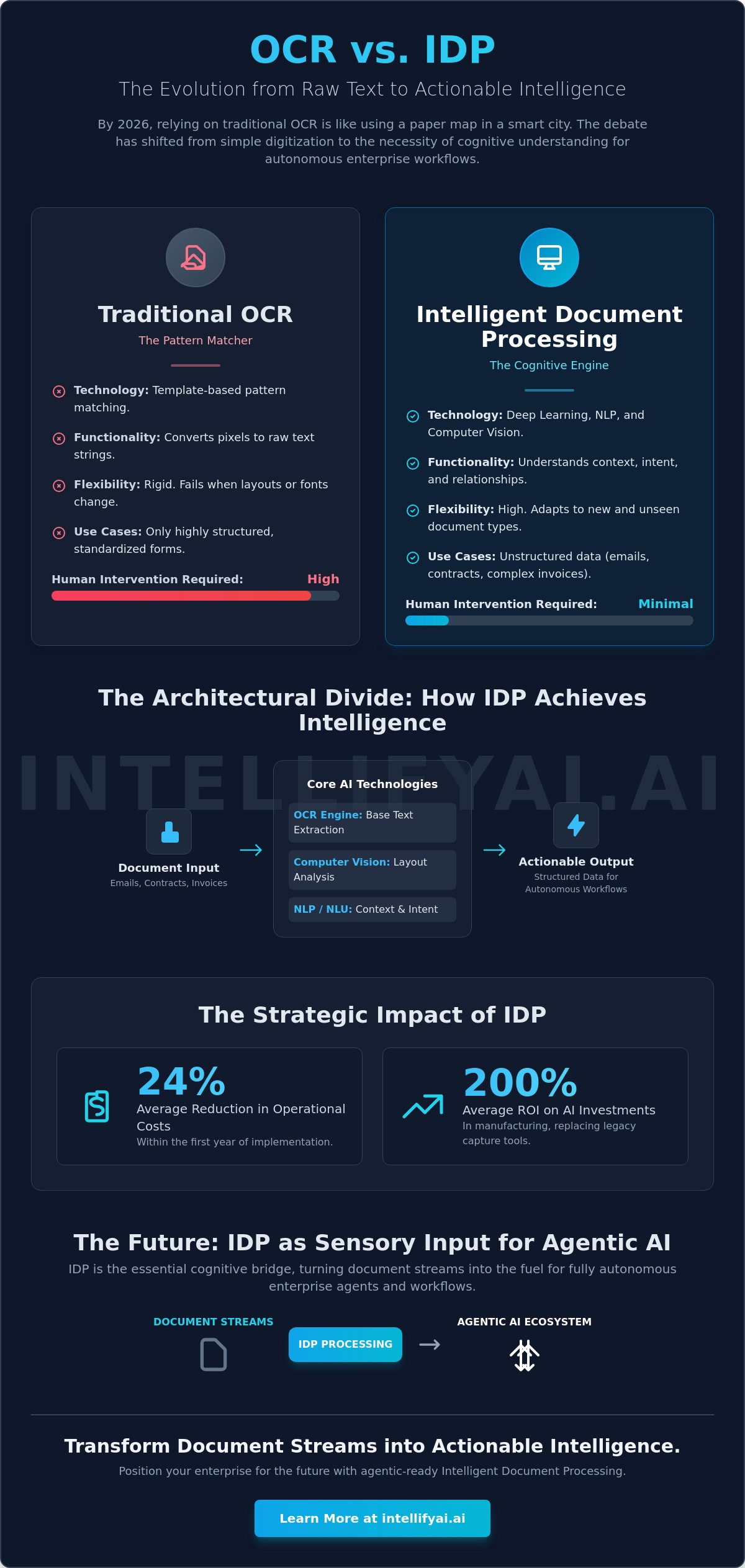
Optical Character Recognition (OCR) is essentially a pattern-matching exercise. It converts pixels into machine-readable characters. It's reliable for structured forms like tax returns or standardized invoices where the layout never changes. However, it's inherently rigid. If a vendor moves a date field or changes a font, template-based OCR systems often fail. They provide the "what" but lack the "why." In a dynamic business environment, relying solely on OCR creates data silos. It forces your teams to manually verify and correct errors. This creates a bottleneck that limits scalability. OCR remains a necessary component of the digitisation stack, but it isn't a standalone solution for modern workflows.
The Rise of Intelligent Document Processing (IDP)
IDP is different. It doesn't just read letters; it understands intent. By integrating OCR with Computer Vision and Natural Language Processing (NLP), IDP platforms interpret unstructured data like legal contracts or sentiment-heavy emails. This represents the critical move from character recognition to contextual understanding. For example, while OCR sees the word "Total," IDP understands if that total refers to a balance due, a tax amount, or a historical credit. This intelligence is a prerequisite for high-velocity digital transformation. It allows systems to take the next logical action autonomously. By 2026, the ocr vs idp technology debate has evolved into a choice between manual oversight and system autonomy.
The manufacturing sector already sees an average 200% ROI on AI investments. Much of this comes from replacing legacy capture tools with intelligent systems. Serious enterprises don't want raw text. They want actionable intelligence. They want to eliminate the operational overhead that plagues traditional back-office functions. Moving toward IDP isn't just a technical upgrade. It's a strategic realization that data is only as valuable as the actions it enables.
The Architectural Divide: How IDP Transcends Pattern Recognition
Understanding the fundamental difference between legacy systems and modern intelligence requires a look at the underlying architecture. Traditional OCR relies on template matching; it looks for text in specific coordinates. If a document deviates by even a few millimeters, the system fails. In contrast, Intelligent Document Processing (IDP) utilizes Deep Learning models that recognize document components regardless of their position. This architectural shift is why the ocr vs idp technology discussion is central to any serious digitisation strategy in 2026.
Natural Language Understanding (NLU) provides the brain for this operation. It allows the system to process unstructured data like emails or multi-page contracts without manual reconfiguration. Instead of searching for a "Date" field in the top right corner, IDP identifies the semantic meaning of dates within a paragraph. This flexibility eliminates the need for thousands of static templates. For enterprises with high document variability, Agentic AI engineering services are essential to fine-tune these models for industry-specific jargon and unique business logic.
Beyond Characters: The Power of Context
IDP doesn't just read; it interprets. It identifies entities like "Buyer" and "Seller," recognizes the relationships between them, and understands the intent of a clause. This moves the workflow from simple text capture to a sophisticated interpretation of business rules. IDP acts as a cognitive layer that mimics human comprehension by synthesizing visual, textual, and logical cues simultaneously. Leaders looking to modernize their back-office operations should consider how AI strategy and consulting can align these capabilities with their specific growth targets.
Generative AI and LLMs in Document Processing
The integration of Large Language Models (LLMs) has revolutionized document processing in 2026. We've moved into the era of zero-shot extraction, where IDP systems can pull data from document types they've never seen before. This significantly reduces the training data requirements that once made IDP deployments slow. However, speed doesn't replace the need for precision. Accuracy is maintained through robust MLOps pipelines and human-in-the-loop (HITL) validation. These frameworks ensure that while the AI handles the bulk of the labor, human experts remain the final authority on complex exceptions. This collaborative approach ensures long-term viability and trust in automated decisions.
Strategic Evaluation: Determining ROI for OCR vs. IDP Investments
Deciding between ocr vs idp technology is a financial calculation that goes beyond software licensing. To build a resilient enterprise, executives must evaluate their document pipelines through a decision matrix focused on volume, variety, and velocity. While legacy OCR might appear cost-effective on a per-page basis, it often carries a heavy "OCR tax" in the form of manual validation and downstream process friction. To forecast a realistic return, leaders need a transparent view of the Total Cost of Ownership (TCO). This calculation must include the price of errors that slip through template-based systems. Engaging in AI strategy and consulting allows for an accurate ROI projection that accounts for these hidden operational drains.
Industry data supports this shift toward intelligence. According to a 2026 Deloitte outlook, 98% of manufacturers are exploring AI, but only 20% feel ready to deploy it at scale. This gap often stems from a lack of foundational data quality. Research from IBM highlights AI's role in advanced document understanding as the catalyst for closing this gap. By transforming raw text into structured, verified data, IDP creates the high-quality inputs required for broader automation initiatives.
Structured vs. Unstructured Data: The Tipping Point
OCR is often sufficient for processing high-contrast, standardized forms where the layout is fixed, such as government IDs or specific tax documents. However, IDP becomes mandatory the moment you encounter invoices, legal contracts, or handwritten notes. Choosing a cheaper OCR solution for complex, variable documents is a false economy. The initial savings on software licenses are quickly erased by the salaries of human workers required to fix extraction failures. In 2026, the complexity of global supply chains and regulatory environments makes the ability to handle unstructured data a non-negotiable requirement for growth.
Measurable Business Outcomes
Success in document transformation is measured by specific, actionable KPIs. While extraction accuracy is the baseline, the real value lies in Straight-Through Processing (STP) rates and cycle time reduction. Companies report an average 24% reduction in operational costs within the first year of implementing automated document processing. Beyond the balance sheet, IDP fuels a better CX improvement framework by accelerating back-office response times. A faster document approval process directly translates to a more responsive customer experience. This creates a virtuous cycle where efficiency drives loyalty and long-term scalability.
Modernizing the Workflow: Integrating IDP into Agentic AI Ecosystems
Static automation is a relic of the past. In 2026, the most significant trend is the move from simple data extraction to Agentic AI. Within this context, the ocr vs idp technology debate reaches its logical conclusion. IDP serves as the critical sensory input for autonomous AI agents. While OCR merely records characters, IDP provides the structured, contextual data these agents need to reason and act. This integration requires a robust foundation of Cloud-Native & Enterprise Modernization to handle the high-velocity data streams typical of modern global enterprises.
Building a frictionless bridge between data extraction and business execution is no longer a luxury. It's a strategic necessity. When your document processing is integrated into an agentic workflow, you move from "reading" a document to "resolving" a business challenge. This shift allows your teams to focus on high-value creative work by removing the burden of repetitive administrative tasks. Modernize your operations today with our Agentic AI Engineering Services to turn document data into autonomous action.
From Extraction to Execution
AI agents use IDP data to trigger downstream API calls and make real-time decisions. Consider the transformation of a standard insurance claims process. In an agentic ecosystem, the workflow follows a logical, autonomous path:
Input
IDP extracts data from damage photos, medical reports, and policy documents.
Reasoning
An AI agent compares the extracted data against policy terms and historical fraud patterns.
Action
The agent autonomously approves the claim, initiates the payment via API, and notifies the customer.
This model reduces human intervention to handling complex exceptions rather than the rule. It accelerates cycle times from days to seconds, providing a massive boost to operational performance.
Governance and Security in the AI Era
As IDP systems become more autonomous, governance becomes your top priority. The regulatory landscape in 2026 is rigorous. The Colorado AI Act, effective June 30, 2026, and the EU AI Act, with high-risk obligations starting August 2, 2026, demand documented risk assessments and ongoing monitoring. Implementing IDP within a cloud-native framework ensures you have the version control and audit trails necessary for compliance. Transparent, auditable AI decision-making isn't just about following the law; it's about building long-term trust with your stakeholders. Secure, scalable IDP pipelines allow you to innovate while maintaining the stability of your core operations.
Beyond Extraction: Achieving Autonomous Intelligence with i_Nova
The strategic transition from legacy systems to autonomous intelligence requires a platform built for the complexities of 2026. Choosing between ocr vs idp technology is no longer just about reading text. It's about empowering your enterprise to act. i_Nova, IntellifyAi's flagship Intelligent Document Processing platform, represents this shift. It moves beyond simple extraction to provide the multi-format intelligence necessary for high-performance operations. This engine turns static documents into the lifeblood of your autonomous workflows.
The i_Nova Advantage
Modern enterprises operate at a scale that breaks traditional tools. i_Nova is engineered to handle millions of documents across global operations without sacrificing precision. It doesn't just return text strings; it delivers actionable insights that feed directly into your decision-making engines. By leveraging our Agentic AI Engineering Services, i_Nova seamlessly connects with your existing enterprise tech stack. This creates a unified data environment that eliminates silos and accelerates growth. The result is a frictionless bridge between raw information and strategic execution.
Your Roadmap to IDP Success
Transformation is a journey, not a single event. We partner with serious enterprises to ensure a phased implementation that prioritizes stability and security. This begins with a focused Proof-of-Value (PoV) to demonstrate immediate impact before moving to an enterprise-scale deployment. Our AI Strategy & Consulting team ensures that your document transformation remains aligned with your long-term financial returns. We don't just sell software; we architect the future of your back-office operations.
Continuous optimization is the final piece of the puzzle. The document landscape is constantly evolving. Managed AI services provide the ongoing model monitoring and refinement needed to maintain high Straight-Through Processing rates. This ensures your investment remains relevant as new document types and regulations emerge. Don't let legacy digitisation tools anchor your company to the past. Connect with a strategist at IntellifyAi to build a frictionless, automated future for your enterprise.
Architecting the Autonomous Enterprise
The choice between ocr vs idp technology is a defining factor for any enterprise aiming for true autonomy in 2026. While legacy tools merely capture text, Intelligent Document Processing interprets business logic. This transition represents the difference between static data silos and a high-velocity, agentic ecosystem. You've explored the architectural necessity of Natural Language Understanding and the measurable impact of straight-through processing. Now, it's time to execute your transformation.
IntellifyAi provides the bridge between your current legacy constraints and a frictionless future. Through our strategic AI consulting and global expertise in Agentic AI engineering, we help you secure a measurable ROI while maintaining strict regulatory compliance. Our i_Nova platform offers the multi-format intelligence required to turn complex documents into actionable assets across your entire organization. We position technology as a liberating force, removing the burden of repetitive tasks to unlock your team's creative potential.
Explore the i_Nova IDP Platform and Transform Your Enterprise Workflows
Step into the era of document intelligence and liberate your teams to focus on the high-value work that truly drives your business forward. We look forward to partnering with you on this journey toward a more efficient, automated future.
Frequently Asked Questions
Is IDP just a newer version of OCR?
No. IDP is a distinct technology stack that incorporates OCR as a foundational element. It moves beyond character recognition to provide contextual understanding through Natural Language Processing and Deep Learning. While OCR captures text, IDP interprets business intent. This allows the system to classify documents and extract data based on meaning rather than just physical coordinates on a page.
How much does IDP technology cost compared to traditional OCR?
IDP generally requires a higher upfront investment than basic OCR but delivers a superior long-term ROI. You must weigh the lower cost of OCR licenses against the high operational expense of manual data correction. IDP reduces these hidden costs by achieving higher straight-through processing rates. Most enterprises find that the reduction in manual labor costs quickly offsets the initial implementation price.
Can IDP process handwritten documents and low-quality scans?
Modern IDP platforms excel at processing handwritten notes and degraded scans. Advanced Intelligent Character Recognition (ICR) can achieve up to 99.85% accuracy on handwriting as of 2026. These systems use neural networks to infer missing data in low-quality documents. This capability allows businesses to digitise historical records or field notes that would otherwise require manual entry.
What is the typical implementation time for an enterprise IDP platform?
Enterprise implementation occurs in stages to ensure stability and accuracy. A Proof-of-Value typically takes 4 to 6 weeks to validate specific use cases. Full integration into your global tech stack often requires 3 to 6 months. This timeline ensures that all compliance frameworks and governance protocols are fully operational before the system handles live production volumes at scale.
How does IDP improve data security and regulatory compliance?
IDP enhances compliance by providing granular control over data access and automated audit trails. This is essential for navigating the Colorado AI Act and the EU AI Act. These systems ensure that every automated decision is traceable back to its source document. By automating sensitive data redaction, IDP also reduces the risk of human exposure to PII during the processing phase.
Do I need data scientists to manage an IDP solution like i_Nova?
You don't need a team of data scientists to manage i_Nova on a daily basis. The rise of "citizen automators" allows non-technical users to configure and adjust workflows using natural language interfaces. While initial setup benefits from expert engineering, the platform is designed for ease of use. This allows your business analysts to maintain the system as your document types evolve.
What industries benefit most from the OCR vs IDP transition?
Finance, manufacturing, and healthcare see the most significant impact from the ocr vs idp technology shift. Manufacturing enterprises report an average 200% ROI on AI investments. These industries rely on complex, unstructured documents where basic OCR is insufficient. Moving to IDP allows these sectors to maintain competitive speed while handling rigorous global compliance and supply chain documentation.
How does IDP integrate with existing RPA or ERP systems?
IDP integrates through robust APIs that serve as the cognitive bridge to your existing systems. It converts document data into structured formats that RPA bots or ERP modules can immediately process. This eliminates the friction between data capture and back-office execution. By providing verified, high-quality data, IDP prevents the "garbage in, garbage out" problem that often plagues basic automation stacks.







.svg)