What if your enterprise AI could sense a market shift and pivot your entire supply chain before a human even read the morning report? In 2026, the competitive divide isn't defined by who has the best model; it's defined by who has the fastest pulse. Relying on stale data for modern LLMs leads to hallucinations and crippling latency in voice and chat agents. To move beyond these bottlenecks, organizations must transition to robust real-time data processing for AI. This isn't just an infrastructure upgrade. It's the creation of a digital nervous system that allows your business to react and scale autonomously.
You likely recognize that your current batch-processing legacy systems can't keep pace with the demands of modern Agentic AI. This guide provides the blueprint to bridge that gap by architecting pipelines that prioritize immediacy and financial efficiency. You'll master the strategic implementation of streaming architectures like Kafka 4.3.1 to eliminate decision-latency. We'll explore how to transition from a store-then-analyze mindset to an analyze-and-act reality, ensuring your AI agents remain grounded in the present and ready for truly autonomous workflows.
Key Takeaways
• Identify the "Value-at-Latency" within your organization to prioritize investments where speed generates the highest operational ROI.
• Master the architectural pillars of real-time data processing for AI to eliminate hallucinations and ensure your models operate on the most current information.
• Transition from reactive systems to Source-Intelligent agents that monitor data at the origin for instant, autonomous responses to market changes.
• Audit your existing data engineering debt to prepare for a cloud-native modernization that supports high-velocity streaming and agentic workflows.
• Leverage the i_Nova platform to integrate real-time unstructured data into your AI strategy, turning document intelligence into a competitive advantage.
The Latency Crisis: Why Static Data Is AI’s Weakest Link in 2026
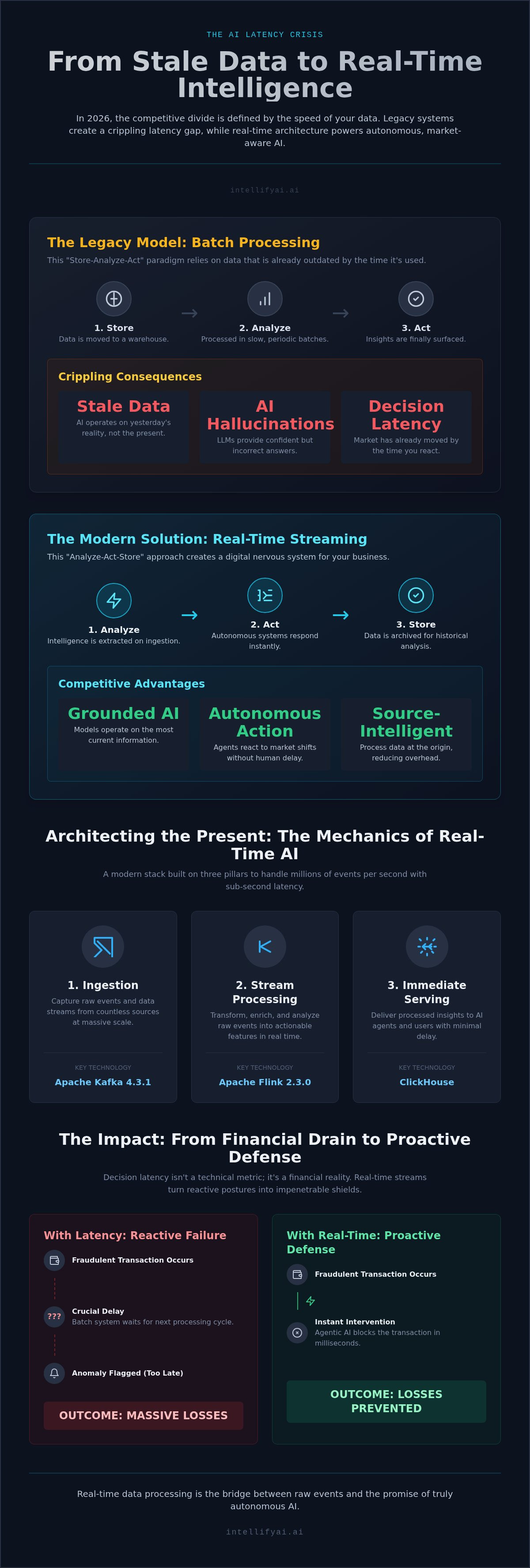
In the high-velocity environment of 2026, data is a perishable asset. Many enterprises still operate on a "Store-Analyze-Act" model. This legacy paradigm moves data into a warehouse, processes it in batches, and eventually surfaces insights. By the time an AI model consumes this information, the market has already moved. Real-time data processing for AI flips this script. It adopts an "Analyze-Act-Store" approach. This methodology ensures intelligence is extracted at the moment of ingestion, allowing systems to respond while the data is still relevant.
Stale data is the primary driver of AI hallucinations. When an LLM relies on 24-hour-old inventory or pricing data, it provides confident but incorrect answers. Research from IBM suggests that nearly 80% of companies are still struggling with data that lacks immediacy. This creates a competitive vacuum. While your AI is hallucinating based on yesterday's reality, your competitors are using live streams to capture market share. In 2026, the risk of using outdated information isn't just a loss in efficiency; it's a failure of the autonomous promise.
The True Cost of Decision Latency
Decision latency isn't just a technical metric; it's a financial drain that erodes customer experience (CX). High latency in customer-facing voice agents leads to abandonment and brand erosion. For advanced systems, real-time data processing for AI is the essential prerequisite for Agentic AI. These autonomous agents require a constant pulse of fresh data to function without human oversight. Consider fraud prevention as a primary example. A delay of just a few milliseconds in refreshing transaction data can result in massive losses before a legacy system even flags the anomaly. Real-time streams allow for instant intervention, turning a reactive security posture into an impenetrable shield.
From Reactive to Proactive: The AI Evolution
Moving toward a proactive stance requires a fundamental shift in architecture. Real-time computing principles must be integrated into the data core to support modern workloads. This "Source-Intelligent" architecture processes information at the point of origin, reducing the overhead of moving massive datasets across cloud environments. It transforms AI from a tool that explains what happened into a workforce that predicts what will happen. Real-time data processing for AI is the bridge between raw events and autonomous reasoning. By enabling AI to anticipate market shifts or supply chain disruptions before they manifest, enterprises can maintain a state of constant readiness. This evolution allows your human workers to focus on high-value creative work while the system manages the burden of repetitive monitoring.
Architecting the Present: The Mechanics of Real-Time Data Processing
Building a robust infrastructure for real-time data processing for AI requires a three-pillared approach: ingestion, stream processing, and immediate serving. In 2026, the architectural standard has shifted toward systems that can handle millions of events per second with sub-second latency. Modern ingestion layers utilize Apache Kafka 4.3.1, which has moved away from ZooKeeper in favor of KRaft to simplify operations and improve scalability. Once data is ingested, stream processing engines like Apache Flink 2.3.0 transform raw events into actionable features. High-performance databases like ClickHouse then serve these insights to AI agents and end-users with minimal delay. This stack allows enterprises to manage high concurrency, serving real-time intelligence to thousands of users simultaneously without performance degradation.
Event-driven triggers have become the backbone of this architecture. By utilizing serverless functions like AWS Lambda, organizations can trigger AI workflows the moment a specific data signal is detected. This eliminates the need for constant polling and reduces operational overhead. When these components are synchronized, the system moves from a collection of static tools to a living, breathing digital organism.
Stream Processing vs. Batch Processing
The distinction between stream and batch processing is no longer just about speed; it's about architectural survival. While batch processing remains cost-effective for historical analysis and long-term trend mapping, it fails to meet the 2026 requirement for instantaneous response. Micro-batching, once a popular middle ground, is now insufficient for high-velocity enterprise workflows because it introduces a forced delay that breaks the chain of autonomous reasoning. Change Data Capture (CDC) has emerged as the vital bridge here. It allows legacy databases to stream updates directly into AI models, ensuring that even traditional systems contribute to real-time data processing pipelines.
Latency
Stream (milliseconds) vs. Batch (hours or days).
Cost
Stream (higher operational investment) vs. Batch (optimized for storage economy).
Complexity
Stream (high architectural demand) vs. Batch (established, lower complexity).
Primary Use Case
Stream (fraud detection, voice agents) vs. Batch (quarterly financial reporting).
Ensuring Data Freshness with MLOps
Integrating real-time streams into enterprise MLOps pipelines is mandatory for maintaining model reliability. Without rigorous version control and data lineage, streaming environments quickly become chaotic and difficult to audit. End-to-End Latency is the critical KPI for AI reliability, measuring the total time from event generation to autonomous action. If you're looking to modernize your stack, our AI strategy consulting can help align your architecture with these high-velocity standards. This ensures your human workers are empowered by technology that is as current as the markets they serve.
The Agentic Advantage: How Real-Time Streams Power Autonomous AI
The evolution from reactive dashboards to autonomous agents hinges on the integration of "Source-Intelligent" logic. These agents don't wait for data to be deposited into a warehouse; they monitor streams at the origin. This shift is fundamental for real-time data processing for AI, as it allows the agent to observe, orient, and act within the same event loop. When an agent is source-intelligent, it can perform Retrieval-Augmented Generation (RAG) using up-to-the-second context. This prevents the knowledge cutoff problem inherent in static models, providing the LLM with a live feed of truth. It's the difference between an AI that remembers what happened last month and one that understands what's happening right now.
Autonomous agents also gain the ability to self-correct. If a workflow is in progress and a live data stream indicates a change, such as a sudden inventory shortage or a shift in market pricing, the agent pivots its strategy instantly. Imagine a voice agent engaged in a sales call. As the customer expresses a specific concern, the agent cross-references live sentiment data with current promotional availability. It can then adjust its offer in real-time, ensuring the resolution is both relevant and profitable. This level of autonomy removes the need for constant human oversight, allowing the system to handle complex, multi-step tasks with confidence.
Autonomous Decisioning in Unstructured Environments
Much of an enterprise's vital information remains trapped in unstructured formats like emails, PDF invoices, and chat logs. Traditional systems struggle to process these in real-time, creating a blind spot for autonomous workflows. Our i_Nova platform addresses this by applying Intelligent Document Processing (IDP) to live document streams. This allows agents to extract actionable intelligence from an incoming invoice the moment it hits the server. Instead of processing tasks in a simple first-in-first-out queue, these agents prioritize events based on strategic business impact. They recognize high-value anomalies and resolve them without human intervention, ensuring that real-time data processing for AI translates directly into bottom-line growth.
Real-Time Personalization and CX
The customer journey is no longer a linear path; it's a series of high-velocity interactions. Static profiles are insufficient for the demands of 2026. Enterprises are moving toward behavioral triggers that power voice agents with instant context. This level of personalization reduces friction by providing resolutions before the customer even articulates a frustration. From a Strategic Architect's perspective, this technology isn't a replacement for human talent. It's a liberating force. By automating the monitoring of complex data streams, you allow your team to focus on high-value creative work and strategic relationship management. This partnership between human intuition and autonomous speed creates a frictionless future for the modern enterprise.
Implementation Roadmap: Transitioning from Batch to Source-Intelligent Pipelines
Transitioning to real-time data processing for AI is a multi-phase strategic commitment. It requires moving beyond simple ingestion to a state where every data event is a trigger for autonomous reasoning. This roadmap allows enterprises to modernize without disrupting existing operations, building a bridge between legacy stability and future-ready agility.
Step 1: Identify the "Value-at-Latency."
Pinpoint specific workflows where speed generates the highest ROI. This often includes fraud prevention, dynamic pricing, or customer-facing voice agents where a three-second delay results in abandonment.
Step 2: Audit engineering debt.
Evaluate your cloud-native readiness. Identify silos where data is trapped in legacy formats that cannot support the sub-second requirements of modern streaming engines.
Step 3: Select a hybrid architecture.
Implement a Lambda or Kappa architecture that allows batch and stream processing to coexist. This ensures historical data remains available for training while live streams power the active agentic layer.
Step 4: Implement robust AI Governance.
Establish GRC frameworks specifically for data-in-motion. This includes automated validation steps that ensure autonomous decisions align with corporate risk appetites.
Step 5: Pilot Agentic workflows.
Deploy real-time data processing for AI in high-impact, controlled environments. The Contact Centre or Back Office are ideal starting points for proving the value of autonomous document intelligence and customer interaction.
Overcoming Enterprise Modernization Hurdles
Modernization is rarely a "greenfield" project. Most firms must reconcile decades of legacy data debt with the high-velocity demands of 2026. This reconciliation is a core pillar of enterprise modernization. Strategic FinOps is essential to manage the cloud costs of high-velocity streaming. For example, with services like Amazon Kinesis priced at $0.014 per million records, unoptimized pipelines can quickly erode margins. Building a "Data-First" culture across the C-suite ensures that technology investments are viewed as central business pillars rather than mere IT expenses.
Security and Governance in Real-Time
Governance in 2026 must be as fast as the data it regulates. Compliance with the EU AI Act, which reached full enforcement in July 2026, demands rigorous transparency for high-risk systems. GDPR and SOC2 compliance must be maintained even when data is processed in milliseconds. Contextual Governance plays a vital role here, validating agentic decisions against real-time business rules before they are finalized. Continuous real-time monitoring is necessary to prevent model drift as autonomous agents interact with shifting market variables. To ensure your roadmap is both secure and scalable, consider engaging our AI Strategy & Consulting team to architect your transition.
Strategic Transformation: Scaling Real-Time Intelligence with IntellifyAi
Transitioning from conceptual AI to a fully autonomous enterprise requires more than just software. It demands a Strategic Architect capable of aligning complex technological stacks with specific financial outcomes. IntellifyAi fills this role by bridging the gap between abstract data science and practical execution. We help organizations move beyond the limitations of legacy infrastructure to embrace real-time data processing for AI as a core business pillar. Our approach ensures that your transition to autonomy is both stable and high-velocity, allowing your firm to capture value while competitors are still managing technical debt.
The i_Nova platform is a cornerstone of this transformation. While many systems struggle with unstructured data, i_Nova applies Intelligent Document Processing (IDP) to live streams. This allows your AI to ingest, understand, and act upon invoices, emails, and contracts the moment they enter your ecosystem. By turning unstructured data into immediate intelligence, we eliminate the blind spots that typically hinder autonomous workflows. This capability is essential for scaling real-time data processing for AI across global operations, ensuring consistency and speed regardless of the data source.
Scaling these solutions requires precision. We provide custom Agentic AI engineering services that are tailored to the unique requirements of enterprise-scale environments. From initial Proof of Value (PoV) to full production deployment, our AI strategy consulting accelerates your roadmap. We focus on removing the friction from your digital transformation, ensuring your systems are ready for the demands of 2026 and beyond.
Our Methodology: Engineering for Autonomy
Our methodology is built on the philosophy that technology should be a liberating force. We systematically break down daunting technical barriers into digestible business outcomes. This approach prioritizes the collaborative relationship between advanced tools and human workers. By automating repetitive monitoring and data entry tasks, we allow your team to focus on high-value creative work. We don't just build for today. We engineer for long-term viability, ensuring your technology stack remains relevant through 2030. This focus on durability makes your investment a lasting pillar of business relevance rather than a temporary fix.
Partnering for the Future
Serious enterprises choose IntellifyAi because we prioritize the bottom line. Our global presence in the UK, US, India, and UAE allows us to provide local expertise with a national and global scale. We understand the stability and security requirements of large-scale operations. This makes us a dependable partner for firms looking to modernize their Contact Centre, Back Office, or core data engineering pipelines. We provide the technical depth and strategic vision necessary to lead your industry into the autonomous era.
The divide between reactive and autonomous enterprises is widening. Don't let stale data define your organization's future. Start your modernization journey with a partner who understands the mechanics of real-time intelligence. Contact IntellifyAi today to architect your path to an autonomous, frictionless future.
Architecting Your Autonomous Future
The transition from reactive analysis to autonomous action is no longer a luxury for the distant future. It's the standard for 2026. By eliminating the latency between event generation and AI reasoning, your enterprise moves from a state of constant catch-up to a position of market leadership. Mastering real-time data processing for AI is the fundamental step in this evolution. It allows your human workforce to step away from the burden of manual monitoring and focus on the high-value creative work that drives growth.
Implementing this transformation requires a partner who understands both the deep technical mechanics and the high-level business stakes. Through our i_Nova platform for intelligent document processing and our expert agentic AI engineering services, we provide a clear path from legacy debt to modern autonomy. We offer the strategic AI roadmap consulting necessary to ensure your investment delivers measurable financial returns. Scale your enterprise with Agentic AI and real-time intelligence; contact IntellifyAi today. The future of the frictionless enterprise is within reach. It's time to build it.
Frequently Asked Questions
What is the difference between real-time and near-real-time data processing?
Real-time processing involves executing tasks within milliseconds of an event generation. Near-real-time typically involves small delays, often ranging from seconds to several minutes. For enterprise AI in 2026, real-time is the necessary standard for autonomous reasoning. Near-real-time is sufficient for analytics dashboards but fails when powering high-velocity voice agents or automated fraud prevention systems where every millisecond counts toward a successful resolution.
How does real-time data processing reduce AI hallucinations?
Hallucinations often occur because a model lacks current context. Real-time data processing for AI ensures the model's knowledge base is updated instantly with live events. By grounding an LLM in current reality rather than a static training set or a day-old batch update, you provide the system with the ground truth it needs to remain accurate and reliable during complex autonomous workflows.
Is real-time data processing more expensive than batch processing?
Real-time processing carries higher operational costs due to the need for continuous compute and high-velocity infrastructure. However, the ROI is found in reduced decision latency and the elimination of manual oversight. While batch processing is cheaper for long-term storage, it creates a competitive vacuum. Organizations must weigh higher infrastructure fees against the millions saved by preventing fraud or capturing instant market opportunities.
What are the most common use cases for real-time AI in 2026?
Use cases in 2026 focus on autonomous responsiveness across the enterprise. Key examples include:
• Voice agents providing instant customer resolutions based on live sentiment and inventory.
• Back-office workflows that process document streams via IDP the moment they arrive.
• Dynamic supply chain adjustments that react to global logistics shifts instantly.
• Real-time fraud detection in high-frequency financial transactions.
Can legacy systems be integrated into a real-time AI data pipeline?
Yes, legacy systems can be integrated using Change Data Capture (CDC) technologies. CDC monitors your existing databases for updates and streams those changes directly into your modern AI pipeline. This allows you to leverage decades of historical data while benefiting from the speed of real-time data processing for AI. It acts as a bridge, ensuring your modernization journey doesn't require a total replacement of stable core systems.
What role does RAG play in real-time data processing for AI?
Retrieval-Augmented Generation (RAG) acts as the model's live library. In a real-time environment, RAG retrieves up-to-the-second context from vector databases that are constantly updated by streaming data. This allows an LLM to answer questions about events that happened just seconds ago. It transforms a static model into a dynamic intelligence agent that is fully aware of its current operational environment.
How do I ensure data security in a streaming AI architecture?
Security in streaming architectures requires automated, contextual governance. You must implement encryption for data-in-motion and utilize real-time monitoring tools to detect anomalies or unauthorized access instantly. Compliance frameworks like GDPR and SOC2 must be integrated directly into the pipeline logic. This ensures that every decision made by an autonomous agent is logged, auditable, and aligned with your enterprise's security protocols and risk appetite.
What is 'Source-Intelligent' data integration?
Source-Intelligent integration refers to processing and extracting intelligence at the point of data origin. Instead of moving raw data to a central warehouse for analysis, the system identifies and prioritizes actionable insights immediately upon ingestion. This reduces the processing overhead and latency associated with traditional pipelines. It allows autonomous agents to react to signals at the source, creating a more efficient and responsive digital nervous system.









.svg)