
With 55% of the U.S. workforce experiencing burnout as of late 2025, the cost of administrative exhaustion has reached a critical breaking point. For many enterprises, the financial impact of this fatigue ranges between $3,999 and $20,683 per employee every year. You've likely seen the signs in your own data-heavy departments: rising turnover, frequent manual errors, and a noticeable drop in strategic output. You understand that your team’s cognitive energy is too valuable to waste on repetitive form filling, yet the volume of documents only continues to grow.
It's time to move beyond managing symptoms and start reducing employee burnout from data entry by addressing its root cause. This article outlines the transition from legacy manual processes to autonomous, agentic workflows that reason and execute tasks independently. We will examine how Agentic AI Engineering Services allow you to reallocate human talent to high-value creative work while building a frictionless back-office. Discover how a strategic investment in system autonomy ensures your operations remain scalable and your best people remain engaged through 2026 and beyond.
Key Takeaways
• Identify the "swivel-chair effect" as a primary driver of mental fatigue in legacy back-office environments.
• Understand how Intelligent Document Processing (IDP) moves beyond simple character recognition to extract actionable intelligence from unstructured data.
• Implement a Human-in-the-Loop architecture that prioritizes reducing employee burnout from data entry by automating heavy lifting while keeping humans in an auditing role.
• Follow a structured framework to audit existing document workflows and launch a proof-of-value engagement for immediate impact.
• Leverage end-to-end Agentic AI Engineering Services to transform repetitive administrative tasks into a source of scalable enterprise growth.
The Cognitive Toll of Manual Data Entry in the Modern Enterprise
Burnout in data-intensive roles is a structural failure, not a personal one. We define data entry burnout as a state of chronic mental exhaustion triggered by high-volume, low-variability tasks that demand perfect accuracy while offering zero creative stimulation. It's the result of human intelligence being forced to operate like a legacy processor. For the modern professional, this often manifests as the "swivel-chair effect," where employees act as the manual bridge between disconnected software systems. They spend their days copying, pasting, and reconciling information that should flow autonomously. This is "invisible work." It consumes vast amounts of cognitive energy but provides no sense of accomplishment or strategic value.
By 2026, the enterprise reality has shifted. Human error is no longer just a nuisance; it's a major competitive liability. When an exhausted employee mistypes a single digit in a financial record or a supply chain log, the downstream impact can be catastrophic. A foundational step in understanding employee burnout is recognizing that repetitive digital labor erodes the very attention to detail these roles require. Organizations can no longer afford to treat their workforce as a fallback for poor system integration. Reducing employee burnout from data entry is now a prerequisite for maintaining operational integrity.
To better understand this concept, watch this helpful video:
The Hidden Costs of Administrative Friction
The financial consequences of administrative friction are quantifiable and severe. Research indicates that burnout costs employers between $3,999 and $20,683 per employee annually, with nearly 90% of that cost linked to presenteeism. High turnover in data-heavy departments further drains resources through constant recruiting and retraining cycles. Beyond the balance sheet, entry errors create a ripple effect that compromises business intelligence. If the raw data is flawed, every subsequent strategic decision is built on a fractured foundation. Cognitive load in repetitive digital labor is the mental tax paid when human intelligence is forced to mimic the rigid logic of a machine.
Why Traditional "Wellness" Programs Fail to Solve Burnout
Many organizations attempt to combat fatigue with surface-level wellness initiatives. However, a yoga session or an extra break cannot offset eight hours of mind-numbing manual processing. These are examples of "symptom management" that ignore the underlying disease of process inefficiency. The only ethical and sustainable solution is architectural liberation. By deploying Agentic AI Engineering Services, businesses remove the burden of repetitive tasks entirely. This shift allows human workers to move from being the "gears" in the machine to being the "architects" of the workflow. Reducing employee burnout from data entry requires a fundamental redesign of how work is executed, moving away from manual labor toward system-wide autonomy.
Beyond OCR: How Intelligent Document Processing (IDP) Eradicates the Burden
Traditional Optical Character Recognition (OCR) is a static tool. It translates pixels into text but fails to grasp intent. For years, enterprises relied on these basic systems, only to find that human employees still had to spend hours correcting misread characters and manually sorting documents. Intelligent Document Processing (IDP) represents the necessary evolution of this technology. By 2026, analyst forecasts suggest that 70% of organizations will utilize IDP to manage their data workflows. This shift moves the focus from simple data capture to the extraction of actionable intelligence. Systems no longer just "see" a document; they understand its purpose, context, and relationship to your broader business goals.
The i_Nova platform serves as the strategic engine for this transformation. It's designed to handle the high-complexity documents that typically cause administrative bottlenecks. Whether it's a 50-page legal contract, a handwritten shipping manifest, or a stack of non-standardized invoices, i_Nova processes unstructured formats with precision. This capability is central to reducing employee burnout from data entry. When the system handles the heavy lifting of interpretation and extraction, the cognitive load on your team drops instantly. They are no longer required to be the "data bridge" between a physical page and a digital database.
Research from preventing employee burnout highlights that a lack of role clarity and unmanageable workloads are primary drivers of workplace stress. IDP addresses these issues by fundamentally redefining the human role. Instead of performing the labor of entry, employees move into a supervisory capacity. They become auditors of high-quality data rather than exhausted creators of it.
The i_Nova Advantage: Processing Unstructured Intelligence
The core strength of i_Nova lies in its ability to ingest and understand context across multiple document types simultaneously. It doesn't require rigid templates to function. This flexibility allows for a seamless transition from "data entry" to "data validation." Your team provides the final oversight, ensuring that the system's high-confidence outputs align with specific business rules. You can explore the technical specifications of these autonomous capabilities through our IntellifyAi Products page. This architectural shift ensures that your back-office remains scalable without the need for linear headcount growth.
Agentic AI: The Next Frontier of Autonomous Workflows
While standard automation follows rigid "If-This-Then-That" rules, Agentic AI introduces goal-oriented reasoning. These systems don't just follow a script; they execute multi-step workflows by planning the best path to a desired outcome. This level of autonomy allows the system to handle exceptions and make informed decisions without constant human prompts. For a deeper dive into how this technology is reshaping the modern enterprise, review our guide on what is Agentic AI. To begin modernizing your own document pipelines, consider a strategic consulting engagement to map your path toward system autonomy.
Strategic Shift: Moving from Managing Burnout to Eradicating Repetitive Tasks
The Strategic Architect views burnout as a diagnostic signal rather than a human resource crisis. When a team exhibits signs of chronic fatigue, it's an indicator of process inefficiency and structural obsolescence. Traditional management focuses on "managing" stress through policy, but this approach assumes that the friction is inevitable. We challenge that assumption. True leadership involves removing the source of the friction entirely. By reducing employee burnout from data entry, you aren't just improving morale; you're repairing a broken operational architecture that relies on human cognition to perform machine-level tasks.
The "Human-in-the-Loop" (HITL) model represents the most effective path forward. In this framework, Agentic AI does the heavy lifting of extraction, categorization, and cross-referencing. The human worker then steps in to provide the final audit. This shift restores professional dignity. It transforms a clerk into a supervisor and a data entry specialist into a quality assurance lead. When employees feel their time is spent on work that requires their unique judgment, they're far more likely to remain with the organization. To complement this shift in focus, leaders can explore Subscription-based access to the Virtue Guide and Stoic knowledge platform options to equip their team with the mental tools needed for high-level oversight. Automation becomes a powerful retention strategy by liberating your best talent from the mental drudgery of the "swivel-chair" workflow.
Unlocking Human Potential through Cognitive Offloading
Cognitive offloading allows your team to focus on the high-level problems they were actually hired to solve. As manual tasks disappear, organizations can re-skill their workforce for sophisticated AI strategy consulting roles. This transition drives a significant increase in engagement. Employees who move from data entry to strategic oversight report a stronger sense of purpose and ownership. By removing the daily friction of administrative labor, you cultivate a composed and authoritative workforce that's capable of driving innovation rather than just maintaining the status quo. This isn't just about happiness; it's about maximizing the intellectual capital of your enterprise.
Measurable Impact: ROI Beyond Headcount Reduction
The return on investment for agentic automation extends far beyond simple headcount reduction. While cost savings are certain, the real value lies in speed, accuracy, and scalability.
Processing Velocity
Autonomous workflows operate at machine speed, handling document volumes that would overwhelm a manual team.
Accuracy Rates
Agentic systems eliminate the fatigue-induced errors that plague manual entry, ensuring your business intelligence is always reliable.
Headcount Stability
You can scale your document processing capacity indefinitely without a linear increase in hiring or office space.
Custom Agentic AI engineering services enable the creation of these custom pipelines, ensuring the technology fits your specific business logic. Long-term viability in 2026 depends on this shift. A manual back-office is a stagnant one; an automated one is built for growth. Reducing employee burnout from data entry isn't just a wellness goal; it's a fundamental business pillar for the modern enterprise.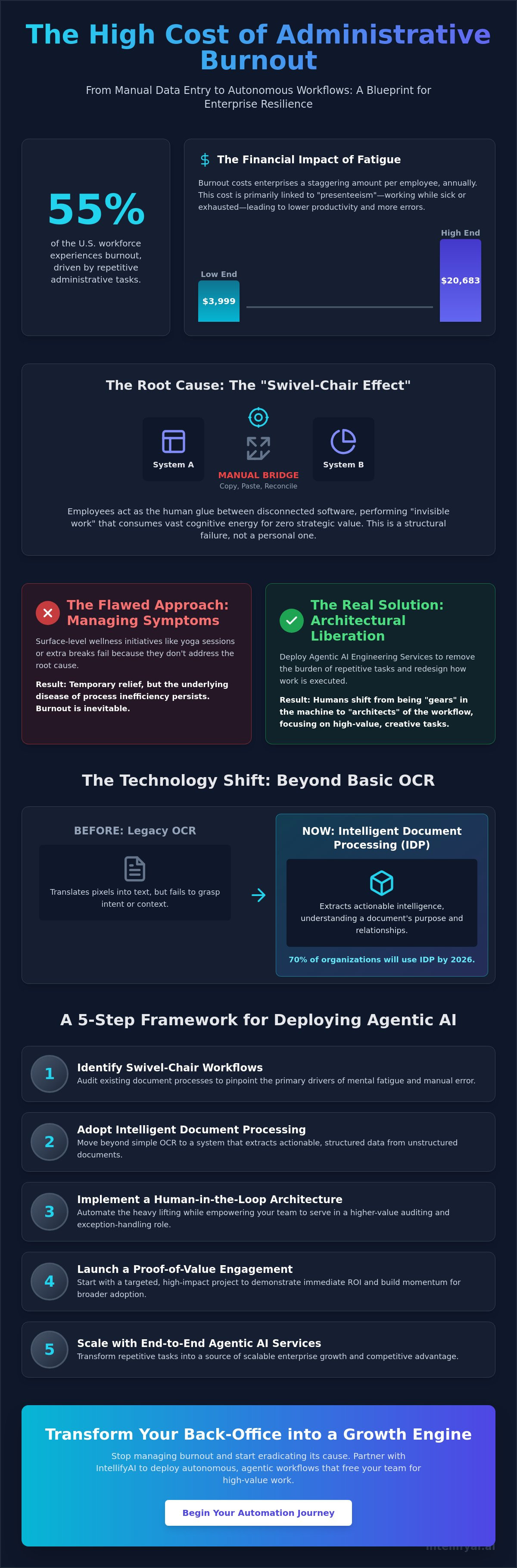
A Framework for Deploying Agentic AI Workflows
Transitioning from manual labor to system autonomy requires a structured methodology. You cannot simply layer AI over a fractured process and expect a frictionless result. Deployment must be approached with the precision of a Strategic Architect. This involves a five step roadmap designed to replace administrative drudgery with high velocity automation.
Step 1: Workflow Audit.
Begin by mapping existing document pipelines. Identify the specific "swivel chair" points where employees are manually bridging gaps between systems. This diagnostic phase is essential for reducing employee burnout from data entry by pinpointing the highest friction tasks.
Step 2: Proof of Value (PoV).
Select a high volume document type, such as standard vendor invoices or multi page contracts, to test IDP capabilities. This stage proves accuracy and establishes the baseline for ROI.
Step 3: Infrastructure Integration.
Connect the Agentic AI engine directly into your cloud native stack. This ensures that extracted intelligence flows into your ERP or CRM without human intervention.
Step 4: MLOps Implementation.
Deploy a continuous optimization pipeline. MLOps ensures that the system learns from exceptions and maintains peak performance as document formats evolve.
Step 5: Workforce Orchestration.
Finalize the transition of your team from "doers" to "orchestrators." In this new model, your staff manages the AI system, providing the final audit only when the system flags a low confidence result.
This systematic approach ensures that reducing employee burnout from data entry becomes a permanent operational reality rather than a temporary initiative. To begin your own transformation, schedule a strategy session with our engineering team.
Data Engineering: The Foundation of Autonomous Entry
Autonomous systems are only as effective as the data foundations they sit upon. Clean, structured data pipelines are a non negotiable prerequisite for removing human labor from the entry process. If your underlying data architecture is siloed or outdated, the AI will struggle to reconcile information across the enterprise. Modernizing your infrastructure is the first step toward true autonomy. You can explore our framework for Enterprise Modernization 2026 to understand how cloud native environments support high velocity automation. A robust data engineering strategy ensures that your AI agents have the latency and accessibility required to execute tasks in real time.
Governance and Compliance in Automated Data Entry
Security is not an afterthought in the automated back office; it's a core component. For serious enterprises, compliance with GDPR, SOC2, and the EU AI Act is mandatory. The i_Nova platform maintains a transparent, immutable audit trail for every processed document. This provides a level of oversight that manual entry can never match. Every extraction and decision made by the AI is logged and verifiable. The Strategic Architect balances the need for rapid innovation with the absolute requirement for data security. By centralizing governance, you ensure that your transition to autonomy remains stable, secure, and fully compliant with global regulations.
Partnering with IntellifyAi for Enterprise-Grade Automation
IntellifyAi serves as the definitive bridge between abstract AI theory and practical back-office results. We understand that leadership teams aren't looking for more complexity; they're looking for measurable impact. Our end-to-end service model guides you through every stage of the digital transformation journey. We begin with a deep dive into your current processes and conclude with a robust MLOps framework that monitors performance in real time. This comprehensive oversight is essential for reducing employee burnout from data entry. It ensures that the transition to autonomy is stable, secure, and perfectly aligned with your long-term financial goals.
Our approach treats technology as a collaborative partner rather than a simple tool. By integrating the i_Nova platform into your existing operations, you create a synergy between human judgment and machine efficiency. This doesn't just improve speed; it fundamentally changes the nature of the work. You move away from a "burnout factory" model and toward a center of excellence where data flows seamlessly across the enterprise. We provide the technical expertise and strategic vision required to make this future a reality today.
The Strategic Architect Approach
We function as your Strategic Architect, designing systems that prioritize long-term viability and relevance. Our AI Strategy & Consulting team works to align your technological investments with your broader corporate vision. With a global presence across the UK, USA, India, and the UAE, we provide the reach necessary to scale transformation across international borders. The i_Nova platform remains the central pillar of our methodology. It acts as the intelligent engine that processes unstructured data with unprecedented accuracy. This platform is designed to handle the heavy lifting, allowing your human teams to focus on the creative and strategic work they were hired to perform.
Next Steps: From Burnout to Brilliance
The path to a frictionless back-office begins with a single strategic decision. Don't attempt to automate every department at once. Instead, identify a high-impact, low-complexity use case where manual processing is currently causing the most friction. This focused start allows you to validate the ROI of agentic workflows while providing immediate relief to your staff. It demonstrates the tangible benefits of reducing employee burnout from data entry before you scale the solution enterprise-wide.
We invite you to Contact IntellifyAi for a discovery session. Our engineers will help you audit your existing document pipelines and define a clear roadmap for modernization. Unlocking the full potential of your intellectual capital requires more than just a software implementation; it requires a holistic philosophy of work. In 2026, advanced technology is the ultimate liberating force. It removes the burden of repetitive tasks and empowers your people to drive genuine innovation. Stop managing the symptoms of burnout and start eradicating its cause.
Architecting the Autonomous Enterprise of 2026
The transition from manual "swivel chair" labor to autonomous workflows is no longer a peripheral goal; it's a strategic mandate. By deploying the i_Nova IDP platform, organizations replace administrative drudgery with high velocity intelligence. This architectural shift ensures your human talent is focused on judgment and strategy rather than repetitive extraction. It represents the only durable solution for reducing employee burnout from data entry while building a foundation for long term scalability. When systems reason and execute independently, your workforce is finally free to innovate.
IntellifyAi brings deep technical expertise in Agentic AI and Cloud Native Modernization to every engagement. With a global presence spanning the UK, USA, India, and the UAE, we are equipped to scale your digital transformation across international borders. It's time to move beyond the constraints of legacy processes and embrace a future of frictionless operations. Consult with our Strategic Architects to automate your back-office and unlock the full potential of your workforce. Advanced technology is the liberating force your enterprise deserves. Let's build a more resilient, human centric future together.
Frequently Asked Questions
How exactly does Agentic AI reduce employee burnout?
Agentic AI assumes full responsibility for the execution of repetitive, multi-step workflows by using goal-oriented reasoning to navigate complex logic. Unlike basic automation that requires constant human prompts, these systems can handle exceptions and make informed decisions independently. By removing the mental drudgery of manual labor, you allow your team to reclaim their cognitive energy for strategic problem-solving. This shift is fundamental to reducing employee burnout from data entry across the modern enterprise.
Is Intelligent Document Processing (IDP) different from standard OCR?
Yes, IDP is a significant evolution beyond standard OCR. While OCR simply translates images into machine-readable characters, IDP uses advanced AI to understand the context and intent of the document. It extracts actionable intelligence from unstructured formats like multi-page contracts and handwritten forms. This means the system doesn't just "see" the text; it understands how that data relates to your specific business rules and downstream processes.
Can i_Nova integrate with our existing legacy ERP and CRM systems?
The i_Nova platform is designed for seamless integration with legacy ERP and CRM systems through a cloud-native, API-first architecture. We specialize in building the digital bridges required to move data between disparate software environments without human interference. This eliminates the "swivel-chair effect" and ensures that your autonomous workflows have direct access to your core business systems, regardless of their age or complexity.
What happens to the employees whose data entry tasks are automated?
Employees transition from being the "doers" of repetitive tasks to being the "orchestrators" of the AI system. In our Human-in-the-Loop model, staff members shift into high-value roles focused on quality assurance, strategic oversight, and exception management. This transition restores professional dignity and allows your workforce to focus on creative work that requires human judgment, which significantly improves long-term retention and engagement.
How long does it take to see ROI from reducing data entry burnout with AI?
Most organizations realize measurable ROI within the first few months of a proof-of-value engagement. Initial returns manifest as immediate increases in processing velocity and a sharp reduction in error rates. Over the long term, the financial impact includes lower turnover costs and the ability to scale document processing capacity without a linear increase in headcount. Reducing employee burnout from data entry creates a more stable, efficient, and profitable back-office.
Is automated data entry as accurate as manual human entry?
Automated data entry typically exceeds the accuracy of manual human entry because machines don't suffer from cognitive fatigue. While humans are prone to errors after hours of repetitive labor, Agentic AI maintains a consistent performance level regardless of volume. Furthermore, systems like i_Nova provide an immutable audit trail for every processed document, ensuring that every data point is verifiable and compliant with global governance standards.
What industries benefit most from reducing data entry burnout?
Any industry with a high volume of unstructured documentation, such as logistics, finance, legal services, and healthcare, sees the most significant benefits. These sectors often struggle with the heavy administrative burden of processing invoices, shipping manifests, and compliance records. By automating these data-heavy pipelines, businesses in these fields can maintain operational integrity while liberating their specialized staff for more complex, high-value assignments.
Do we need a massive data engineering project before implementing IDP?
You don't necessarily need a massive overhaul, but a robust data foundation is essential for success. We recommend starting with a targeted audit of your existing document workflows to identify high-friction points. From there, we implement a structured data engineering phase to ensure your pipelines are clean and accessible. This focused approach allows you to build a scalable infrastructure without the need for a total system replacement.









.svg)