
If you could guarantee a 200% to 400% return on investment within the first twelve months, would your board still hesitate? Despite these verified returns, many automation initiatives stall because they're framed as technical upgrades rather than strategic assets. You've likely encountered budget fatigue from past OCR projects or faced internal resistance when getting stakeholder buy-in for idp. It's frustrating when the technical potential is clear but the executive path remains blocked by legacy skepticism and a lack of clear financial modeling.
This guide will show you how to master the art of executive persuasion by aligning Intelligent Document Processing with enterprise-wide strategic goals and measurable ROI. We believe advanced technology isn't a daunting complexity, but a liberating force that allows your business to focus on high-value creative work by removing the burden of repetitive tasks. You'll learn to position IDP as a central business pillar rather than just another software implementation.
We'll provide a clear, action-oriented roadmap for securing approval in the 2026 regulatory environment. This framework ensures total alignment between IT, Finance, and Operations while proving value before you commit to full-scale deployment. By the end of this article, you'll have the tools to bridge the gap between abstract technical fields and the practical needs of your growing enterprise.
Key Takeaways
• Understand how Intelligent Document Processing acts as the critical bridge between massive unstructured data volumes and autonomous, enterprise-wide decision-making in 2026.
• Identify the specific motivations of key executive personas, from the CFO's focus on FinOps predictability to the CTO's requirement for reducing technical debt.
• Quantify the full impact of IDP by measuring both direct labor savings and high-value indirect returns like accelerated cycle times and enhanced customer experience.
• Follow a proven, four-step framework for getting stakeholder buy-in for idp that aligns your automation proposal with existing enterprise AI strategies.
• Discover how a holistic approach to AI strategy and consulting ensures long-term project viability and transforms document workflows into competitive advantages.
The 2026 Case for Intelligent Document Processing
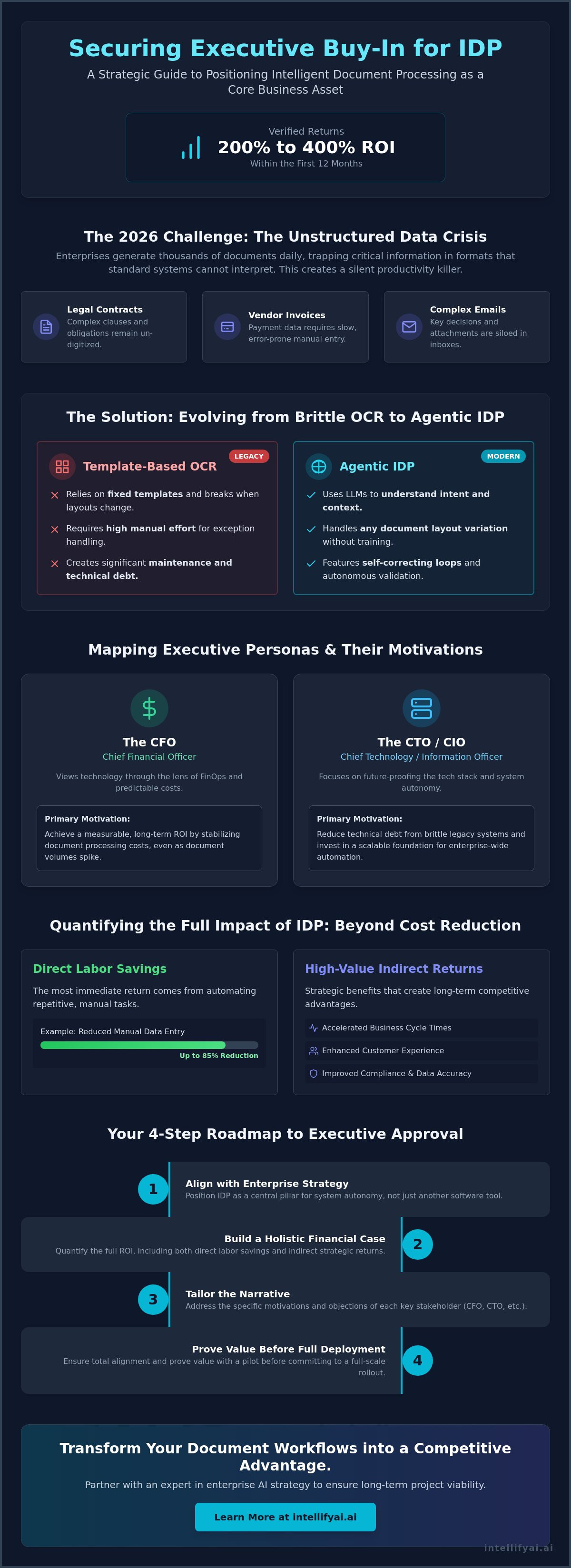
In 2026, enterprises face a silent productivity killer. We call it the "Unstructured Data Crisis." Your organization likely generates thousands of documents daily, including legal contracts, vendor invoices, and complex emails. Most of this information stays trapped in formats that standard databases cannot interpret. Intelligent Document Processing (IDP) serves as the critical bridge here. It converts static files into actionable intelligence that drives autonomous decision-making across the entire enterprise.
Securing funding for these initiatives requires a shift in perspective. Success relies on getting stakeholder buy-in for idp by positioning it as a strategic architect for your data ecosystem. You're not simply purchasing a tool; you're investing in a foundation for system autonomy. This allows your business to move beyond manual data entry and toward a future where information flows without friction.
To better understand this concept, watch this helpful video:
Modern Agentic AI-driven processing functions with a human-like understanding of context. It recognizes data points based on their meaning rather than their coordinates on a page. Consider these fundamental differences:
Legacy OCR
Relies on fixed templates and breaks when document layouts change.
Agentic IDP
Uses Large Language Models to understand intent and context, handling any layout variations.
Legacy OCR
Requires high manual effort for exception handling.
Agentic IDP
Features self-correcting loops and autonomous validation.
Why Traditional Automation is No Longer Enough
Template-based OCR is too brittle for the dynamic markets of 2026. These legacy systems often create significant maintenance debt, requiring constant manual updates to remain functional. This brittleness often leads to "automation fatigue" among executives who've seen previous projects fail to scale. Intelligent Document Processing within an Agentic AI framework acts as a liberating force, removing the burden of repetitive tasks so your team can focus on high-value creative work.
The Strategic Shift Toward Agentic Intelligence
The industry is moving toward Agentic AI. These autonomous workflows do more than just read text; they validate information, cross-reference sources, and resolve errors without human intervention. This shift is a core component of enterprise modernization. Getting stakeholder buy-in for idp is easier when you show that these systems don't just collect data, they provide a lasting investment in organizational relevance.
Mapping Stakeholder Personas and Their Core Objections
Successful leaders recognize that 2026 stakeholders are more sophisticated than ever. They don't just want automation; they want strategic relevance. This requires a structured stakeholder engagement plan that addresses individual departmental priorities. When getting stakeholder buy-in for idp, you must tailor your narrative to solve their specific business challenges. Each executive sees the project through a different lens of value and risk.
The CFO views technology through the lens of FinOps and cost predictability. They want to see how IDP provides a measurable, long-term ROI by stabilizing document processing costs regardless of volume spikes. Meanwhile, the CTO and CIO focus on technical debt reduction. They'll prioritize cloud-native solutions that integrate into the existing enterprise architecture without creating rigid, hard-to-maintain dependencies. Their goal is a frictionless stack that supports future growth.
Operational resilience and employee experience (EX) drive the COO's decision-making. They see IDP as a liberating force that removes the burden of repetitive tasks, allowing the workforce to focus on high-value creative work. Finally, the Chief Risk Officer (CRO) requires rigorous AI governance. In the 2026 regulatory landscape, they need assurance that data privacy and GRC frameworks are integrated into the processing engine itself. They're looking for a partner who prioritizes the stability and security of the client's operations.
Addressing the "Why Now?" Objection
The risk of falling behind in the "Agentic Frontier" is the most compelling reason to act immediately. Enterprises that delay their transition to real-time document intelligence face a widening competitive gap. Today's platforms have reached a level of technical stability that makes them a dependable investment rather than a risky experiment. Waiting only increases the cost of eventual modernization. Proactive adoption ensures your business remains a professional partner for serious enterprises looking to modernize.
Overcoming Security and Compliance Fears
Modern IDP solutions are built with data sovereignty at their core. Security is not a hurdle to clear; it's a fundamental feature of the i_Nova platform. We offer private cloud deployment options that ensure your data remains within your controlled environment. These systems include integrated GRC frameworks that simplify compliance with 2026 regulations like the EU AI Act. This frames advanced technology as a secure, central business pillar.
If you're looking to align these technical capabilities with your board's expectations, our AI strategy and consulting services can help bridge the gap between abstract technical fields and practical business needs.
Quantifying the ROI: Moving Beyond Simple Cost Reduction
ROI for Intelligent Document Processing isn't just about shaving pennies off an invoice. It's about fundamental enterprise transformation. When you are getting stakeholder buy-in for idp, you must lead with the data. Typical first-year returns range from 200% to 400%, with a payback period often as short as three to six months according to 2026 industry benchmarks. These aren't just projections; they are the result of reducing manual data entry by up to 80% and achieving accuracy levels exceeding 98%.
Scalability is the silent engine of this ROI. Modern IDP allows an enterprise to process ten times its current document volume without increasing back-office headcount. This creates a predictable cost structure that appeals directly to the CFO's need for FinOps stability. Beyond the balance sheet, the strategic value lies in risk mitigation. By flagging inconsistencies and ensuring compliance with regulations like the EU AI Act, IDP acts as an automated guardian of your corporate reputation. Indirect value also manifests as accelerated cycle times and a superior customer experience. When documents are processed in seconds rather than days, your entire service delivery chain speeds up.
The "Time-to-Value" Metric
Rapid deployment is the hallmark of cloud-native solutions. Unlike legacy systems that take months to configure, modern IDP platforms offer a significantly shorter time-to-value. This speed is essential for maintaining momentum during the transition. Engaging in AI strategy consulting accelerates your initial roadmap, ensuring you target high-impact friction points first. The cost of inaction isn't just a missed savings opportunity. It's the compounding weight of technical debt and lost market agility in a high-velocity economy.
Enhancing Human Potential via Automation
We view technology as a means for unlocking human potential. IDP functions as a "human-in-the-loop" collaborator rather than a replacement for labor. By removing the burden of repetitive, low-value tasks, you liberate your skilled workers to focus on high-value creative work. This shift directly impacts employee retention and reduces the burnout common in high-volume processing environments. Getting stakeholder buy-in for idp becomes a conversation about building a more resilient, human-centric workforce that is ready for the future. You're not just automating a process; you're investing in your most valuable asset: your people.
The Strategic Roadmap to Securing Executive Approval
Securing approval for a large-scale automation project requires more than a technical demonstration. It requires a methodical, business-centric roadmap that speaks the language of the board. When getting stakeholder buy-in for idp, your approach must be structured to eliminate ambiguity and demonstrate a clear path to system autonomy. This process begins with a rigorous audit of your current state to identify high-impact friction points where manual document handling slows your operations.
Alignment is your most powerful tool. You must ensure your IDP proposal integrates seamlessly with your broader enterprise AI strategy. Executives are often wary of siloed tools; they want a holistic solution that contributes to a unified data ecosystem. Once you've established this alignment, focus on identifying a high-level "Champion" within the executive circle. This partner will help navigate internal politics and ensure your initiative remains a priority during budget cycles.
Why Proof of Value (PoV) is the New Standard
Traditional Proof of Concept (PoC) models often fail because they only test technical feasibility. In 2026, the standard has shifted to the Proof of Value (PoV). A PoV focuses entirely on business outcomes, proving that the technology can solve a specific financial or operational challenge. Leveraging custom AI engineering allows you to tailor this PoV to your unique environment, making the results undeniable.
Use this four-step PoV checklist to build your case:
• Identify one high-friction document workflow with measurable costs.
• Establish clear baseline KPIs, such as current error rates and processing times.
• Deploy a targeted IDP solution to handle a representative sample of real-world data.
• Quantify the delta between the baseline and the automated results to prove ROI.
Communicating the Vision with Clarity
Authority is built through direct, declarative statements. Avoid technical jargon or hyperbolic promises that can trigger skepticism. Instead, act as a Strategic Architect. Systematically break down complex concepts like MLOps pipelines into digestible segments that focus on the bottom line. Explain how these pipelines ensure long-term viability by allowing the AI models to learn and adapt without constant manual intervention.
Ready to build your roadmap? Contact our consulting team to start your strategic IDP audit today.
Partnering for Success: The IntellifyAi Approach to IDP
Getting stakeholder buy-in for idp is the first step; sustainable execution is the second. At IntellifyAi, we don't just provide software. We serve as the Strategic Architect for your digital transformation. Our approach combines high-level strategic thinking with practical, results-oriented execution to ensure your investment delivers measurable impact from day one. Our flagship platform, i_Nova, represents the culmination of this vision, acting as the intelligent engine that powers your document-driven workflows.
Our Agentic AI engineering services are designed to modernize your back office by creating systems that do more than just extract data. These autonomous agents validate information, handle complex exceptions, and integrate directly into your core business processes. This transforms document processing from a manual burden into a frictionless, automated asset. We treat our core methodology as a holistic philosophy, presenting it as a central business pillar that supports your long-term growth and operational stability.
Seamless Integration with Cloud-Native Ecosystems
Success in document automation depends heavily on the underlying infrastructure. Modernization is not an optional upgrade; it's a prerequisite for the high-velocity demands of 2026. We prioritize cloud-native modernization to ensure your IDP solution is scalable, secure, and resilient. This approach eliminates the brittleness associated with legacy systems and reduces technical debt over time. We focus on long-term viability over temporary fixes, positioning your enterprise to remain relevant in an increasingly competitive landscape.
Next Steps: From Strategy to Execution
Move beyond theoretical discussions and begin your journey toward autonomous intelligence. Getting stakeholder buy-in for idp is significantly easier when you have a clear, data-backed plan. We invite you to initiate a strategic audit of your existing workflows to identify the high-impact friction points we discussed earlier. This audit serves as the foundation for a tailored Proof of Value engagement that demonstrates the financial and operational benefits of our framework before you commit to full-scale deployment.
Don't let legacy skepticism stall your progress toward a more efficient future. Our team is ready to help you bridge the gap between abstract technical fields and the practical needs of your growing company. Contact our AI strategy consultants today to begin your IDP journey and unlock the full potential of your enterprise data.
Leading the Autonomous Enterprise in 2026
The transition from legacy automation to Agentic AI represents a fundamental shift in how businesses interpret information. By moving beyond simple data extraction toward contextual understanding, you transform document workflows into a strategic engine for growth. Success in getting stakeholder buy-in for idp requires a deliberate focus on measurable business outcomes and executive alignment. You've seen how a Proof of Value framework and a clear scalability roadmap can turn technical potential into a central business pillar.
IntellifyAi stands ready to guide your enterprise through this modernization. With a global presence across the UK, USA, India, and the UAE, we specialize in Agentic AI and large-scale enterprise transformation. Our flagship i_Nova platform provides the technical foundation needed for high-accuracy, autonomous processing in a complex regulatory environment. We don't just implement software; we build a lasting investment in your organization's relevance.
Now is the time to bridge the gap between abstract technology and practical, bottom-line results. Partner with IntellifyAi for your Enterprise IDP Strategy to unlock your workforce's full potential and secure your place at the cutting edge of the industry.
Frequently Asked Questions
What is the difference between OCR and Intelligent Document Processing (IDP)?
OCR is a baseline technology for character recognition, while IDP is a holistic system that uses AI to understand context and intent. While OCR extracts text from pixels, IDP interprets that text to drive autonomous decision-making. This shift allows enterprises to process unstructured data without relying on rigid templates that often break during layout changes. It transforms raw data into high-value intelligence that integrates directly into your business strategy.
How long does it typically take to see ROI from an IDP implementation?
Most enterprises realize a return on investment within three to six months following deployment. Verified industry data from 2026 shows that first-year ROI typically ranges between 200% and 400%. This rapid payback is a critical factor when getting stakeholder buy-in for idp, as it demonstrates immediate financial impact and justifies the initial implementation costs. These results are driven by reducing manual data entry by 80% and minimizing costly human errors.
Is IDP secure enough for highly regulated industries like finance or healthcare?
Modern IDP platforms are designed with integrated GRC frameworks to meet the rigorous standards of finance and healthcare. These systems support private cloud deployments and comply with the latest 2026 regulations, such as the EU AI Act. Security is treated as a foundational feature that ensures data sovereignty and protects sensitive information from unauthorized access. This professional-grade security reassures potential clients of deep technical expertise and a focus on operational stability.
What is a Proof of Value (PoV) and why is it better for stakeholder buy-in?
A Proof of Value (PoV) focuses on specific business outcomes rather than just technical feasibility. Unlike a Proof of Concept (PoC) which merely tests if a tool works, a PoV proves that the technology solves a financial or operational challenge. This results-oriented approach is far more effective for getting stakeholder buy-in for idp because it quantifies the actual impact on the bottom line. It moves the conversation from abstract technical capabilities to practical, measurable performance.
Can IDP integrate with our existing legacy ERP and CRM systems?
IDP systems integrate seamlessly with legacy ERP and CRM platforms through cloud-native APIs and custom connectors. These solutions act as an intelligent layer that bridges the gap between unstructured documents and your existing digital core. This ensures that extracted, validated data flows directly into your systems of record without requiring a complete overhaul of your current infrastructure. It preserves your existing investments while adding a new layer of system autonomy and processing speed.
How does Agentic AI improve the accuracy of document processing?
Agentic AI improves accuracy by moving beyond simple extraction toward contextual reasoning and self-correcting loops. These systems can achieve over 98% accuracy by validating data against external sources and autonomously resolving discrepancies. This reduces the need for human intervention and ensures that the output is high-quality intelligence rather than just raw data. By understanding the intent behind a document, Agentic AI eliminates the ambiguity that often plagues traditional automation tools.
What role does MLOps play in the long-term success of an IDP project?
MLOps ensures the long-term viability and performance of IDP models through continuous monitoring and automated retraining. It prevents model drift where accuracy declines over time as document types and data formats evolve. By treating AI as a living system rather than a static installation, MLOps maintains the stability of your operations and protects your investment. This structured approach to maintenance ensures that your automation remains relevant as your business scales and changes.
How do we address employee concerns about AI and automation?
Organizations should frame automation as a liberating force that removes the burden of repetitive, low-value tasks. The goal is to unlock human potential by allowing skilled workers to focus on high-value creative work. Emphasize that IDP is a human-in-the-loop collaborator designed to enhance performance and reduce burnout. This messaging positions technology as a partner that adds a layer of ethical consideration to the brand while positioning the service as a lasting investment.








.svg)