
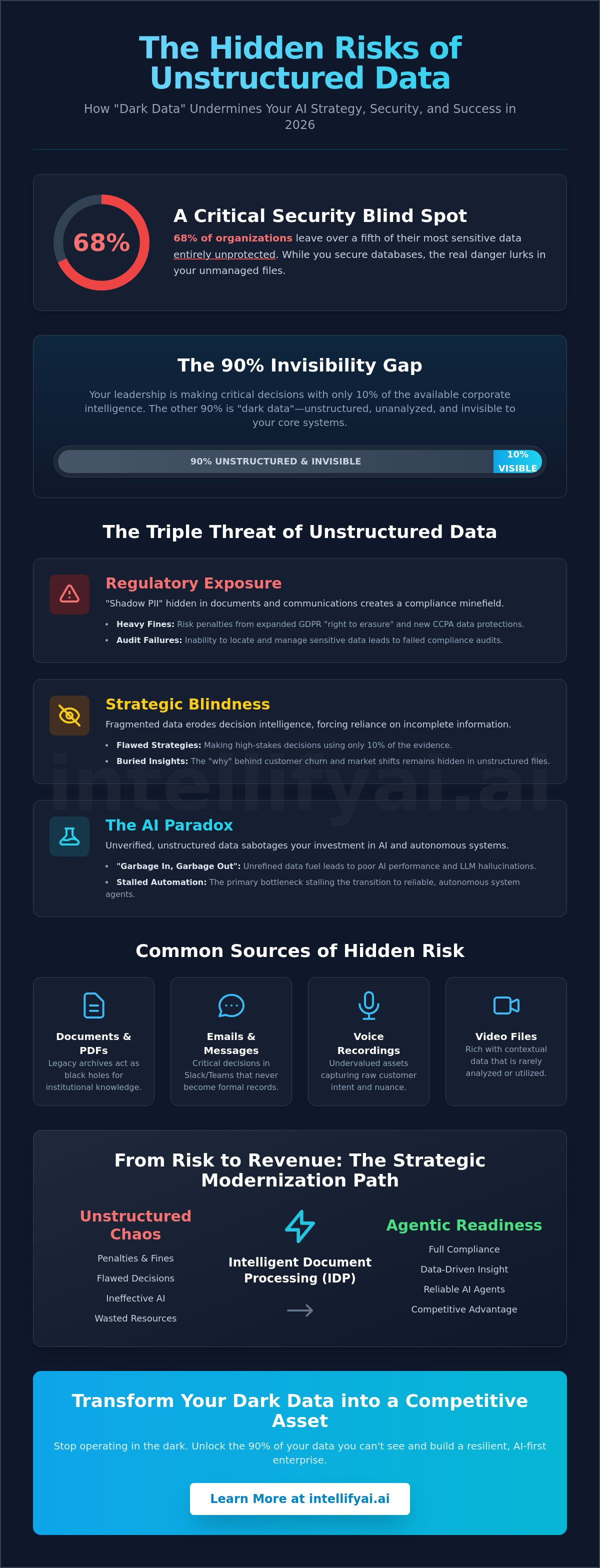
Did you know that 68% of organizations currently leave more than a fifth of their most sensitive information entirely unprotected? While most enterprises focus on securing their structured databases, the real danger lies in the shadows. For many leaders, the risks of unstructured data in business have shifted from a simple storage inconvenience to a critical strategic liability. You likely feel the weight of this "dark data" through rising manual extraction costs and the constant anxiety of shadow PII lurking in your systems. It's a valid concern. Currently, 90% of corporate data remains effectively invisible to the AI models you're trying to train.
This article identifies the hidden operational, regulatory, and AI-readiness risks that will define your 2026 performance. You'll learn how to mitigate the threat of heavy regulatory fines from new CCPA neural data protections and the expanded GDPR "right to erasure" enforcement. We provide a clear roadmap to move from unstructured chaos to a state of agentic readiness. By the end, you'll understand how to transform these liabilities into a competitive engine that powers your enterprise forward. We'll show you how advanced technology can act as a liberating force, removing repetitive burdens and allowing your team to focus on high-value execution.
Unmanaged information is a strategic liability. In 2026, the risks of unstructured data in business have evolved from storage inefficiencies into critical threats against AI performance and regulatory standing. This summary provides a high-level framework for identifying hidden vulnerabilities and implementing a roadmap for enterprise modernization.
The Invisibility Gap: Understand why the "90% Rule" leaves leadership making decisions based on only 10% of available corporate intelligence. Data fragmentation doesn't just slow you down; it erodes the very foundation of decision intelligence.
Regulatory Exposure: Identify "Shadow PII" within unmanaged repositories to mitigate risks associated with the latest CCPA amendments and GDPR enforcement priorities. Failure to manage this dark data invites significant financial penalties and audit failures.
Agentic Readiness: Solve the AI Paradox by eliminating the "Garbage In, Garbage Out" cycle. Unverified unstructured data drives LLM hallucinations and stalls the transition to autonomous system agents.
Strategic Modernization: Use Intelligent Document Processing and the i_Nova platform to bridge the gap between unstructured chaos and measurable financial returns. Transforming dark data into a competitive asset is the only way to ensure long-term viability in an AI-first economy.
What is Unstructured Data and Why is it a Business Risk in 2026?
Unstructured data is information that lacks a predefined data model. Think of it as the digital debris of an enterprise: PDFs, voice notes, video files, and endless email chains. Unlike its structured counterpart, which fits neatly into the rows and columns of a database, unstructured data is inherently difficult for legacy machines to parse without advanced intervention. It's essentially machine-unfriendly content that requires sophisticated processing to become useful.
The "90% Rule" dictates that the vast majority of enterprise knowledge is currently invisible to your core systems. If your business relies solely on structured databases for insights, you're operating on a fraction of your actual intelligence. In 2026, the risks of unstructured data in business have reached a tipping point. As companies race toward Agentic AI, this unorganized mass becomes the primary bottleneck for automation. Data is the fuel for these autonomous systems, and unrefined fuel leads to engine failure.
To better understand why this concept is now a board-level priority, watch this helpful video:
The Evolution from Big Data to Dark Data
The industry has transitioned from the era of Big Data accumulation to the reality of Dark Data. This term describes information that an organization collects and stores during regular business activities but fails to use for any other purpose. Legacy storage habits have turned corporate servers into digital landfills. For decades, the strategy was simply to store everything. Today, that approach is a liability. The focus has shifted from the mere act of storing data to the absolute necessity of understanding it. If you can't categorize it, you can't secure it or use it to drive growth.
Common Sources of Unstructured Risk
Risk often hides in the most familiar places. Legacy document archives and unindexed PDF repositories act as black holes for institutional knowledge. Similarly, communication silos like Slack and Microsoft Teams contain critical project decisions that never make it into a formal record. These silos create fragmented intelligence and duplicated efforts across global departments. The risks of unstructured data in business are amplified when these sources remain disconnected from your strategic framework.
Voice recordings are the most undervalued unstructured asset in 2026 because they capture the raw emotional intent and specific nuances of customer interactions that traditional text-based summaries often strip away.
Modernizing these repositories requires a sophisticated AI engineering strategy that transforms chaos into a structured competitive advantage.
Strategic Blindness: How Data Fragmentation Erodes Decision Intelligence
Strategic blindness is the silent byproduct of a fragmented data architecture. When leadership relies solely on structured databases, they make high-stakes decisions using only 10% of the available evidence. This "Invisibility Gap" means that the "why" behind customer churn, market shifts, and operational bottlenecks remains buried in unindexed archives. The risks of unstructured data in business become a direct threat to growth when your decision intelligence is fundamentally incomplete. You can't lead effectively if you're only seeing a fraction of the board.
Fragmentation also breeds massive operational redundancy. In global enterprises, departments often solve the same problems repeatedly because the original solution is trapped in a PDF or a recorded call in a different region. This lack of shared intelligence doesn't just waste time; it erodes the foundation of your digital transformation. Without a 360-degree view of the customer, personalization efforts feel hollow and reactive. Regulatory bodies are already assessing risks in unstructured data to detect market patterns, yet many businesses remain oblivious to these same insights within their own walls. Modernizing your approach through AI Strategy & Consulting ensures your roadmap is grounded in data reality rather than assumptions.
The High Cost of Manual Data Retrieval
Manual data extraction acts as a heavy "Knowledge Worker Tax" on your most expensive talent. When engineers and analysts spend hours parsing documents instead of building solutions, your innovation velocity stalls. Relying on human-in-the-loop processes also introduces significant error rates that structured systems don't have to contend with. These errors trickle down to the customer experience. Slow response times and inaccurate service happen when your front-line staff can't find the information they need in real-time. It's a friction-heavy model that won't survive the 2026 competitive landscape.
Opportunity Cost and Market Lag
While you struggle with manual retrieval, competitors using Intelligent Document Processing (IDP) are identifying market trends months ahead of the curve. They're spotting early warning signs in contract renewals and supply chain disruptions hidden in unstructured feedback. This market lag is a strategic vulnerability. Missing a single clause in a vendor agreement or a recurring complaint in a support transcript can lead to millions in lost revenue. To navigate these complexities, you need a clear framework for Enterprise AI Strategy Consulting that addresses the agentic frontier. By the time a trend appears in your structured reports, the opportunity to pivot has likely already passed.
The Compliance Minefield: Regulatory and Security Risks of Dark Data
Dark data functions as a legal landmine for the modern enterprise. While traditional security tools scan for social security numbers in text files, they often fail to identify "Shadow PII" embedded in scanned images, handwritten notes, or messy support chat screenshots. This invisible threat is a primary driver of the risks of unstructured data in business. If your compliance team can't see the data, they can't protect it. This lack of visibility creates a massive surface area for modern ransomware attacks and sophisticated data exfiltration tactics that target unmonitored repositories.
The regulatory environment in 2026 demands absolute visibility. Under the EU AI Act and strict GDPR enforcement, the "Right to be Forgotten" has become a non-negotiable operational requirement. You cannot delete what you cannot find. Organizations are currently struggling with data fragmentation challenges that make responding to a simple Data Subject Access Request (DSAR) an expensive, multi-week manual ordeal. Failing these requests doesn't just damage your reputation; it invites heavy financial penalties that scale with your global revenue.
Regulatory Transparency and the Audit Trail
Maintaining a defensible audit trail requires more than just good intentions. In the current legal climate, claiming "I didn't know we had that data" is no longer a valid defense in court or during a regulatory audit. Automated classification is now a necessity for maintaining SOC2 and ISO compliance. You must demonstrate a proactive stance on data hygiene. Implementing a robust framework for AI Governance, Risk & Compliance allows you to modernize these workflows and turn compliance from a reactive burden into a strategic advantage.
Data Sovereignty and Geographic Risks
Managing geographic boundaries is the next great hurdle for AI implementation. Multi-national cloud environments often lead to unstructured data inadvertently crossing borders, violating strict data sovereignty laws. This risk is amplified by Agentic AI systems that may move sensitive information between regions to complete a task if not governed by precise data engineering. The risks of unstructured data in business are particularly acute when autonomous agents operate without geographic constraints. Data residency is the biggest hurdle for global AI deployments in 2026 because conflicting international privacy laws require physical data localization that many legacy architectures simply cannot support.
The AI Paradox: Why Unstructured Data Sabotages Your Agentic Transformation
The promise of autonomous workflows relies on a dangerous assumption: that your AI can make sense of your existing document mess. It can't. The "Garbage In, Garbage Out" (GIGO) principle is more punishing for Agentic AI than for any previous technology. When agents operate autonomously, the risks of unstructured data in business manifest as unpredictable hallucinations. An AI agent making decisions based on unverified, contradictory PDFs will confidently execute incorrect actions. This isn't just a technical glitch; it's a strategic failure that can trigger cascading operational errors.
Efficiency is the next casualty of unorganized data. Many enterprises attempt to solve the visibility problem by dumping raw unstructured files into an AI's context window. This approach is prohibitively expensive and computationally slow. Large language models (LLMs) struggle to prioritize relevant information when buried under digital noise. Structured intelligence isn't just a preference; it's the absolute prerequisite for deploying reliable Agentic AI Voice Agents that can interact with customers without constant human supervision.
Training vs. Execution: The Data Quality Gap
Retrieval-Augmented Generation (RAG) is often marketed as a silver bullet for data visibility. However, RAG systems fail spectacularly without rigorous data engineering. If your retrieval layer pulls from a "dark data" landfill, the AI will synthesize outdated or conflicting information. This leads to "Model Poisoning," where the system's logic is fundamentally compromised by its own training set. You must prioritize Data Engineering Services to ensure your AI is built on a foundation of verified, high-fidelity facts. Accuracy in execution is impossible without precision in preparation.
The Scalability Wall
Manual data cleaning is a relic of the past that cannot support the velocity of modern AI deployment. As you scale your agentic workforce, the volume of incoming unstructured data will outpace your ability to process it by hand. This creates a compounding technical debt that eventually brings transformation projects to a halt. You need a systemic shift in how information is ingested and classified. Transitioning through Enterprise Modernization is the only way to break through this scalability wall. Don't let your legacy data habits sabotage your future autonomy. Consult with our experts to audit your AI readiness and build a scalable data foundation.
From Risk to Revenue: Implementing Intelligent Document Processing (IDP)
Transforming a strategic liability into a revenue-generating asset requires a fundamental architectural shift. Intelligent Document Processing (IDP) acts as the essential bridge between unstructured chaos and structured intelligence. It isn't merely about reading text. It's about making your most complex information machine-ready for autonomous execution. While the risks of unstructured data in business are significant, they aren't insurmountable. By shifting from passive storage to an active "Intelligence-as-a-Service" model, you turn your dark data into a high-velocity competitive engine.
This transition allows your team to stop acting as manual data entry points and start functioning as strategic architects. We view advanced technology as a liberating force. It removes the burden of repetitive extraction tasks and allows your workforce to focus on high-value creative work. When your data is structured, verified, and accessible, your enterprise moves from a state of reactive compliance to one of proactive market leadership.
The i_Nova Advantage for Enterprise
The i_Nova platform represents a significant leap beyond legacy OCR technology. While standard tools merely recognize characters, i_Nova is designed to understand the underlying context and intent within your documents. It can parse complex legal agreements, handwritten medical notes, and technical manuals with precision. This sophisticated extraction layer is designed for seamless integration into existing MLOps Pipelines. By automating the ingestion of unstructured files directly into your AI workflows, you eliminate the friction that typically stalls digital transformation. Organizations implementing this level of automation can reduce document processing time by up to 90%, delivering a measurable impact on the bottom line.
Next Steps: Building a Resilient Data Strategy
Modernizing your data foundation requires a logical, layered approach. You can't fix what you can't see. Follow this roadmap to mitigate the risks of unstructured data in business and prepare for an agentic future:
Step 1
Conduct a comprehensive "Dark Data" audit. Identify high-risk silos where sensitive PII might be hiding in unindexed formats.
Step 2
Implement automated classification. Use IDP to extract actionable insights and tag data according to its strategic value and risk level.
Step 3
Integrate structured intelligence. Feed your verified data into Agentic AI workflows to power autonomous decision-making with high-fidelity facts.
The cost of inaction is a compounding technical and regulatory debt that will define the winners and losers of 2026. Don't let your enterprise remain blind to its own intelligence. Contact IntellifyAi for a Strategic AI Consultation to begin your transition from unstructured chaos to agentic readiness.
Navigating the Agentic Frontier with Data Certainty
The transition to an AI-first enterprise requires more than just deploying models; it demands a radical reclamation of your corporate knowledge. We've explored how the risks of unstructured data in business extend from strategic blindness to severe regulatory vulnerability. Managing this "dark data" is the only way to ensure your agentic transformation doesn't stall due to poor visibility or hallucination-driven errors. By implementing end-to-end cloud-native modernization frameworks, you build a foundation that supports long-term viability and performance.
Our global expertise in Agentic AI engineering ensures your systems operate with precision. Through the i_Nova IDP platform, we provide the complex document intelligence necessary to turn liabilities into assets. This isn't just about security; it's about unlocking human potential by removing the friction of manual data extraction. You have the tools to move from unstructured chaos to a state of operational excellence. Secure your enterprise future with a custom AI Strategy Consultation. The path to a frictionless, automated future is within your reach.
Frequently Asked Questions
What is the biggest risk of unstructured data for small to medium businesses?
The primary danger is regulatory non-compliance followed by operational paralysis. Small to medium businesses often lack the expansive legal departments of large enterprises, making a single fine for "Shadow PII" catastrophic. The risks of unstructured data in business for smaller firms often involve lost contracts or missed renewal clauses buried in unindexed PDFs. This creates a disproportionate liability surface where one overlooked document can jeopardize annual revenue.
Can legacy OCR systems handle the risks associated with unstructured data?
No, legacy OCR systems are insufficient because they lack the ability to understand context or intent. Traditional tools merely convert images into flat text strings; they don't classify information or identify sensitive data patterns. To effectively manage the risks of unstructured data in business, you need intelligent processing that can distinguish between a standard invoice and a high-risk disclosure. Relying on character recognition alone leaves your data unorganized and vulnerable.
How does the EU AI Act specifically affect my unstructured document storage?
The EU AI Act mandates strict governance for any data used to train or prompt AI systems. If your unstructured document storage is unmanaged, you risk non-compliance through biased outputs or the inadvertent ingestion of sensitive information. You must now prove that your data repositories are audited and accurate. This legislation forces a shift from passive "digital landfills" to active, transparent data management that can survive a regulatory audit.
Is unstructured data more expensive to store than structured data?
Unstructured data carries a significantly higher total cost of ownership due to its volume and the lack of compression efficiency. While raw cloud storage fees might seem low, the hidden costs of securing, backing up, and searching unindexed files are substantial. You're effectively paying a premium to store "dark data" that provides no actionable intelligence. Structured data is compact and optimized, whereas unmanaged files often duplicate across your infrastructure, bloating your operational overhead.
What is the difference between unstructured data and dark data?
Unstructured data refers to a format, while dark data refers to a state of neglect. Unstructured data includes files like emails, videos, and PDFs that don't fit into a standard database. Dark data is any information your organization collects but fails to analyze or use for decision-making. While the majority of dark data is unstructured, the terms aren't interchangeable. One describes the technical structure, while the other describes a failure in your data strategy.
How can Agentic AI help in mitigating unstructured data risks?
Agentic AI acts as a persistent governance layer that automates the discovery and classification of unmanaged files. These autonomous agents can navigate complex directories to identify sensitive clauses or PII and move them to compliant locations. They scale with your data growth in a way that human workers cannot. By handling the repetitive burden of data hygiene, Agentic AI allows your team to focus on high-value execution and strategic growth.
What industries are most at risk from unmanaged unstructured data?
Healthcare, finance, and legal services face the most severe risks due to the high density of PII and strict federal oversight. These sectors rely on documentation that is historically unstructured, such as patient charts, loan applications, and case files. A single data leak or the inability to fulfill a "Right to Erasure" request can result in multi-million dollar penalties. For these industries, unmanaged data isn't just a mess; it's a critical threat to their operating license.
How long does it take to implement an Intelligent Document Processing solution?
A standard implementation typically requires eight to twelve weeks to achieve full operational maturity. This timeline covers the initial data audit, model training for your specific document formats, and integration into your existing MLOps pipelines. While the setup requires a deliberate strategic investment, the subsequent reduction in manual extraction costs provides an immediate return. Most enterprises see significant gains in processing speed and accuracy within the first quarter of deployment.









.svg)