
In 2026, the high cost of manual document processing is no longer a mere line item on an OpEx report; it's a silent "Innovation Tax" that actively stalls enterprise scaling and erodes your competitive edge. When a single manual invoice can cost your organization up to $40 to process and correcting a single data entry error can drain $90 from your bottom line, these inefficiencies become strategic liabilities. You likely feel the pressure of ballooning administrative overhead and the frustration of slow turnaround times that impact your customer experience. It's a common challenge for serious enterprises looking to modernize without losing operational stability.
This financial analysis uncovers the hidden operational drains and strategic opportunity costs of manual workflows. We'll provide a clear ROI framework for Intelligent Document Processing (IDP) and show you how to reduce OpEx by removing the burden of repetitive tasks. We'll examine the path to autonomous efficiency and demonstrate how to reallocate your most valuable asset, human talent, to high-value strategic work.
Key Takeaways
• Identify why traditional document workflows act as a strategic bottleneck that limits enterprise scaling in a high-velocity digital economy.
• Quantify the total cost of manual document processing by evaluating direct labor overhead alongside the exponential "error multiplier" effect.
• Uncover the "Innovation Tax" that drains your team's creative bandwidth and learn how to extract value from unstructured dark data.
• Contrast human operational variability with the consistent precision and high-velocity throughput provided by Agentic IDP solutions.
• Establish a clear path to ROI using a phased Proof-of-Value (PoV) approach that ensures business continuity during modernization.
The 2026 Reality: Why Manual Document Processing is a Financial Liability
In 2026, manual document processing refers to any operational workflow where a human worker serves as the primary conduit for data extraction, validation, or entry. This "human-bridge" model is increasingly incompatible with high-velocity digital economies that demand sub-second response times. Traditional Document processing methods, while once standard, now represent a significant financial liability. They force organizations to operate at the speed of human cognition rather than the speed of silicon. The benchmark for success has shifted from simple digital storage to the generation of actionable intelligence. If your data isn't structured to feed an Agentic AI ecosystem immediately upon arrival, it's a bottleneck.
To better understand how these hidden inefficiencies manifest in enterprise environments, watch this helpful video:
The Scalability Ceiling of Human-Centric Workflows
The most glaring issue for modern enterprises is the scalability ceiling. Many organizations attempt to solve increasing document volumes through linear hiring. This strategy is a primary driver for the rising cost of manual document processing, as it ties operational growth directly to headcount. It's a recipe for margin erosion. Beyond the payroll, "processing fatigue" introduces a consistent error rate between 1% and 4% in manual data entry. These aren't just typos; they're downstream disasters. In a 2026 regulatory environment, the average cost of a compliance violation can exceed $4 million. Relying on human stamina to maintain data integrity is no longer a viable risk management strategy. These bottlenecks also prevent the adoption of real-time business intelligence, as leadership teams are forced to make decisions based on data that is days or weeks old.
Beyond Paper: The Digital Manual Trap
Many leaders believe they've automated because they use PDFs instead of paper. This is the "digital manual" trap. Manual processing in 2026 includes re-typing data from email attachments or performing "swivel-chair" tasks where employees move data between disconnected systems. These tasks rob your best talent of creative bandwidth, acting as a silent tax on innovation. Enterprises must move beyond simple digitization toward autonomous extraction. If your data remains trapped in unstructured formats, it's effectively "dark data." It costs money to store in the cloud but provides zero strategic value. Transitioning to agentic workflows isn't just about saving time; it's about making your data work for you. For organizations ready to break this cycle, exploring AI Strategy & Consulting is the first step toward a frictionless future.
Quantifying the Tangible Costs: The CFO’s Framework
To move beyond abstract inefficiency, we must apply a rigorous mathematical framework to the cost of manual document processing. Finance leaders often underestimate the total expense because they view labor in isolation. A comprehensive analysis requires a transition from simple wage tracking to a fully loaded cost model that accounts for the entire lifecycle of a document. This perspective reveals that manual entry isn't just slow; it's a structural drain on capital.
The Direct Labor Calculation
Calculating direct labor starts with a specific formula: (Monthly Document Volume x Average Processing Time per Document x Fully Loaded Labor Rate). While the average hourly wage for a data entry clerk in 2026 is approximately $19.50, the loaded rate is significantly higher. The Fully Loaded Labor Rate is the total hourly cost of an employee including salary, benefits, payroll taxes, office space, and equipment overhead. When you factor in management oversight and necessary quality assurance cycles, the median cost to process a single manual invoice often reaches $21.40. For organizations with complex, non-standardized workflows, this figure can climb as high as $40 per document. These numbers represent a baseline, assuming every transaction is flawless.
The Exponential Cost of Inaccuracy
In reality, things rarely go perfectly. Manual data entry carries an average error rate of 1% to 4%, which triggers an "error multiplier" effect. Research indicates that correcting a single manual data entry error costs between $15 and $90. This is often ten times the original processing fee. The ripple effect of a single mistake, such as an incorrect SKU or a transposed bank digit, cascades through the supply chain. It leads to delayed payments, strained vendor relationships, and potential customer churn. Prevention through automation isn't just a technical upgrade; it's a strategic hedge against remediation costs that can cripple operational margins. Enterprises looking to stabilize these variables should consider Agentic AI Engineering Services to build more resilient data pipelines.
Compliance and infrastructure add another layer of financial pressure. In 2026, the average cost of a compliance violation for a mid-sized firm exceeds $4 million. Manual oversight in Governance, Risk, and Compliance (GRC) frameworks is a high-stakes gamble. Simultaneously, unorganized documents create storage "bloat." While cloud storage remains cheap, the fees for data retrieval and egress from unoptimized "dark data" repositories can consume half of a public cloud budget. Physical storage is even more taxing, with off-site banker's boxes costing up to $0.95 per month. These tangible drains underscore why a status quo approach to document management is a losing financial strategy.
The Invisible Drain: Opportunity Costs and the Innovation Tax
Manual workflows also create a significant barrier to modern AI readiness. Custom enterprise AI models require clean, structured data for training. If your critical business information remains trapped in unstructured, unsearchable documents, it's effectively "Dark Data." This information is invisible to your strategic systems, making it impossible to achieve true "Server Intelligence." Without this, your AI agents lack the context needed to function autonomously. Decision latency follows this lack of visibility. Waiting days for data that should be available in seconds means your market response is always lagging. In a high-velocity economy, speed is a primary differentiator. Manual processing ensures you remain slow. It keeps your organization reactive rather than predictive.
Talent Misallocation and Employee Attrition
Repetitive labor carries a heavy psychological cost. High-skilled employees quickly become disengaged when their primary function is rote data entry. This frustration often leads to turnover. The financial impact is severe, as the cost to replace an employee ranges from 50% to 200% of their annual salary. Automation acts as a talent magnet. It signals that your enterprise values human creativity and strategic thinking over administrative repetition. For organizations looking to bridge this gap, IntellifyAi Consulting Services offers a roadmap for strategic talent realignment, ensuring your best minds are focused on high-value initiatives.
Unlocking the Value of Trapped Data
Unlocking trapped data transforms traditional cost centers into profit centers. By automating extraction, you gain the competitive advantage of real-time trend analysis from thousands of invoices and contracts. This level of visibility allows for proactive negotiation and immediate spend optimization. Manual processing is the single biggest hurdle to reaching this level of operational maturity. Removing this bottleneck doesn't just save money; it generates insight. You move from a reactive posture to a proactive strategy driven by data that was previously inaccessible. This transition is essential for any enterprise serious about long-term viability in an AI-driven market.
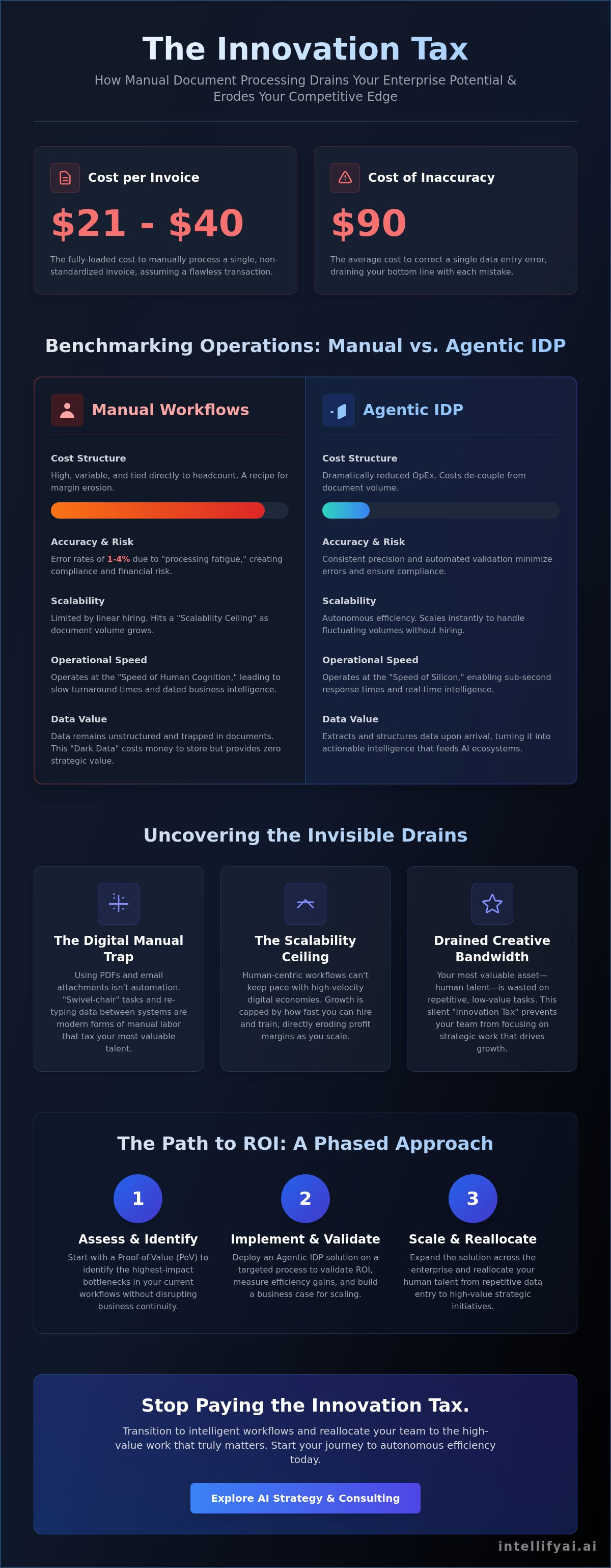
Benchmarking Operations: Manual vs. Agentic IDP
Benchmarking the cost of manual document processing against Agentic Intelligent Document Processing (IDP) reveals a divide that is no longer just quantitative; it is qualitative. While a high-performing accounts payable clerk can manually process between 25 and 40 invoices per day, an agentic system handles thousands of documents per second. This shift represents a move from linear, human-dependent output to elastic, cloud-native scalability. You're no longer constrained by the physical limits of a 9-to-5 processing window. Instead, you gain a 24/7 autonomous operation that eliminates backlogs entirely. The financial impact is immediate. The cost to process a single invoice drops from a median of $21.40 to under $1 when using full AI-powered automation.
Throughput and Efficiency Gains
Traditional workflows are bound by human variability and the inevitable fatigue of repetitive labor. Agentic IDP provides consistent precision that fundamentally alters your financial reporting cycles. Month-end closing, which typically takes days of manual reconciliation and data entry, can be compressed into hours. Our i_Nova solution redefines the speed of extraction by utilizing advanced neural architectures that process documents 10 to 50 times faster than manual entry. This isn't just about raw speed. It's about the financial agility that comes from having real-time data ready for analysis. When your processing capacity is decoupled from headcount, you can scale your operations without a corresponding increase in OpEx.
Security and Governance Benchmarks
Manual document handling introduces significant security risks, from lost physical files to unauthorized digital access during the "swivel-chair" transfer of data. In contrast, agentic workflows are encrypted and fully auditable from the moment of ingestion. Automated redaction ensures that sensitive information is protected, maintaining strict GDPR compliance without requiring manual intervention. Version control becomes a native feature of your document management system rather than an administrative burden. This creates a robust governance framework that protects your enterprise from the multi-million dollar penalties associated with regulatory failures. Transitioning to these systems ensures that your data is both accessible and secure.
Modernizing your back-office operations requires a partner with deep technical expertise and a focus on long-term viability. Explore our Agentic AI Engineering Services to build a custom path to autonomous efficiency and secure your competitive edge in 2026.
Transitioning to Intelligent Workflows: The Path to ROI
Dismantling the status quo requires more than just new software. It demands a strategic realignment of how your enterprise handles its most fundamental asset: data. The most effective way to reduce the cost of manual document processing without risking business continuity is through a Proof-of-Value (PoV) approach. Start by identifying high-impact, low-complexity wins where automation can deliver immediate results. This method allows you to validate the technology in a controlled environment before scaling across the organization. It's about building confidence through measurable execution.
Phased implementation is the key to a frictionless transition. Most enterprises begin by moving from legacy OCR systems, which often require heavy manual validation, to Agentic IDP. This progression ensures that you don't disrupt existing operations while you modernize. Success shouldn't be measured solely by "time saved." Instead, focus on "value created." When you shift document management to an autonomous model, you're positioning IDP as a critical pillar of your broader Enterprise AI Strategy. You aren't just fixing a workflow; you're building a foundation for agentic intelligence.
Identifying Your Automation North Star
Begin with a rigorous audit of your current workflows to locate the most expensive manual bottlenecks. Not all documents are created equal. You need to select a technology stack that specifically excels at unstructured data extraction, as this is where most "dark data" resides. For unique document types or complex industry-specific forms, off-the-shelf solutions often fail. This is where custom Agentic AI Engineering becomes essential. Tailoring the extraction logic to your specific business rules ensures that the output is immediately actionable and requires zero human intervention.
Calculating Your Expected ROI
A realistic ROI framework looks beyond the first quarter. We recommend projecting savings over a 12, 24, and 36-month horizon to capture the full impact of the "Innovation Dividend." In the first year, savings are primarily driven by the reduction in direct labor and error remediation. By year three, the primary value comes from the strategic reallocation of resources toward high-growth initiatives. By eliminating the structural cost of manual document processing, you unlock capital and creative bandwidth that was previously trapped in administrative loops. This is the ultimate benchmark of a successful digital transformation. Ready to quantify your potential savings? Contact IntellifyAi for a Strategic ROI Audit and begin your path to autonomous efficiency.
Secure Your Enterprise's Autonomous Future
Transitioning from human-dependent workflows to agentic intelligence is no longer a luxury; it's a prerequisite for relevance. We've quantified how the cost of manual document processing acts as a persistent drain on both capital and creative potential. By moving beyond legacy systems, you eliminate the error multiplier and reclaim the "Innovation Dividend" trapped in unstructured data. True digital transformation requires a shift from reactive data entry to proactive, actionable intelligence.
Our i_Nova platform provides the precision needed for complex unstructured data extraction, backed by global expertise in Agentic AI engineering. We maintain an uncompromising focus on enterprise-grade GRC and compliance to ensure your modernization is secure and scalable. It's time to transform your back office from a cost center into a strategic engine of growth. Book a Strategic AI Consulting Session to eliminate your manual processing overhead and begin your journey toward frictionless operations. Your organization's potential is too valuable to be lost in administrative loops. Embrace the liberating force of advanced technology today.
Frequently Asked Questions
How do you calculate the cost of manual document processing?
Calculation involves the product of your monthly document volume, the average time spent per document, and your fully loaded labor rate. This rate must include base salary plus benefits, taxes, and facility overhead to reflect the true cost of manual document processing. Management oversight and quality assurance cycles should also be factored into the final equation to establish a realistic financial baseline.
What is the average error rate for manual data entry in 2026?
The average error rate for manual data entry in 2026 remains between 1% and 4%. While this sounds low, Gartner's 2026 data quality index shows this rate is 67% higher than automated methods. These inaccuracies are expensive because they trigger a cascade of downstream corrections that drain organizational resources and damage vendor relationships.
How does Intelligent Document Processing (IDP) differ from traditional OCR?
Traditional OCR simply converts images into text without understanding the content's meaning. IDP uses advanced neural architectures to extract context, intent, and relationships within a document. It transforms unstructured text into structured, actionable data that integrates directly into your enterprise ecosystem. This allows for autonomous decision-making rather than just digitizing paper.
What are the most common hidden costs of manual document management?
Hidden costs include error remediation fees, which range from $15 to $90 per mistake, and missed early payment discounts. Most companies relying on manual workflows capture only 20% to 30% of available vendor discounts. You must also account for the high price of employee turnover caused by administrative burnout and the "Innovation Tax" of lost creative bandwidth.
Can Agentic AI handle unstructured documents like handwritten notes or complex legal contracts?
Yes, modern Agentic AI is designed specifically for high-complexity, unstructured formats. Through custom Agentic AI Engineering Services, models interpret various handwriting styles and extract specific clauses from dense legal contracts. These systems understand the semantic structure of the document, ensuring high precision across diverse templates and non-standardized layouts that traditional software cannot process.
What is the typical ROI timeline for switching to an IDP platform like i_Nova?
Most enterprises see a significant return on investment within the first 12 months of implementation. Our i_Nova platform accelerates this timeline by reducing the cost of manual document processing from over $20 per document to under $1. Long-term ROI continues to grow over 36 months as organizations reallocate human talent to high-value strategic initiatives.
How does manual processing impact enterprise compliance and GRC?
Manual processing creates significant gaps in your Governance, Risk, and Compliance (GRC) framework. Human fatigue leads to oversight failures that can result in compliance violations exceeding $4 million for mid-sized firms. Automated workflows provide an immutable, encrypted audit trail that ensures every document is handled according to strict regulatory standards without the risk of human error.
Is manual document processing still viable for small-scale operations?
Manual workflows are increasingly difficult to justify even for smaller teams. While the document volume may be lower, the opportunity cost of tying up skilled workers in rote tasks is often higher for growing companies. Moving to an automated model early prevents the need for linear hiring and allows the organization to scale its operations without a corresponding spike in OpEx.









.svg)