
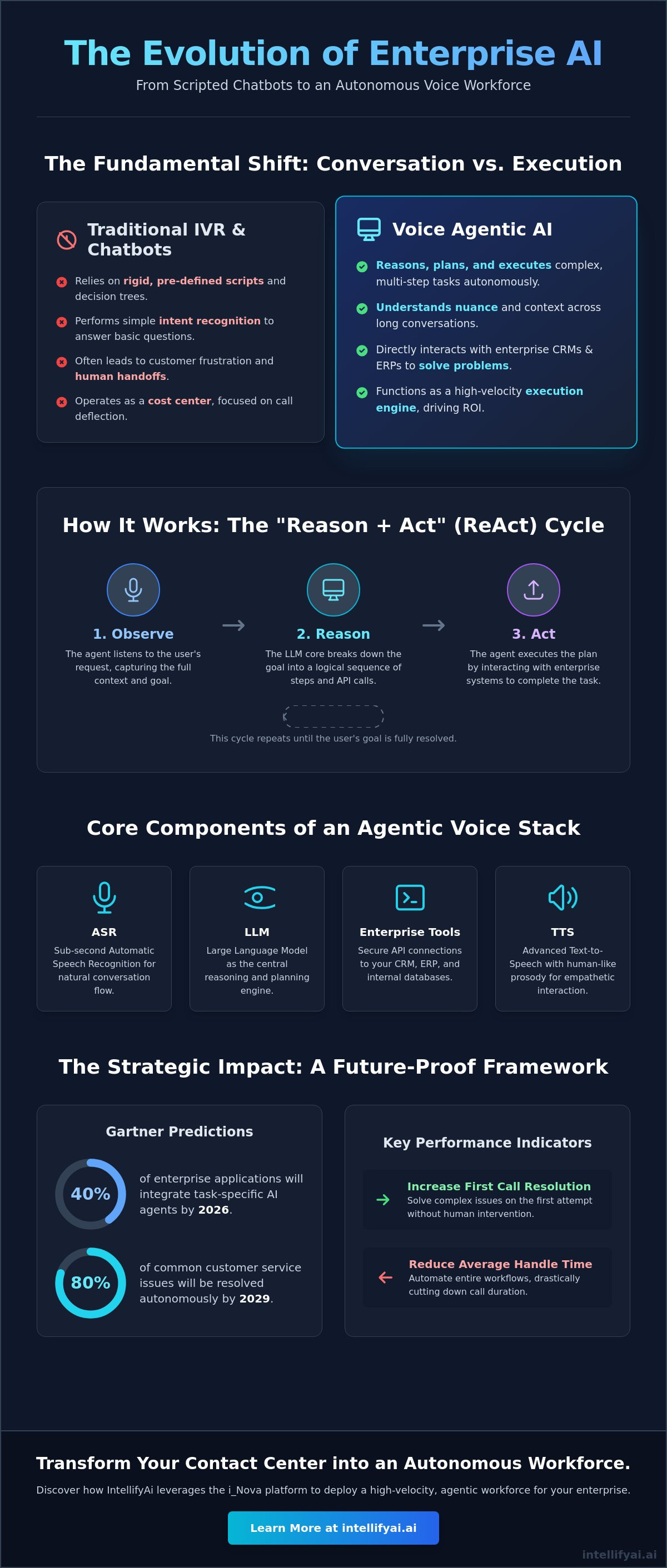
The era of the conversational chatbot is over; the era of the autonomous enterprise workforce has arrived. While traditional IVR systems and basic bots have long frustrated customers with rigid scripts, voice agentic ai is redefining the boundary between conversation and execution. Gartner predicts that 40% of enterprise applications will integrate task-specific AI agents by the end of 2026. This shift represents a move away from systems that simply answer questions toward an intelligent architecture that takes decisive action.
You likely recognize the strain of rising operational costs in your contact centers and the difficulty of scaling human-level personalization. It's a common challenge for serious enterprises looking to modernize without sacrificing quality. This guide will show you how to deploy a workforce of voice agents capable of handling complex transactions autonomously, effectively reducing Average Handle Time and increasing First Call Resolution. We'll explore the shift from scripted logic to agentic architecture, the critical regulatory landscape including TCPA compliance, and the strategic framework for integrating these tools into your existing enterprise operations.
Key Takeaways
• Understand the fundamental shift from traditional NLU-based chatbots to goal-oriented voice agentic ai that reasons and executes tasks autonomously.
• Learn how the "Reason + Act" (ReAct) cycle enables agents to interact directly with enterprise CRMs and ERPs to complete transactions without human intervention.
• Quantify the strategic impact on your bottom line by analyzing improvements in First-Contact Resolution (FCR) and significant reductions in Average Handle Time (AHT).
• Deploy a future-proof 2026 framework that prioritizes data engineering foundations and identifies high-impact opportunities for voice automation.
• Discover how IntellifyAi leverages the i_Nova platform to transform your contact center into a high-velocity, autonomous workforce.
What is Voice Agentic AI? Defining the Next Evolution of Interaction
Voice agentic ai represents a fundamental shift from systems that merely process speech to systems that possess agency. While traditional conversational AI focuses on intent recognition and scripted responses, agentic systems are defined by their ability to reason, plan, and execute. This technology functions as an autonomous workforce capable of navigating complex workflows without human intervention. To understand the foundation of this shift, it's helpful to consider What is an AI Agent? at its core: a goal-directed entity that perceives its environment and takes actions to achieve specific results. In the enterprise, this means moving beyond "answering" a caller to "solving" for the caller by interacting directly with backend systems.
To better understand how this technology transforms the enterprise landscape, watch this helpful overview of next-generation agentic systems:
The Shift from IVR to Autonomous Agency
Core Components of an Agentic Voice Stack
Building an effective agentic workforce requires a sophisticated integration of several high-performance layers. First, Automatic Speech Recognition (ASR) must operate with sub-second latency to ensure the conversation feels natural and responsive. Second, the LLM acts as the central reasoning engine, mapping out the logic required to navigate enterprise databases and APIs. Finally, advanced Text-to-Speech (TTS) technology provides human-like prosody, ensuring the interaction is empathetic rather than robotic. For a deeper dive into how these autonomous workflows are structured, explore our executive guide on What Is Agentic AI? to see how these components unify to drive measurable business impact.
From Listening to Acting: How Voice Agents Execute Workflows
The ReAct Framework in Voice Environments
In a live voice environment, logic must be fluid. When a customer speaks, the agent breaks the request into discrete logical steps. For instance, if a caller wants to update their billing address and then pay an outstanding balance, the agent recognizes two distinct tasks. It prioritizes the address update first to ensure the payment receipt is sent to the correct location. This requires a robust "working memory" to track progress across long-form interactions. Effective Strategic Deployment of Voice AI necessitates that these agents handle natural interruptions. If a user changes their mind mid-process, the agent must instantly recalibrate its reasoning chain without losing the context of previous steps.
Enterprise System Integration and Tool Use
Agency is meaningless without the ability to touch the systems of record. Modern voice agentic ai integrates directly with CRMs, ERPs, and legacy databases through secure APIs. This allows agents to perform high-value actions such as processing secure payments, updating medical records, or modifying logistics schedules. Reliability is maintained through "Grounding," where the agent's reasoning is anchored in your specific enterprise knowledge base rather than general training data. Before confirming any action to the user, the agent performs a verification check. It queries the backend to ensure the record was successfully updated, providing a level of precision that often exceeds manual data entry. To maintain this performance across thousands of concurrent calls, enterprises rely on MLOps and server intelligence agents to monitor backend latency and model drift in real time. If you're ready to move beyond basic automation, exploring our Agentic AI Engineering Services can help you build the infrastructure required for these autonomous workflows.
The Strategic Impact: Measuring ROI in the Agentic Era
ROI in the agentic era isn't just about reducing headcount; it's about increasing the velocity of business transactions. Traditional metrics like Average Handle Time (AHT) are transformed when voice agentic ai pre-collects data and routes calls with precision. Industry data suggests that AI-powered customer service can reduce operational costs by 20% to 30%. However, the real value lies in First-Contact Resolution (FCR). Because these agents can execute tasks in real time, they solve problems rather than just documenting them. This shifts the focus from "how fast did we hang up?" to "how effectively did we fulfill the request?"
A critical differentiator is the collaborative relationship between technology and human workers. The true autonomy of voice AI agents allows them to filter out repetitive, low-value interactions. This liberates your human experts to focus on complex, high-judgment scenarios that require empathy and strategic negotiation. This "Human-in-the-loop" model ensures that when a situation escalates beyond the agent's guardrails, a human professional steps in with full context. This isn't a replacement strategy. It's a capacity expansion strategy that positions AI as a revenue-generating asset rather than a cost centre.
Beyond Cost Savings: Revenue and CX Gains
Frictionless service directly correlates with improved CSAT and NPS scores. By offering 24/7 availability, enterprises eliminate the frustration of wait times and rigid IVR menus. These agents also provide unmatchable scale for consistent upselling and re-engagement campaigns. They maintain perfect adherence to brand guidelines while processing transactions at any time of day. To align these capabilities with your broader business goals, a structured Enterprise AI Strategy Consulting framework is essential for identifying high-revenue opportunities within your existing customer journeys.
Security, Compliance, and Trust Frameworks
Trust is the currency of the digital enterprise. Managing data privacy in autonomous voice agentic ai interactions requires rigorous audit trails and version control. With the FCC's 2024 ruling classifying AI voices under the TCPA, mandatory consent and clear disclosures are non-negotiable. Violations can lead to penalties of $500 to $1,500 per call, making compliance a cornerstone of any deployment. Implementing strict guardrails prevents hallucinations and ensures every interaction remains within regulatory and ethical boundaries. This disciplined approach protects the enterprise while delivering the high-performance automation modern markets demand.
Building a Scalable Voice Agent Strategy: A 2026 Framework
Deploying voice agentic ai at scale requires more than a software installation; it demands a fundamental rethink of your communication architecture. Success begins with a rigorous audit of your existing voice journeys. You must identify high-friction points where customers are currently trapped in rigid IVR loops or where human agents are bogged down by repetitive data entry. By prioritizing these high-impact opportunities, you ensure that your initial pilot delivers a measurable return on investment while proving the viability of autonomous execution. Gartner predicts that 40% of enterprise applications will have integrated task-specific AI agents by the end of 2026, making this the critical window for establishing your strategic roadmap.
A successful implementation rests on a solid data engineering foundation. Real-time model grounding ensures your agents access the most current enterprise data, preventing the static responses typical of older systems. This foundation allows the agent to reason through a request with the same context as a human employee. Selecting the right engineering partner is vital here. You need a team that understands how to bridge the gap between abstract LLM capabilities and the practical requirements of your legacy databases and secure APIs. Once the foundation is set, you can move from a controlled pilot to a full-scale deployment using robust MLOps pipelines to ensure long-term reliability.
Modernizing the Contact Centre Infrastructure
Legacy on-premise IVR systems are the primary bottleneck for modernization. These systems lack the elasticity and processing power required for real-time reasoning. Transitioning to a cloud-native agentic solution allows your enterprise to handle fluctuating call volumes without sacrificing performance. This move isn't just about changing hosting; it's about integrating voice agents into a unified CX improvement framework that connects every touchpoint. If you're ready to build a resilient, autonomous workforce, consult our specialists in Agentic AI Engineering Services to begin your architectural audit.
The Role of MLOps in Voice Performance
Voice performance is not a "set and forget" metric. Continuous monitoring of latency, sentiment, and emotional signals is required to maintain a human-like experience. By establishing a robust MLOps pipeline, enterprises can surface failure patterns in real time, allowing for iterative improvements to the agent's reasoning capabilities. This disciplined approach to model management prevents performance drift and ensures your voice agentic ai remains a dependable asset. For a detailed breakdown of how to manage these complex systems, explore our MLOps Pipelines Guide to learn about enterprise-grade automation standards.
Why IntellifyAi is the Architect of Voice Agentic AI
IntellifyAi stands at the intersection of sophisticated engineering and strategic business transformation. We don't just deploy software; we architect autonomous workforces. Our approach to voice agentic ai is grounded in the reality that every enterprise possesses unique legacy constraints and specific operational goals. We function as a bridge between the abstract potential of large language models and the practical necessity of measurable financial returns. By providing an end-to-end service model, we guide our partners from initial AI Strategy & Consulting through to custom cloud-native execution. This ensures that your transition to an agentic architecture is both seamless and sustainable.
The synergy between our custom voice agents and the i_Nova platform represents a new standard for enterprise intelligence. While others offer fragmented tools, we provide a holistic philosophy that treats AI as a central business pillar. Our methodology prioritizes the stability and security of your operations while pushing the boundaries of what autonomous systems can achieve. We focus on long-term viability, ensuring that your investment in automation continues to deliver value as the technological landscape evolves toward 2030 and beyond.
Custom Engineering for Complex Enterprise Needs
Off-the-shelf retail software often fails to meet the rigorous demands of a global enterprise. These generic tools lack the deep integration capabilities required to navigate complex ERPs or maintain the security standards essential for regulated industries like finance and healthcare. At IntellifyAi, we prioritize custom engineering that respects your existing infrastructure. We build agents that are intrinsically linked to your data architecture, ensuring every interaction is grounded in your specific business logic. Explore Our Products and Platforms to see how the i_Nova Voice engine creates a seamless synergy between autonomous action and existing corporate systems.
Unlocking Human Potential Through Automation
Our philosophy is rooted in the belief that technology should liberate rather than replace. By removing the burden of repetitive, high-volume tasks, we empower your human workforce to focus on high-value creative and strategic work. This collaborative relationship is the hallmark of a modern digital transformation. As your Strategic Architect, we ensure that every deployment is stable, secure, and intensely focused on the bottom line. We don't just solve for today's inefficiencies; we future-proof your organization for the next era of commerce. Ready to modernize your operations? Connect with our team at IntellifyAi to begin your journey toward a frictionless, automated future.
Architecting the Future of Autonomous Voice
The transition from conversational interfaces to autonomous execution is a strategic necessity for the modern enterprise. You've seen how voice agentic ai moves beyond simple intent recognition to navigate complex workflows and interact with core systems. This shift turns the contact center into a high-velocity execution engine that improves First-Contact Resolution while liberating your human experts for high-value work. Success in the agentic era requires a disciplined approach to data engineering and a robust MLOps framework to ensure long-term stability.
With a global presence across the UK, USA, India, and UAE, IntellifyAi provides the deep technical expertise required to bridge the gap between abstract technology and measurable business growth. Our end-to-end strategy and flagship i_Nova platform ensure your automation is both secure and scalable. It's time to move beyond the limitations of legacy systems and embrace a future where technology and human potential work in perfect synergy. Partner with IntellifyAi to engineer your autonomous voice workforce and secure your position at the cutting edge of the agentic era. The path to a frictionless, automated future starts with a single strategic decision.
Frequently Asked Questions
What is the difference between a chatbot and a voice agentic AI?
A chatbot typically follows pre-defined scripts or intent-based logic to provide information. In contrast, voice agentic ai possesses the agency to reason and execute tasks autonomously. While chatbots are conversational, agentic systems are goal-oriented. They use a "Reason + Act" cycle to solve problems by interacting with backend tools, moving beyond simple retrieval to end-to-end task completion.
How does voice agentic AI handle security and sensitive customer data?
Security is maintained through multi-layer encryption, strict audit trails, and version control within the agent's reasoning chain. Enterprises must ensure compliance with regulations like GDPR and the TCPA, which requires mandatory consent for AI-generated voices. Systems are grounded in specific enterprise knowledge bases to prevent hallucinations and ensure that all sensitive data remains within secure, authorized environments.
Can voice agents integrate with my existing legacy CRM system?
Yes, these agents integrate with legacy CRM and ERP systems through secure APIs and custom middleware. Engineering services focus on bridging the gap between modern LLM reasoning and older database architectures. This allows the agent to update records, retrieve customer history, and process transactions in real time without requiring a complete and costly overhaul of your existing infrastructure.
What is the typical ROI timeline for an enterprise voice agent deployment?
Most enterprises realize a return on investment within six to twelve months, depending on call volume and workflow complexity. Initial gains often stem from reduced Average Handle Time and improved First-Contact Resolution. By automating repetitive tasks, businesses can reduce operational costs by 20% to 30%, while scaling personalized service without the need for additional human headcount.
How does agentic AI handle natural human interruptions during a call?
Agentic AI handles interruptions through a sophisticated "working memory" and real-time latency optimization. Unlike rigid IVR systems, these agents can pause, process new verbal input, and recalibrate their reasoning chain instantly. This allows for fluid, multi-turn conversations where the user can change their mind or ask a clarifying question mid-process without breaking the logic of the transaction.
Is voice agentic AI safe for highly regulated industries like banking?
Voice agentic ai
is designed for highly regulated sectors by incorporating strict guardrails and compliance frameworks. In banking, agents can handle secure identity verification and transaction processing while maintaining high operational standards. The use of server intelligence agents ensures continuous monitoring, making the system a stable partner for institutions that require intense focus on security and regulatory integrity.
What should I look for when evaluating a voice AI engineering partner?
Look for a partner with deep technical expertise in both LLM reasoning and enterprise modernization. A strategic partner should offer end-to-end services, from strategy consulting to cloud-native execution. Ensure they have a proven track record in data engineering and MLOps, as these components are critical for maintaining long-term viability and managing the complex security requirements of a global enterprise.









.svg)