
Eighty percent of your enterprise intelligence is currently dormant. It's trapped in formats that traditional systems cannot read. The global market for unstructured data extraction tools is expanding rapidly, yet most organizations still rely on legacy OCR that fails on complex layouts. You've likely realized that scaling requires more than basic digitisation. It demands a sophisticated pipeline that turns raw text into autonomous fuel for Agentic AI.
We'll bridge the gap between technical potential and your business needs. You'll gain a clear framework for choosing between enterprise-grade and open-source solutions. We'll ensure your selection aligns with the 2026 CCPA updates regarding automated decision-making. This article provides a strategic roadmap to integrate extracted data into your agentic workflows. We'll show you how to reduce manual back-office costs while unlocking human potential for high-value work. We move from a high-level vision into the specific requirements for a frictionless, automated future.
Key Takeaways
• Understand how Vision-Language Models (VLMs) and modern partitioners bridge the gap between complex document layouts and clean, LLM-ready data.
• Evaluate the strategic trade-offs of various unstructured data extraction tools to ensure your enterprise balances cost-efficiency with rigorous SOC2 and GDPR compliance.
• Identify the optimal path for your data ingestion by choosing between rule-based, machine learning, or large language model extraction methodologies.
• Learn to architect an end-to-end pipeline that transforms dormant text into actionable intelligence for autonomous agentic workflows.
• Explore how integrating a dedicated intelligence engine can modernize your contact center and back-office functions through professional Agentic AI Engineering Services.
Why Unstructured Data Extraction Tools are the Foundation of Enterprise AI
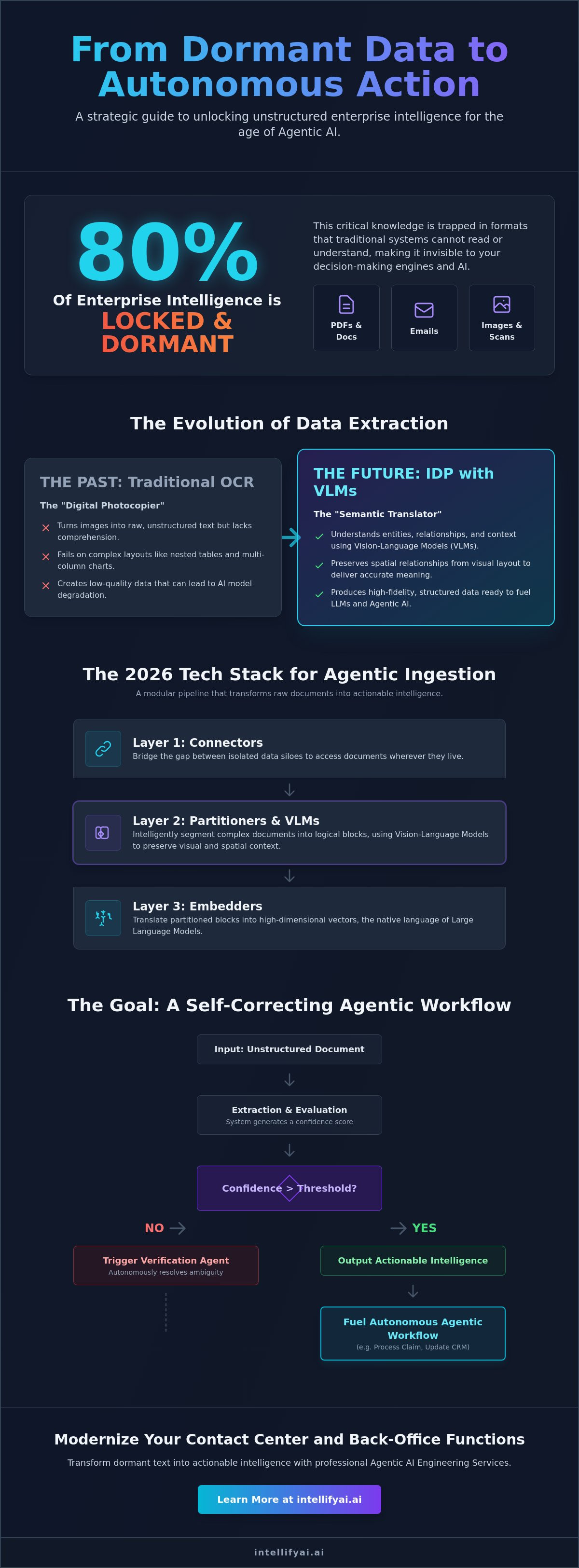
In 2026, the competitive divide is defined by a company's ability to process what it already knows. While databases are organized, what is unstructured data represents the vast majority of corporate knowledge. Most estimates confirm that 80% of enterprise information remains trapped in PDFs, emails, and images. Without modern unstructured data extraction tools, this information is effectively invisible to your decision-making systems.
Traditional OCR was a digital photocopier. It turned images into text but lacked comprehension. Today, Intelligent Document Processing (IDP) acts as a translator. It doesn't just see characters; it understands entities and relationships. This transition is critical because Large Language Models (LLMs) require high-fidelity structured data to function without error. High-quality extraction is the fuel that prevents model degradation.
To better understand this concept, watch this helpful video:
The Economic Cost of Inaccessible Data
From Ingestion to Actionable Intelligence
Simple extraction pulls raw text. Semantic extraction captures meaning, hierarchy, and context. This distinction is vital for Agentic AI workflows. These autonomous systems need structured inputs to execute complex tasks, such as processing a claim or updating a CRM, without human intervention. Our visionary approach at IntellifyAi focuses on this transformation. We provide the AI Strategy & Consulting necessary to turn raw ingestion into actionable intelligence that drives real financial returns. By removing the burden of repetitive tasks, we allow your business to focus on high-value creative work.
The 2026 Tech Stack: How Agentic AI Redefines Data Ingestion
The 2026 tech stack moves beyond simple ingestion into the realm of intelligent orchestration. Modern unstructured data extraction tools are now composed of three core layers: Connectors, Partitioners, and Embedders. Connectors bridge the gap between isolated data siloes. Partitioners segment complex documents into logical blocks. Embedders then translate those blocks into high-dimensional vectors. This modularity allows enterprises to swap components as new models emerge. It ensures long-term viability without requiring a total system overhaul.
Vision-Language Models (VLMs) represent the most significant leap in this stack. While traditional tools struggled with nested tables or multi-column charts, VLMs process visual and textual data simultaneously. For instance, Gemini 3.5 Flash, released in May 2026, powers advanced extraction by treating the document as a single multimodal input. This ensures that the spatial relationship between data points is preserved. It's the difference between seeing a list of numbers and understanding a financial balance sheet.
We're seeing the rise of "Agentic Ingestion." In this model, the extraction tool doesn't just output text; it evaluates its own output. If a confidence score falls below a threshold, the system autonomously triggers a secondary verification agent to resolve the ambiguity. This self-correction loop is a cornerstone of Agentic AI. It turns document-heavy processes into self-sustaining workflows that require minimal human oversight.
Beyond OCR: The Rise of Multimodal Extraction
Traditional OCR frequently fails when encountering non-standard layouts. Blueprints, medical forms, and handwritten logs present structural challenges that rule-based systems cannot solve. The U.S. government definition of unstructured data highlights its lack of a pre-defined data model. This is why zero-shot extraction is revolutionary. By using multimodal LLMs, 2026 tools "read" documents with human-like comprehension. They don't require prior training on specific templates to find the information you need.
The Role of Custom AI Engineering
Off-the-shelf software has limits. For highly specialized industries, custom engineering becomes a strategic necessity. Maintaining accuracy over time requires robust MLOps to monitor for model drift and data shifts. Our Agentic AI engineering services focus on building these bespoke pipelines for serious enterprises. We bridge the gap between abstract technical potential and your specific operational needs. If you're ready to modernize your back-office, our AI Strategy & Consulting team can help you architect the right solution.
Evaluating Extraction Tools: Open-Source Libraries vs. Enterprise IDP Platforms
Choosing between unstructured data extraction tools requires a rigorous evaluation of the Total Cost of Ownership (TCO). While open-source libraries offer zero licensing fees, the engineering talent required to maintain them is a significant overhead. In 2026, 62% of organizations report a skills gap in AI data management. This shortage makes the "build" route risky for enterprises without deep internal expertise. Scaling from 1,000 documents to 10 million in production isn't just about compute; it's about maintaining accuracy across diverse schemas without constant manual intervention.
Security and compliance add another layer of complexity to this decision. The updated CCPA regulations effective January 1, 2026, mandate privacy risk assessments for automated decision-making. Enterprise platforms often include these safeguards by design. They provide SOC2 compliance and detailed audit trails that are difficult to replicate in-house. For a deeper look at the technical foundations, consider this academic overview of web data mining tools. These official standards ensure your data ingestion remains a lasting investment in relevance rather than a temporary fix.
Developer experience versus business user accessibility is the final pivot point. Developers value the granular control of APIs and modular pre-processing. However, business leaders require visibility and clarity. Modern enterprise solutions bridge this gap by providing intuitive dashboards alongside robust technical backends. This allows your team to focus on high-value creative work while the system handles the repetitive burden of data validation.
When to Choose Open-Source (e.g., Unstructured-IO, LangChain)
Open-source is ideal for rapid prototyping and developer-led experimentation. It allows your team to test logic without procurement delays. If your sector demands absolute data sovereignty, local deployment of these libraries ensures sensitive information never leaves your firewall. You must account for the hidden costs, though. Infrastructure management and the continuous refinement of extraction logic often exceed the price of a SaaS subscription over a three-year horizon.
The Case for Enterprise IDP Platforms
Enterprise-grade Intelligent Document Processing (IDP) platforms prioritize operational stability. They offer human-in-the-loop (HITL) interfaces to resolve low-confidence extractions, ensuring your ground truth remains accurate. Pre-built connectors to systems like SAP or Salesforce allow for immediate impact on your bottom line. Our i_Nova platform embodies this Strategic Architect approach. It's designed to feed directly into our Agentic AI Engineering Services, creating a frictionless path from raw ingestion to autonomous action. If you're looking for a partner to modernize your back-office, our AI Strategy & Consulting team can help you map the most efficient route.
Strategic Implementation: Integrating Extracted Data into Autonomous Workflows
Turning raw ingestion into a competitive advantage requires a structured execution plan. Implementation begins with a rigorous audit of your existing document repositories. You must identify high-value extraction targets that offer the greatest impact on your bottom line. Once these targets are clear, the next step involves selecting the right methodology. While legacy rule-based systems offer predictability, modern unstructured data extraction tools leverage LLM-based approaches for high-velocity environments where templates are constantly shifting.
The technical output must follow a strict schema. Whether you choose JSON, CSV, or a Vector Store, the structure must align with the requirements of your downstream systems. This leads to the orchestration phase. Here, you integrate the extracted data into agentic workflows that execute business logic without human intervention. To maintain accuracy, establish a robust MLOps framework for continuous governance and quality control. This ensures that your extraction pipeline remains resilient as your data volume grows toward the 10PB threshold common in 2026 enterprises.
Bridging the Gap to Enterprise Modernization
Extraction isn't an isolated task; it's the foundational layer of Enterprise Modernization. This process initiates the "Data Flywheel." High-quality extraction leads to more accurate AI models, which in turn improve the quality of future data ingestion. Version control is essential in these pipelines. You must track changes in extraction logic to ensure historical data remains consistent with current business rules.
Ensuring Governance and Compliance
Contextual Governance is vital when handling automated document processing. Your systems must be capable of identifying and redacting PII (Personally Identifiable Information) in real-time during the extraction phase. This is critical for meeting the 2026 CCPA updates regarding automated decision-making and privacy risk assessments. By maintaining transparent extraction logs, you create "Audit-Ready" AI systems that satisfy both internal stakeholders and external regulators. If you're ready to architect a secure, autonomous future, our Agentic AI Engineering Services provide the technical expertise to build these complex pipelines.
Beyond Extraction: Unlocking Actionable Intelligence with i_Nova
The final stage of digital maturity is the transition from data engineering to true Enterprise Transformation. While general unstructured data extraction tools provide the raw ingredients, the i_Nova platform serves as the intelligence engine that synthesizes them. It's not enough to simply have clean data. You need a system that understands how to apply that information within your specific operational context. We integrate i_Nova with our AI Strategy & Consulting to ensure your technology stack serves your bottom line and drives measurable growth.
This is where the "Agentic" advantage becomes visible. i_Nova doesn't just store extracted text; it empowers AI agents to act upon it. By providing high-fidelity, structured inputs, the platform allows autonomous agents to execute complex back-office tasks and improve contact center responsiveness. This capability turns your document repositories into a live, reacting knowledge base. It liberates your human workforce from the burden of repetitive data validation, allowing them to focus on high-value creative work that moves the needle for your enterprise.
The i_Nova Difference: Intelligence Over Ingestion
Standard tools often baffle when faced with complex enterprise formats or non-standard layouts. i_Nova handles these challenges with a sophisticated multimodal architecture that treats every document as a strategic asset. It goes beyond simple ingestion by enriching data with external context during the extraction process. This ensures that every data point is accurate, contextualized, and strategically relevant to your goals. We invite you to explore the full suite of IntellifyAi Products to see how we architect frictionless, automated futures for serious organizations.
Partnering for Strategic AI Success
Choosing an extraction tool is a long-term investment in your company's relevance. It's a strategic partnership that ensures your operations remain ahead of the curve in an increasingly automated market. We help leaders move beyond the limited scope of a "Proof of Concept" and into scalable, stable production environments. Our approach treats technology as a holistic business pillar rather than a temporary software fix. This focus on stability and security guarantees that your digital transformation is both impactful and permanent. Contact our Strategic Architects to modernize your data workflow and unlock the full potential of your enterprise intelligence.
Architecting Your Autonomous Future
The shift from passive ingestion to agentic intelligence is no longer a theoretical goal. It is a functional requirement for any enterprise managing massive datasets in 2026. You now understand that the right unstructured data extraction tools do more than parse text; they provide the structured ground truth necessary for autonomous decision-making. By moving through a deliberate implementation roadmap and choosing platforms built for scale, you eliminate the friction of manual back-office tasks and unlock human potential for high-value work.
We bridge the gap between technical complexity and business-centric outcomes. Our flagship i_Nova platform provides the intelligent document processing foundation needed for this transformation. As a partner trusted by global enterprises for Agentic AI engineering, we offer strategic consulting led by industry veterans to ensure your modernization remains a lasting investment in relevance. It's time to turn your dormant documents into a proactive competitive advantage and a self-sustaining engine for growth.
Transform your enterprise data into autonomous intelligence with i_Nova
Frequently Asked Questions
What are the best unstructured data extraction tools for PDFs in 2026?
Leading enterprise options include Amazon Textract, Google Document AI, and Nanonets. As of May 2026, Amazon Textract version 3.1026.0 and Google’s Gemini 3.5 Flash-powered processors offer high-fidelity parsing for complex PDF layouts. These platforms provide the necessary scalability for processing millions of documents while maintaining low error rates through specialized multimodal processors.
How does LLM-based data extraction differ from traditional OCR?
Traditional OCR converts images to raw text without understanding document structure, while LLM-based extraction identifies semantic meaning and context. Modern unstructured data extraction tools use Vision-Language Models to comprehend the relationship between visual elements. This allows for zero-shot extraction, where the system identifies specific fields without requiring a pre-defined template or prior training.
Can unstructured data extraction tools handle handwritten documents or complex tables?
Yes, 2026 tools manage these challenges through multimodal processing and Mixture-of-Experts models. Nanonets introduced OCR-3 in April 2026 specifically to handle these non-standard layouts. These systems preserve the spatial context of nested tables and use advanced handwriting recognition to ensure accuracy in medical forms, legal filings, and historical logs.
What is the "Buy vs. Build" trade-off for enterprise data extraction?
The decision rests on your internal engineering capacity and specific compliance needs. Building with open-source libraries offers absolute data sovereignty but carries significant hidden costs in maintenance and talent. Buying an enterprise IDP platform provides immediate SOC2 security and built-in audit trails, allowing your organization to focus on high-value creative work instead of infrastructure management.
How do I ensure data privacy when using AI-driven extraction tools?
Maintain compliance by selecting tools that align with the 2026 CCPA updates and mandatory privacy risk assessments. Your extraction pipeline must include automated PII redaction and support for local or cloud-native deployment. Transparent extraction logs are vital for creating "Audit-Ready" AI systems that satisfy the latest regulations for automated decision-making technology.
What role does data extraction play in building Agentic AI workflows?
Data extraction provides the structured ground truth that autonomous agents require to execute business logic. Without clean inputs from unstructured data extraction tools, AI agents cannot interact with legacy document repositories or perform complex back-office tasks. Effective extraction transforms dormant text into actionable intelligence that triggers real-time, autonomous workflows across the enterprise.
How do I measure the ROI of an Intelligent Document Processing (IDP) implementation?
Measure ROI by analyzing the reduction in manual data entry costs and the decrease in document processing cycle times. You should also factor in the financial impact of eliminating human errors and the value of reclaiming employee time for strategic initiatives. Most serious enterprises find the greatest return in the long-term viability and scalability of their automated data pipelines.








.svg)