
By 2026, 70% of leading enterprises have moved beyond manual data entry, yet many still struggle to unlock the full value of their unstructured data. If you're investigating what is idp software, it's vital to recognize that the technology has evolved. It's no longer just a tool for digitizing text. Modern IDP serves as a sophisticated reasoning layer that allows Agentic AI to interpret, analyze, and act upon information trapped in complex documents.
You likely recognize the operational drag caused by data silos and the persistent inaccuracies of legacy OCR systems. These bottlenecks don't just increase costs; they stifle your ability to innovate. This guide outlines a strategy to reduce manual processing by 90% and achieve field-level accuracy rates of up to 98%. We'll preview how to integrate document data into autonomous workflows that align with the EU AI Act and global privacy standards. By the end of this article, you'll understand how to transform document processing into a high-performance engine for enterprise modernization and long-term growth.
Key Takeaways
• Understand what is idp software by distinguishing it from other IT acronyms and defining its role as a bridge between unstructured data and strategic intelligence.
• Identify the four-stage lifecycle of ingestion, classification, extraction, and validation that replaces rigid templates with neural-network understanding.
• Compare the performance gap between legacy OCR and modern IDP to eliminate the high operational costs and inaccuracies of manual data entry.
• Explore industry-specific use cases in banking and legal sectors that integrate document data directly into autonomous, high-velocity workflows.
• Preview the transition to Agentic Intelligence, where software moves beyond reading data to executing complex business actions via the i_Nova platform.
Defining IDP Software: Beyond the Acronym Ambiguity
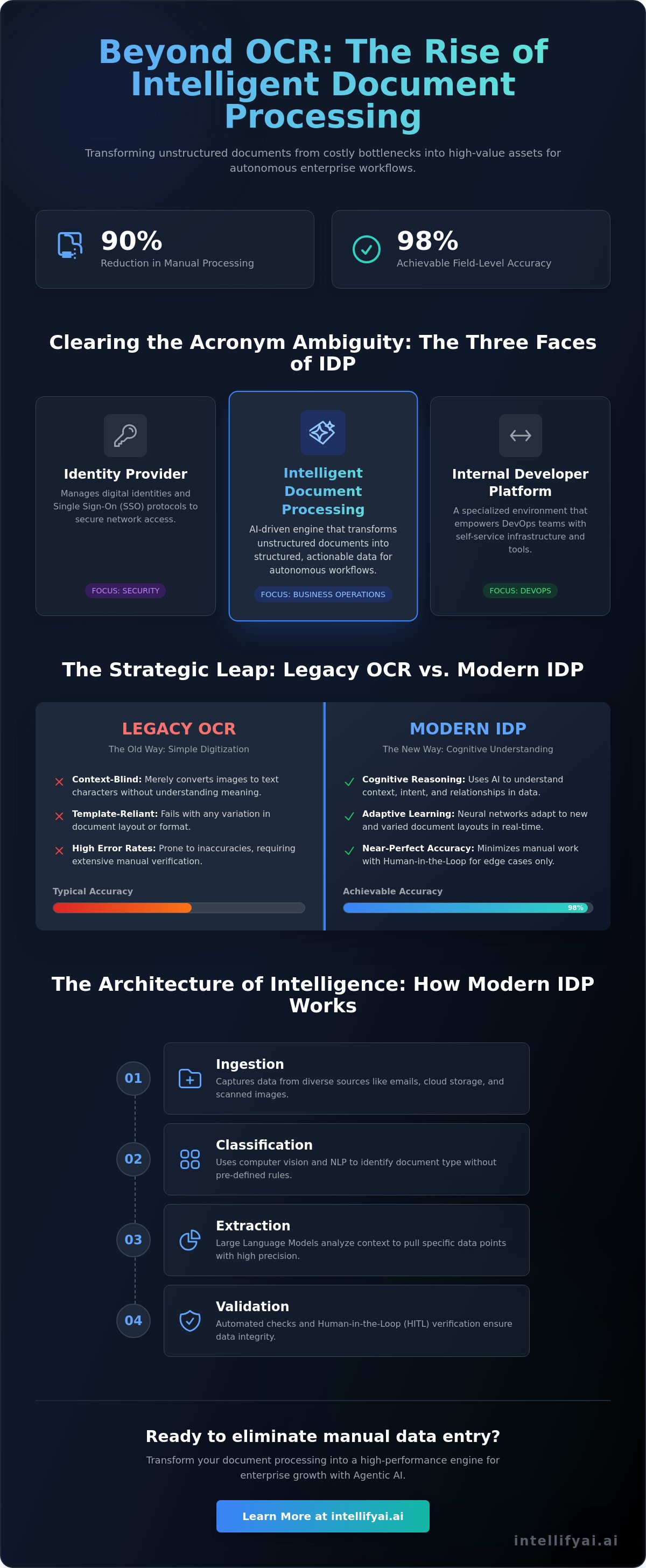
Enterprise leaders often encounter a linguistic hurdle when researching what is idp software. In technical circles, the acronym IDP serves three distinct masters. While DevOps teams use it for infrastructure and security teams for access management, business operations leaders use it to solve a $1.3 trillion problem: unstructured data. Understanding the difference is the first step toward reclaiming your operational efficiency.
To better understand this concept, watch this helpful video:
Intelligent Document Processing (IDP) is the AI-driven technology that transforms unstructured documents into structured, actionable data by combining machine learning with natural language understanding. It acts as a reasoning layer for the modern enterprise. Traditional tools fail because they only see pixels, not context. Most organizations are currently drowning in "Dark Data." Approximately 80% of all enterprise information exists in formats that traditional databases cannot read. This creates a massive intelligence gap that prevents true system autonomy.
The Three Faces of IDP in 2026
To ensure your strategic roadmap is accurate, you must distinguish between these three technologies. Identity Providers (IdP) focus on managing digital identities and Single Sign-On (SSO) protocols to secure network access. Internal Developer Platforms (IDP) are specialized environments that empower DevOps teams with self-service infrastructure. Finally, Intelligent Document Processing (IDP) is the engine of document intelligence. It's the only one of the three designed to turn static documents into fuel for autonomous business workflows.
Why Intelligent Document Processing is the Enterprise Priority
Ignoring unstructured data is no longer a viable strategy. Every unread invoice, unindexed contract, and siloed email represents a loss in operational efficiency and financial clarity. This "Dark Data" hides risks and obscures opportunities. When evaluating what is idp software for your organization, remember that the goal isn't just digitization; it's the elimination of manual labor in favor of high-value strategic oversight.
Transitioning your workforce away from the drudgery of data entry allows them to focus on creative problem-solving and growth. This shift is essential for long-term viability. At IntellifyAi, we view IDP as a foundational pillar of enterprise modernization. Our approach ensures that your data engineering efforts lead directly to measurable performance gains and a frictionless, automated future.
The Architecture of Intelligence: How Modern IDP Works
Understanding what is idp software requires looking beneath the interface at its structural foundation. Modern systems operate through a refined four-stage lifecycle: Ingestion, Classification, Extraction, and Validation. Unlike the rigid, template-reliant systems of the past, 2026-era IDP utilizes neural networks that adapt to document variations in real time. This shift from "reading" to "reasoning" is what defines the current generation of document intelligence.
The process begins with Ingestion, where the system captures data from diverse streams like emails, cloud storage, and scanned images. Classification then uses computer vision to identify the document type without needing pre-defined rules. Extraction is where the true transformation occurs. Large Language Models (LLMs) analyze the document context to pull specific data points with high precision. Finally, Validation ensures data integrity. While automation handles the bulk of the work, high-stakes scenarios still rely on Human-in-the-Loop (HITL) verification to maintain near-perfect accuracy and meet compliance standards.
From OCR to Cognitive Understanding
Legacy OCR was a simple character recognition tool. It converted images to text but lacked the "brain" to understand what that text meant. Modern IDP software bridges this gap using Natural Language Processing (NLP) to grasp intent and sentiment. Computer vision allows the software to "see" layouts like a human expert. It understands that a date near the top of a page is likely an invoice date, while one at the bottom is a due date. This cognitive layer is why modern platforms achieve field-level accuracy rates exceeding 95% for common document types.
Integration with the Enterprise Tech Stack
An IDP solution is only as valuable as its connectivity. To drive true autonomy, the software must integrate seamlessly with your existing ERP, CRM, and custom databases. An API-first architecture is non-negotiable for serious enterprises looking to modernize. This ensures that extracted data flows directly into your downstream processes without manual intervention, eliminating the silos that previously trapped valuable information.
Building these connections often requires specialized expertise to ensure security and scalability across the enterprise. If your organization has complex legacy systems or unique data requirements, exploring professional Agentic AI engineering services can accelerate your deployment. Strategic implementation turns document data into a live asset rather than a static record. For those ready to modernize their operations, consulting with a technical partner ensures your architecture is built for long-term viability and performance.
IDP vs. Legacy OCR: A Strategic Comparison
In a high-velocity 2026 market, "Simple OCR" is more than just outdated; it's a liability. Relying on basic character recognition creates a brittle infrastructure that requires constant human intervention. When businesses ask what is idp software, they're often looking for a way to escape the trap of legacy systems that fail the moment a vendor moves a logo or changes an invoice font. This brittleness creates significant technical debt, as IT teams must constantly build and maintain new templates to keep the system functioning.
Legacy OCR typically hits an accuracy ceiling between 60% and 70% on semi-structured documents. This forces your team into a cycle of manual corrections that negates the benefits of automation. Modern IDP software achieves field-level accuracy of 95% or higher. It doesn't just look for text at specific coordinates. It uses reasoning to identify data points like "Total Amount" regardless of where they sit on the page. This adaptability transforms document processing from a source of maintenance costs into a strategic asset that scales with your business.
Capability Benchmark: Rules vs. Reasoning
Template-based systems are fragile. They break when document formats vary even slightly, leading to processing delays and data silos. IDP utilizes contextual extraction, meaning it understands the semantic relationship between labels and values. It also features self-learning loops. Every document processed and every human verification performed feeds back into the system, refining the underlying models. This creates a virtuous cycle of increasing efficiency and decreasing error rates without manual reprogramming.
The ROI of Intelligence
The financial impact of switching to intelligent systems is immediate. By slashing the "cost per document," enterprises can reallocate capital to high-growth initiatives rather than administrative overhead. Beyond the balance sheet, there's a human element. Removing repetitive "grunt work" significantly improves employee retention and morale. To maintain these high-performance models at scale, organizations often implement robust MLOps Pipelines. These pipelines ensure that your document intelligence remains accurate and compliant as your data environment evolves. Investing in reasoning over rules isn't just a technical upgrade; it's a commitment to long-term operational viability.
High-Impact Use Cases for Enterprise IDP Software
Understanding what is idp software only yields value when you apply it to high-stakes business processes. In 2026, the most successful enterprises use document intelligence as a prerequisite for enterprise modernization. By moving beyond simple data capture, these organizations turn static documents into the fuel for autonomous operations. This is particularly evident in the legal and compliance sectors. IDP now handles complex contract analysis and regulatory auditing by identifying non-compliant clauses across thousands of documents in seconds. With the EU AI Act enforcement beginning on August 2, 2026, this automated compliance validation is no longer optional for global firms.
Supply chain leaders also rely on this technology to maintain logistical velocity. Modern IDP software processes Bills of Lading, customs forms, and inventory tracking documents with precision. It ensures that data from disparate global vendors integrates seamlessly into centralized management systems. This eliminates the friction that often leads to port delays or inventory inaccuracies. When your software can reason through a complex customs declaration, your supply chain becomes a competitive advantage rather than a cost center.
Financial Services: Accelerating the Back Office
Banking institutions use IDP to revolutionize Know Your Customer (KYC) protocols and mortgage processing. By automating accounts payable from initial ingestion to final payment execution, firms drastically reduce operational overhead. Loan processing times have plummeted from several days to mere minutes. The ultimate goal here is Straight-Through Processing (STP). STP is an automated workflow where data moves from ingestion to final execution without any manual intervention. Achieving this level of autonomy requires the near-perfect accuracy rates that 2026-era document intelligence provides.
Healthcare and Insurance: Managing Complex Data
To see how these capabilities can be tailored to your specific operational needs, explore our AI strategy and consulting services. We help you design a roadmap that moves your back office from manual labor to strategic, AI-driven performance.
The Future of IDP: Transitioning to Agentic Intelligence
The trajectory of document intelligence is moving beyond passive observation toward active execution. In 2026, the discussion regarding what is idp software has shifted from simple data extraction to the era of Agentic IDP. This evolution represents a fundamental change in how enterprises interact with their data. Rather than merely populating a database, these systems now reason through information, initiate complex business logic, and communicate with other platforms autonomously. This capability is a core component of the broader shift toward Agentic AI, where software acts as an intelligent partner in the workforce.
Adoption rates reflect this urgency. Approximately 70% of organizations are expected to utilize some form of IDP by the end of 2026 to drive their digital transformation. This isn't just a matter of convenience; it's a financial imperative. Industry data shows that successful IDP implementation can deliver an average ROI of 200% to 300% within the first year of operation. Moving from a digital-first to an autonomous-first strategy is the next frontier for leaders seeking long-term viability and competitive advantage.
i_Nova: Intelligence That Executes
Our flagship platform, i_Nova, is designed to bridge the gap between reading data and taking action. It goes beyond extraction by triggering downstream business workflows the moment a document is validated. Whether it's initiating a payment, updating a supply chain record, or flagging a compliance risk, i_Nova handles the execution. The platform is built on a cloud-native architecture, ensuring it can handle millions of documents with the resilience required by global enterprises. You can explore the specific technical capabilities and modules on our products page to see how it fits your infrastructure.
Next Steps for Strategic Leaders
Modernization requires a clear roadmap. Start by conducting a thorough document audit to identify where your most valuable data is currently trapped. Most organizations find that high-value intelligence is buried in unindexed PDFs and email threads. Once you understand the scope of your "Dark Data," you'll need a partner to help you navigate the complexities of deployment and compliance. Selecting a specialist for AI strategy consulting ensures that your implementation isn't just a temporary fix, but a central pillar of your business philosophy.
The transition to autonomous operations is a journey toward frictionless growth. We invite you to Contact IntellifyAi for a Proof of Value engagement. Our team will work with you to demonstrate how Agentic IDP can transform your document processing into a strategic intelligence engine, allowing your human talent to focus on the creative work that drives your bottom line.
Mastering the Transition to Autonomous Document Intelligence
The evolution of document processing has reached a critical turning point. Understanding what is idp software in 2026 requires moving beyond the narrow view of data extraction and embracing the era of system autonomy. By replacing brittle, template-based OCR with reasoning-driven intelligence, your enterprise can eliminate the high costs of manual entry and reclaim thousands of productive hours. This transition isn't just about efficiency; it's about building a foundation for long-term strategic relevance and operational stability.
At IntellifyAi, we provide the technical expertise and proprietary tools needed to bridge this gap. Our i_Nova platform represents the cutting edge of Agentic AI, turning static information into a catalyst for automated business logic. With a global presence across the UK, USA, and UAE, our team specializes in Agentic AI engineering services that integrate seamlessly into your enterprise architecture. We help you transform document data from a stagnant record into a dynamic asset that drives financial performance.
Don't let your data remain trapped in legacy silos. Consult with our Strategic Architects to modernize your document workflows and unlock the full potential of your operations. The future of your enterprise is autonomous, and it's well within your reach.
Frequently Asked Questions
How does IDP software differ from traditional OCR?
IDP software differs from traditional OCR by providing a cognitive layer that understands document context. While OCR merely converts images into machine-readable text, IDP uses natural language processing to identify the intent and relationship between data points. This allows the system to distinguish between an invoice number and a purchase order number. It's the difference between seeing letters and reading a story.
Can IDP software process handwritten documents?
Modern intelligent systems can process handwritten documents with significant precision. Using advanced computer vision and deep learning models, the software interprets varied handwriting styles, including cursive and semi-legible text. This capability is essential for sectors like healthcare and insurance. It allows organizations to digitize legacy records and patient forms that were previously trapped in physical formats, ensuring no data silo remains unaddressed.
Is IDP software secure for sensitive financial or medical data?
Enterprise IDP solutions are engineered with rigorous security protocols to protect sensitive financial and medical data. High-performance platforms utilize end-to-end encryption and automated compliance validation to align with global standards like the EU AI Act. When evaluating what is idp software, security must be a primary pillar. These systems ensure that data sovereignty is maintained through hybrid or cloud-native deployment models that fit your specific risk profile.
How long does it take to implement an IDP platform?
The timeline for implementing an IDP platform typically ranges from four to twelve weeks depending on the complexity of your workflows. Pre-trained models for common documents like invoices or KYC forms allow for rapid deployment. Custom implementations involving complex legacy systems may require additional time for data engineering and integration. Starting with a Proof of Value engagement helps define a clear roadmap and ensures a frictionless transition to autonomous operations.
What is the typical ROI for an enterprise IDP project?
Organizations typically achieve a return on investment (ROI) between 200% and 300% within the first year of implementation. This financial gain is driven by a 90% reduction in manual processing and the elimination of costly data entry errors. Beyond direct savings, the strategic value lies in increased operational velocity. Faster document processing allows your enterprise to capitalize on early payment discounts and improve overall customer satisfaction through rapid service delivery.
Does IDP software require a data scientist to operate?
Operating modern IDP software doesn't require a dedicated data scientist on your daily staff. While initial setup and custom model training benefit from Agentic AI engineering services, the day-to-day interface is designed for business users. Low-code tools allow your functional teams to manage validation and refine extraction rules. This democratizes document intelligence, allowing your human talent to focus on high-value strategic work rather than technical maintenance.
How does Agentic AI enhance the capabilities of IDP?
Agentic AI transforms IDP from a passive extraction tool into an active participant in your business workflows. It enables the system to not only read data but also reason through it and initiate downstream actions autonomously. For example, an agentic system can extract an invoice total, verify it against a contract, and trigger a payment in your ERP. This shift creates a truly autonomous enterprise where document intelligence drives real-time execution.








.svg)