
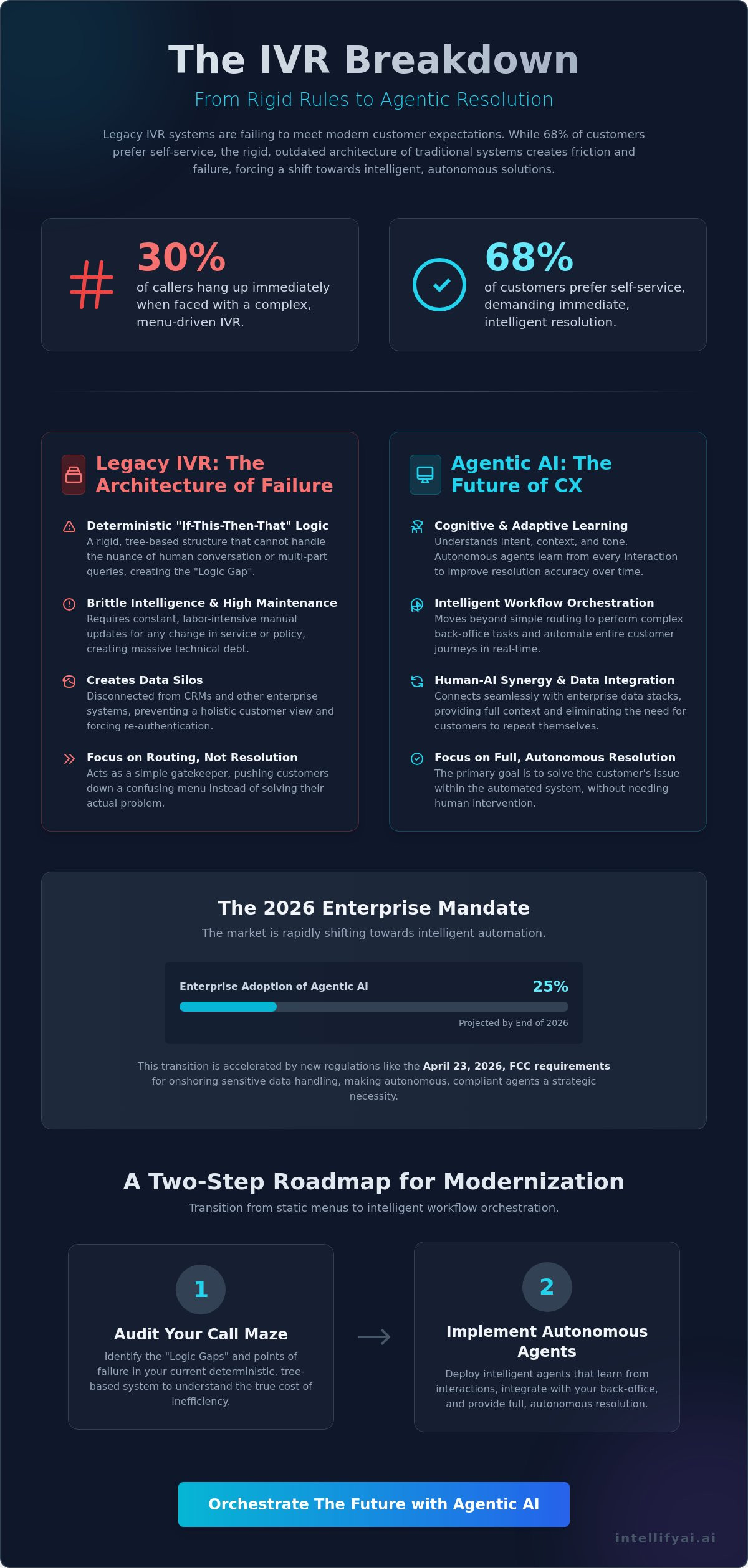
While 68% of customers prefer self-service options, 30% of callers will hang up immediately when faced with a complex, menu-driven interface. This disconnect is exactly why traditional ivr systems fail when customers demand immediate, intelligent resolution. You've likely seen the symptoms in your own operations: rising cost-per-interaction and data silos that prevent a holistic view of the customer journey. It's frustrating to manage rigid technology that requires constant manual updates just to keep pace with basic queries.
This article explores the structural and strategic reasons legacy systems are collapsing under the weight of modern expectations. You'll discover how Agentic AI is moving beyond simple automation to provide the cognitive flexibility required for 2026 enterprise standards. We'll examine the shift toward autonomous agents that learn and adapt, ensuring your architecture remains scalable while meeting the April 23, 2026, FCC requirements for onshoring sensitive data handling. By the end of 2026, 25% of enterprises will have deployed these agents to achieve operational excellence and full resolution without human intervention. It's time to transition from static rules to intelligent workflow orchestration.
Key Takeaways
• Identify the "Logic Gap" in deterministic systems. Understand why rigid, tree-based routing can't resolve fluid human conversations.
• Evaluate the high maintenance costs of manual intent mapping. Uncover the technical debt inherent in legacy NLP architectures.
• Analyze why traditional ivr systems fail to scale. These systems often create data silos that prevent valuable customer insights from reaching your CRM.
• Master a two-step roadmap for modernization. You'll learn to audit your existing call maze and implement autonomous agents that learn from every interaction.
• Explore the concept of Human-AI Synergy. Discover how modern voice agents perform complex back-office tasks instead of just routing calls.
The Anatomy of Failure: Why Legacy IVR Is No Longer Fit for Purpose
Legacy systems were built for a different era. Traditional IVR systems operate as deterministic, tree-based frameworks designed solely for call routing. They aren't built for resolution. Instead, they force callers into a rigid "if-this-then-that" structure. This architecture is the fundamental reason why traditional ivr systems fail in a landscape where 68% of customers demand immediate self-service. These systems prioritize the organization's internal hierarchy over the customer's immediate needs.
The "Logic Gap" represents the chasm between human intent and machine code. Pre-programmed rules cannot account for the infinite nuances of human speech, such as tone, context, or multi-part queries. A customer might call to "dispute a charge and update a billing address," but a legacy system only understands one intent at a time. This rigidity creates immediate friction. In 2026, enterprise leaders must view enterprise modernization as a strategic mandate. It's the only way to move from simple routing to actual cognitive resolution.
To better understand the limitations of these legacy frameworks, watch this analysis on why current systems struggle to meet modern demands:
The Deterministic Trap: Why Rules Break
Rule-based logic is inherently fragile. When a query falls outside a narrow set of keywords, the system collapses. This failure leads to high "zero-out" rates, where 30% of customers abandon the call or frantically press zero to reach a human. These systems simply cannot handle the complexity of modern consumer behavior. Deterministic systems are the primary bottleneck in modern CX because they prioritize rigid structure over the dynamic nature of human dialogue.
The Disconnect Between Voice and Action
Legacy IVR often exists as a voice-only silo. It's disconnected from the broader enterprise data stack and CRM systems. This isolation forces customers to undergo the frustration of "re-authentication" once they finally reach a human agent. It's a significant drain on operational efficiency. True resolution requires a system that can access back-office data in real-time to perform actual work. Without this integration, the IVR remains a gatekeeper rather than a problem solver.
Technical Debt and the Rule-Based Trap: The Architecture of Inefficiency
Technical debt isn't just a line item on a balance sheet; it's an operational anchor that prevents agility. For years, enterprises have poured millions into manual intent mapping and keyword tuning. This labor-intensive process is a primary reason why traditional ivr systems fail as soon as a business evolves. When you introduce a new service or change a policy, the entire rule-based tree requires a manual overhaul. This creates "Brittle Intelligence." One minor update in your product line can break the logic of the entire customer journey; this leads to misrouted calls and systemic inefficiency.
Research highlights the technical limitations of IVR, particularly in how these systems struggle with task completion when faced with non-standard inputs. Traditional NLP is fundamentally different from modern Agentic AI. While legacy systems look for a match in a pre-defined library, agentic solutions use autonomous reasoning to understand the customer's goal. This shift reduces the cognitive load for both the system and the caller. The machine doesn't just search for keywords; it understands the intent behind the inquiry. If you're ready to move beyond these rigid structures, our Agentic AI Engineering Services can help bridge the gap.
From Scripted Dialogues to Autonomous Reasoning
Legacy dialogues follow a script. They're incapable of handling nuance, sarcasm, or complex multi-intent queries. Agentic AI leverages Large Language Models (LLMs) to engage in goal-oriented reasoning rather than simple pattern matching. This allows the system to remain flexible and context-aware. Maintaining these models at scale requires robust MLOps pipelines. These pipelines ensure that your AI agents are constantly learning and adapting to new data without manual intervention.
The Failure of Traditional NLU in 2026
By May 2026, the global IVR market is estimated to reach up to $12.89 billion, yet many of these systems still rely on outdated NLU. Traditional Natural Language Understanding often fails in noisy environments or when faced with diverse accents and dialects. This leads to a 30% call abandonment rate when customers encounter friction. The future lies in "Contextual Intelligence." This approach allows the system to remember the customer's last five interactions across all channels, providing a seamless and personalized experience that legacy NLU simply cannot replicate.
The Strategic Impact of IVR Failure on Enterprise Scalability
Enterprise scalability isn't just a measure of how many calls your system can handle. It's a measure of how effectively those interactions translate into business value. This strategic layer is exactly why traditional ivr systems fail to support modern growth. When 75% of customers report frustration because they cannot reach a live agent, the system isn't just failing to route a call; it's actively eroding brand loyalty. In high-stakes sectors like Finance and Insurance, where trust is the primary currency, these failures become a significant driver of customer churn. A single mismanaged interaction can lead to the loss of a multi-year contract.
The hidden costs of legacy systems extend far beyond the technology stack. There is a massive operational drain associated with training agents to handle already-frustrated callers. When a system fails to resolve an issue, the human agent inherits a "repair" task rather than a "service" task. This increases the cost-per-interaction and accelerates agent burnout. Furthermore, misrouted data leads to "Data Black Holes" where valuable customer insights are lost in transit. To understand the full scope of these inefficiencies, many organizations partner with IntellifyAi Consulting Services for comprehensive enterprise-wide ROI assessments.
A critical gap in current enterprise architectures is the lack of connection between voice channels and back-office functions like intelligent document processing (IDP). Legacy systems treat voice as an isolated silo. If a customer calls about a claim they submitted five minutes ago, a traditional IVR has no awareness of that document. This disconnect forces the customer to repeat information, creating a friction-heavy journey. Modern agentic solutions bridge this gap by integrating voice intelligence directly with document workflows, ensuring that every interaction is contextually aware and data-driven.
The Operational Drain of 'False Automation'
False automation occurs when a system deflects a call without actually resolving the customer's intent. This is a common trap for enterprises focused on short-term cost savings. While it might look like your automation rates are high, your Average Handle Time (AHT) for human agents will likely spike. Agents must spend the first two minutes of every call repairing the interaction and re-collecting data that the IVR failed to capture or pass along. It's a cycle of inefficiency that masks the true cost of legacy technology.
Data Silos and the Loss of Actionable Intelligence
Traditional IVRs fail to capture the "Voice of the Customer" in a way that is usable by the rest of the enterprise. Because they rely on rigid, pre-defined menus, they miss the nuance of why customers are actually calling. This results in a massive missed opportunity for cross-selling and up-selling. When you can't identify a customer's specific needs through their natural speech, you can't offer them the right solution at the right time. Transitioning to a data-centric model ensures that every voice interaction feeds directly into your CRM, creating a 360-degree view of the customer. For businesses looking to turn these insights into revenue, Next Creed provides AI automation tools designed to optimize sales pipelines through database reactivation.
A Roadmap for Transformation: Transitioning from Menus to Autonomous Agents
Modernizing your communication stack requires more than a simple software patch. It demands a fundamental shift in how your organization perceives the voice channel. Understanding why traditional ivr systems fail is the first step toward building a resilient, future-proof architecture. By the end of 2026, 25% of enterprises will have moved away from static menus in favor of autonomous agents. This transition isn't just about better speech recognition; it's about shifting from a routing-first mindset to a resolution-first strategy.
The transformation begins with a rigorous audit of your existing "Maze." You must identify exactly where your customers drop off. Data shows that complex IVR systems cause 30% of callers to hang up prematurely. Once these friction points are mapped, the next step involves implementing "Human-in-the-Loop" AI. This allows the system to learn directly from your best human agents, capturing the nuances of how they resolve complex queries. This synergy ensures that the AI doesn't just mimic a script but masters the cognitive logic required for operational excellence.
True value is realized when you integrate these voice agents with back-office platforms. For document-heavy industries, connecting voice intelligence to solutions like i_Nova enables the system to process claims or verify documents in real-time. This level of Agentic AI Engineering Services allows your agents to scale from answering simple FAQs to executing multi-step transactions. The goal is a seamless flow where the machine performs the repetitive "work" while humans handle the high-value emotional nuances of the interaction.
Phase 1: Intelligence Extraction and Intent Mapping
Phase one focuses on turning your existing call recordings into a "Cognitive Roadmap." By analyzing thousands of hours of historical data, you can identify the most common paths to resolution. Modern voice agents utilize Zero-Shot learning to understand and respond to new intents without requiring extensive manual retraining. This capability ensures your system remains agile and can adapt to new business requirements on day one.
Phase 2: Deep Integration and Workflow Orchestration
Successful transformation requires deep integration with your ERP, CRM, and bespoke legacy databases. This connectivity is what enables workflow orchestration. An autonomous agent should be able to execute tasks like refund processing or policy updates without human intervention. By bridging the gap between the voice channel and your back-office systems, you create a frictionless environment that prioritizes the customer's time and your company's ROI.
If your organization is ready to eliminate the inefficiencies of legacy routing, explore how IntellifyAi Engineering Services can architect a bespoke agentic solution for your enterprise.
Orchestrating the Future with IntellifyAi’s Agentic Voice Solutions
IntellifyAi views the contact centre as a primary engine for operational excellence rather than a mere cost hub. We focus on Human-AI Synergy. This approach ensures that technology liberates your human workforce to focus on high-value creative work. While legacy vendors offer minor software patches, we provide a complete paradigm shift. This is exactly why traditional ivr systems fail; they lack the cognitive depth to handle the complexities of 2026 enterprise workflows. Our voice agents are designed for action. They don't just route calls. They perform actual work through sophisticated workflow orchestration and bespoke integration.
Our methodology centers on future-proofing your enterprise. We bridge the abstract world of machine learning with your practical business needs. By deploying autonomous agents, we enable your organization to achieve a frictionless customer journey that adapts in real-time. These agents navigate back-office systems, update databases, and resolve queries without human intervention. This is the hallmark of a modern, agentic contact centre. It's a move away from deterministic traps toward a state of constant, intelligent evolution.
The i_Nova Advantage: Voice Meets Document Intelligence
One of the most persistent bottlenecks in customer engagement is the gap between voice channels and unstructured data. Our i_Nova platform eliminates this silo entirely. Imagine a customer calling to verify a claim while the system "reads" their uploaded invoice or ID in real-time during the conversation. This unification of voice and document intelligence leads to a drastic reduction in resolution time. It transforms a twenty-minute manual process into a two-minute automated success. By unifying these data streams, you eliminate the friction that defines why traditional ivr systems fail in document-heavy industries.
Why Partner with IntellifyAi?
We project the personality of a Strategic Architect. We don't build "cool" tech for its own sake. We build for scalability, security, and measurable ROI. Our global reach allows us to implement these solutions across diverse regulatory environments, ensuring your operations remain compliant with evolving standards. Transitioning to this level of intelligence requires a robust Enterprise AI Strategy. We guide you through the agentic frontier, ensuring your modernization journey is both visionary and dependable.
Your enterprise can't afford to rely on the rigid, rule-based structures of the past. If you're ready to embrace the future of intelligent automation, our team is prepared to architect your success. Contact our AI strategists today to begin your transformation journey.
Architecting the Agentic Frontier
The transition from deterministic routing to autonomous resolution is a strategic mandate for the modern enterprise. We've explored how technical debt and rigid rule-based logic are the fundamental reasons why traditional ivr systems fail to meet 2026 standards. Success now requires a unified architecture that connects voice intelligence directly to back-office workflows. By prioritizing Human-AI Synergy, your organization can transform a legacy contact centre into an engine of operational excellence.
IntellifyAi serves as a global partner with a strategic presence in the UK, USA, India, and UAE. Our specialists deliver high-value Agentic AI engineering and leverage the i_Nova platform to ensure your voice agents process unstructured data in real-time. This approach guarantees scalability and a significant return on investment. It's time to move beyond the "Press 1" era and embrace a frictionless, automated future that respects your customer's time.
Design your future-proof contact centre with IntellifyAi's Agentic Voice Solutions.
The path to digital transformation is clear. We're ready to help you build a more intelligent and dependable enterprise today.
Frequently Asked Questions
Why do customers hate traditional IVR systems?
Customers hate legacy systems because they prioritize organizational routing over immediate resolution. 75% of callers report frustration when they cannot reach a live agent or resolve an issue through a rigid menu. These systems force users into a deterministic trap where complex or multi-intent queries are ignored. It's a friction-heavy experience that consistently erodes brand loyalty and consumer trust.
What is the difference between traditional IVR and Conversational AI?
Traditional IVR follows a rigid, tree-based logic designed for simple routing. Conversational AI uses natural language processing to understand intent and engage in fluid dialogue. While IVR asks you to "Press 1," Conversational AI allows you to speak naturally. The latter focuses on understanding the nuance of a call rather than just deciding which department should receive it.
How does Agentic AI differ from a standard Voice Assistant?
Agentic AI goes beyond conversation to perform actual work. While a standard voice assistant might answer a simple question, an autonomous agent executes multi-step workflows like processing a claim or updating a database. It uses goal-oriented reasoning to orchestrate tasks across your entire enterprise stack. This shift from information to execution is the core of modern operational excellence.
Can modern AI voice agents handle complex transactions without a human?
Modern AI voice agents successfully handle complex, multi-step transactions without human intervention. By integrating directly with ERP and CRM systems, these agents can process refunds or manage policy updates securely. This capability is a key reason why 25% of enterprises are expected to deploy AI agents by the end of 2026. They move from simple FAQ bots to functional digital employees.
What are the primary technical reasons for IVR failure in 2026?
The primary technical reasons why traditional ivr systems fail include brittle rule-based logic and the inability to maintain context across channels. Legacy systems cannot account for the infinite variations of human speech, leading to a 30% call abandonment rate. They also suffer from data silos that prevent the system from accessing the real-time back-office information needed for full resolution.
How much can an enterprise save by switching from IVR to Agentic Voice Agents?
Enterprises typically report up to a 30% reduction in operational costs when transitioning to AI-powered automation. These savings stem from lower handle times and a significant decrease in misrouted calls. By automating routine interactions, you allow human agents to focus on high-value work. This synergy improves first-call resolution rates by nearly 25%, further driving down the enterprise cost-per-interaction.
Is it possible to integrate AI voice agents with legacy contact centre software?
Integration with legacy contact centre software is entirely possible through bespoke engineering services. Modern agentic solutions act as a bridge between cloud-native intelligence and on-premise databases. This approach allows you to modernize your CX without a complete "rip-and-replace" of your existing infrastructure. It ensures the stability of your operations while introducing the scalability required for 2026 standards.
What is the role of Intelligent Document Processing (IDP) in voice automation?
Intelligent Document Processing allows voice agents to handle unstructured data like invoices or IDs in real-time. Platforms like i_Nova enable an agent to "read" a document while the customer is still on the line. This unification of voice and document intelligence drastically reduces resolution time. It's the final piece in creating a truly frictionless customer journey that requires zero human intervention.









.svg)