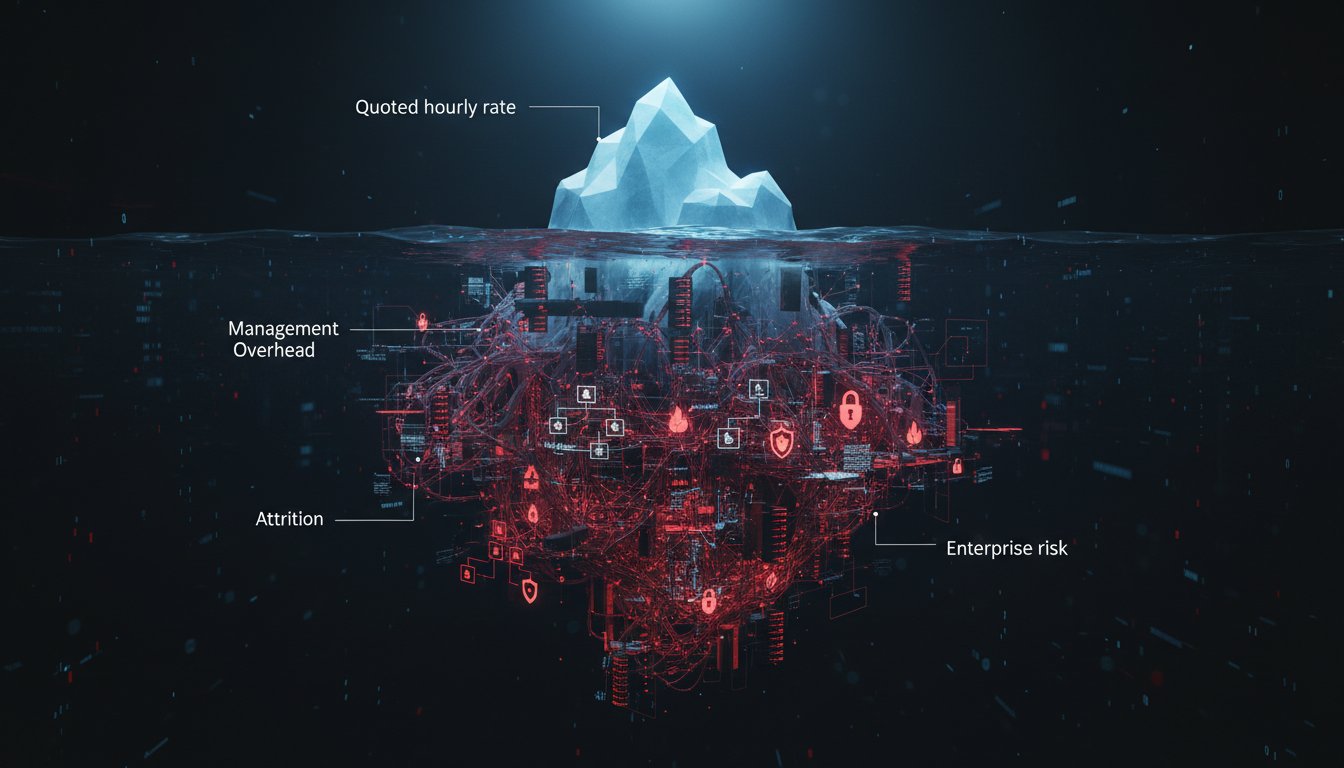
Why does an offshore rate of $12 per hour often manifest as a $40 operational burden on your balance sheet? While traditional BPO models promise efficiency, the hidden costs of call center outsourcing frequently erode the very margins they were designed to protect. You've likely felt the friction of management bloat and the quiet damage of brand erosion, yet these variables rarely appear in a standard vendor quote. With global businesses losing over $75 billion annually to poor customer service, the legacy labor-arbitrage model is reaching its breaking point.
It's true that scaling a human workforce feels like the safe path for enterprise growth. However, when you factor in the $13,745 cost to replace a single departed agent and the $100,000 required for annual compliance management, the math no longer supports a linear headcount strategy. This guide provides a definitive framework to calculate your true Total Cost of Ownership for 2026. You'll discover how to transition from brittle, labor-intensive workflows to an intelligent automation strategy. We'll show you how Agentic AI transforms CX from a cost center into a scalable engine for operational excellence.
Key Takeaways
• Learn why quoted hourly rates represent less than 60% of total expenses and how it's possible to calculate a realistic Total Cost of Ownership for 2026.
• Identify the "Shadow Team" management overhead and attrition taxes that create a perpetual cycle of reinvestment in basic training.
• Evaluate the escalating enterprise risk premiums and data sovereignty challenges inherent in traditional offshore BPO models.
• Uncover the hidden costs of call center outsourcing that stifle your ability to scale elastically without a linear increase in headcount.
• Develop a strategic roadmap for transitioning labor-intensive contact centers into high-value assets using Agentic AI and workflow orchestration.
Beyond the Hourly Rate: Defining the Call Center TCO Iceberg
Most enterprise leaders view call center pricing through a narrow lens of hourly seat rates. This perspective is a strategic oversight. In 2026, the quoted per-hour rate typically represents less than 60% of total operational expenses. This Iceberg Effect obscures the hidden costs of call center outsourcing that lie beneath the surface, such as recruitment fees, technology surcharges, and the high price of attrition. Traditional models rely on labor arbitrage, where the primary value proposition is simply cheaper human labor in a different geography.
Modern operations require a shift toward intelligent workflow orchestration. While Business process outsourcing (BPO) remains a standard practice, many legacy contracts are designed with baked-in inefficiencies. Vendors often protect their margins by maintaining high headcounts rather than optimizing for resolution speed. This creates a conflict of interest where the client pays for volume while the vendor profits from complexity.
To better understand the global landscape of these pricing models, watch this helpful video:
The Distinction Between Direct and Indirect Costs
Direct costs are the visible line items: seat rates, CRM licensing, and initial implementation fees. These are easy to track but rarely tell the whole story. Indirect costs include internal management time, vendor procurement cycles, and the "Shadow Team" needed to audit BPO performance. Verified industry data shows that initial training costs range from $1,000 to $2,000 per agent. These indirect costs scale faster than call volume because managing a distributed, high-turnover workforce requires exponential administrative effort. As your operation grows, the management tax often outpaces the savings gained from lower hourly rates.
The 2026 Enterprise Cost Framework
A modern TCO analysis must account for the strategic impact on your brand. Customer churn due to inconsistent service is a massive, often unmeasured, expense. When a BPO loses experienced staff, your organization suffers from knowledge leakage, forcing you to pay for "Day 1" training repeatedly. To understand your true investment, you must adopt a more rigorous metric. Total Cost of Ownership is the holistic sum of financial, operational, and strategic expenditures over the contract lifecycle. Transitioning to voice agents and autonomous systems allows enterprises to bypass these hidden costs of call center outsourcing by replacing volatile OpEx with stable, strategic AI assets.
Operational Friction: The Management and Attrition Tax
The "Iceberg Effect" introduced earlier manifests most clearly through management overhead. When you outsource, you don't eliminate management; you often duplicate it. Many enterprises find themselves building a "Shadow Team" of internal supervisors to monitor, audit, and course-correct the BPO partner. This management tax is one of the most persistent hidden costs of call center outsourcing. It consumes the time of high-value internal leaders who should be focused on strategy rather than micro-managing external workflows.
The burden extends to Quality Assurance (QA). If your BPO's internal QA doesn't align with your brand standards, your internal team must step in. This results in double-handling of data and prolonged feedback loops. Add the communication tax of cross-timezone coordination, and the "savings" from lower seat rates begin to vanish. Strategic leaders must account for the hundreds of hours spent annually on cultural alignment and synchronization meetings. These hours represent a significant diversion of corporate resources.
The High Price of Agent Attrition
Turnover is the silent killer of BPO efficiency. Verified data for 2026 indicates that it costs approximately $13,745 to replace a single mid-level agent. This figure includes recruitment, administrative processing, and the initial training costs which typically range from $1,000 to $2,000 per head. Because attrition rates in traditional BPOs often exceed 40%, you are perpetually paying for "Day 1" competency. This constant churn creates "Service Variability," where the quality of customer support fluctuates based on agent tenure. This inconsistency erodes brand equity and forces a cycle of constant reinvestment in basic product training.
Fragmented Customer Journeys
Operational friction also degrades the customer experience through fragmented data. Siloed BPO operations often lack a 360-degree view of the customer, leading to expensive "re-work" when agents fail to resolve issues on the first contact. Each failed resolution multiplies your cost per ticket and frustrates your user base. To bridge these gaps, many organizations are adopting a CX Improvement Framework to unify their service delivery. By integrating autonomous agents into your workflow, you can eliminate the attrition tax and ensure every interaction is handled with peak institutional knowledge. If you're ready to audit your current model, our engineering services can help map a more efficient, future-proof path forward.

Security, Compliance, and Technical Debt Risks
Expanding your operational footprint through a BPO introduces a complex web of legal and technical liabilities. Data sovereignty is no longer a peripheral concern; it's a primary financial driver. Ensuring GDPR and SOC2 compliance across international borders requires a rigorous, ongoing investment that many organizations fail to quantify upfront. These hidden costs of call center outsourcing emerge when you realize that managing in-house regulatory compliance can cost up to $100,000 annually. When this responsibility is distributed across a third-party vendor’s infrastructure, the cost of auditing and verifying their security protocols often doubles.
Enterprise risk premiums also reflect this reality. Cybersecurity insurance providers frequently spike premiums when customer data is handled by external agents in regions with varying privacy protections. This cost is rarely factored into the initial ROI calculation. Risk is further compounded by "Shadow IT." When BPO agents are pressured by unrealistic SLAs, they may resort to using unauthorized AI tools or personal devices to manage workflows. This creates massive security gaps that can lead to catastrophic data breaches, where the fine-weighted risk far outweighs any marginal savings on labor.
The Cost of Regulatory Non-Compliance
Calculating the potential impact of a data breach in an outsourced environment requires a cold, analytical approach. You aren't just paying for the breach itself; you're paying for the internal resources required to manage the fallout. Continuous auditing of a BPO's security posture is a non-negotiable expense that drains your IT and legal departments. To mitigate these vulnerabilities, enterprises are shifting toward a more robust Enterprise AI Governance model. By centralizing data within a secure, sovereign cloud environment, you eliminate the compliance friction inherent in traditional BPO models.
Technical Integration Friction
The technical debt associated with legacy BPO systems is a significant barrier to modernization. Custom API development and the maintenance of third-party integrations can cost 18-20% of original licensing fees every year. Manual data entry by outsourced agents often leads to inconsistent or "dirty" data. This creates "Data Debt" that makes it nearly impossible to train future AI models effectively. Batch-processed reporting is another common bottleneck. When you rely on weekly or monthly BPO performance dumps, you lose the ability to perform real-time analytics. This delay prevents your leadership from making the high-velocity, data-driven decisions required to maintain a competitive edge in 2026.
The Opportunity Cost of Stagnation: What You Lose by Not Automating
Stagnation is a choice with a high price tag. While legacy BPO contracts offer the illusion of stability, they often act as a barrier to innovation. Many long-term agreements are structured around headcount-based pricing, which directly disincentivizes the adoption of autonomous agents. This creates a significant innovation gap. By remaining tethered to traditional models, enterprises miss the opportunity to transition from volatile labor costs to a more predictable, software-driven cost structure. The hidden costs of call center outsourcing in this context are measured in lost agility and the inability to pivot as market demands shift.
Inelastic scalability is another major liability. Traditional BPOs require a linear increase in hiring to handle volume spikes. If your call volume increases 10x during a product launch or a service outage, you must pay for 10x the human labor, assuming the vendor can even find the staff. This model is fundamentally incapable of handling the high-velocity fluctuations of the modern market. Beyond the financial burden, there's an "Insight Vacuum" to consider. Human agents, burdened by high average handle times (AHT), often provide inconsistent or brief call summaries. You lose the granular, structured data necessary for deep operational analysis.
Scaling Without Linear Costs
Transitioning to Agentic AI fundamentally changes the unit economics of customer service. The marginal cost of an AI-driven interaction is a fraction of a human-led outsourced call. These digital agents provide 24/7/365 availability without the burden of holiday pay, shift differentials, or the $2,000 initial training costs associated with human onboarding. This allows for the rapid deployment of new service lines without the typical 3-6 month recruitment and training lag. You gain the ability to scale elastically, ensuring your service quality remains high regardless of call volume.
Capturing the Voice of the Customer
The strategic value of automation extends into market intelligence. Human notes are subjective and frequently less actionable than AI-driven sentiment analysis. By utilizing autonomous systems, every interaction becomes a precise data point for product development and marketing teams. Our i_Nova engine can extract high-fidelity intelligence from unstructured call transcripts, identifying emerging customer pain points before they escalate into churn. This level of oversight is impossible in a fragmented BPO environment where data is batch-processed and siloed. To begin modernizing your infrastructure and capturing this lost value, explore our range of voice agents designed for enterprise excellence. Moving away from repetitive Tier 1 human labor allows you to reinvest those resources into high-value creative work, fostering true Human-AI Synergy.
Transitioning to Agentic AI: The Future-Proof Alternative
The era of labor arbitrage is concluding. As we've analyzed, the hidden costs of call center outsourcing often negate the initial savings promised by low hourly rates. To reclaim operational margins, enterprises must transition from a reliance on external OpEx labor to the cultivation of strategic AI assets. This isn't merely a technological upgrade; it's a fundamental shift toward a more resilient business model. By deploying voice agents, organizations can convert volatile monthly expenses into durable, scalable, and high-performing infrastructure.
A sophisticated CX strategy in 2026 doesn't seek to eliminate the human element but rather to elevate it. We advocate for a "Human-in-the-Loop" model where autonomous agents manage the high-volume, repetitive Tier 1 queries that typically drive high attrition. This allows your most talented internal staff to focus on complex, high-empathy escalations where human nuance is a strategic differentiator. Intelligent Document Processing (IDP) acts as a force multiplier for back-office automation. It ensures that the data captured during voice interactions is structured and integrated into your enterprise systems without the "Data Debt" caused by manual entry errors.
From BPO to Agentic AI Engineering
Transitioning from a legacy BPO contract to an in-house, AI-driven workflow requires a disciplined roadmap. The first step is a rigorous audit of your current interaction data to identify high-frequency patterns suitable for automation. Success in this new paradigm is no longer measured by Average Handle Time (AHT). Instead, we focus on the Automated Resolution Rate and the accuracy of the data extracted. This evolution requires specialized AI Strategy & Consulting to help re-skill your internal management teams. Your supervisors will move from managing human headcounts to orchestrating autonomous agent performance, a shift that drastically reduces the management tax discussed in previous sections.
The IntellifyAi Advantage
Our Agentic AI engineering services are designed for serious enterprises that require more than off-the-shelf software. We build bespoke, brand-aligned voice agents that integrate seamlessly with your existing cloud-native infrastructure. By leveraging MLOps, we ensure that your CX performance undergoes continuous optimization. Every interaction becomes a learning opportunity for the system, driving down the hidden costs of call center outsourcing over time. This approach ensures your operations are not just efficient today, but future-proofed against the labor market volatility of tomorrow. Contact our strategists to conduct a detailed TCO audit of your current call center operations and begin your journey toward operational excellence.
Reclaiming Operational Excellence in the AI Era
Success in 2026 requires a departure from legacy labor models that prioritize headcount over resolution. We have demonstrated that the hidden costs of call center outsourcing, from the $13,745 attrition tax to the $100,000 compliance burden, create a structural drag on enterprise growth. True operational excellence is found in the transition to autonomous agents and workflow orchestration. By centralizing intelligence through our i_Nova platform and Agentic AI Engineering services, you replace unpredictable human variables with high-fidelity, scalable digital assets.
Our global teams across the UK, USA, India, and the UAE specialize in bridging the gap between abstract machine learning and practical business outcomes. We focus on building Human-AI Synergy that empowers your workforce to focus on high-value creative work. The math of 2026 is clear; automation is no longer a luxury but a core pillar of a resilient enterprise. Take the first step toward a friction-free future and audit your call center TCO with an IntellifyAi strategy session. It's time to transform your contact center from a cost liability into a strategic engine for growth.
Frequently Asked Questions
What are the most common hidden costs in call center outsourcing contracts?
Common hidden costs of call center outsourcing include setup fees ranging from $2,000 to $15,000, technology platform surcharges of $25 to $300 per user monthly, and steep overage rates for call volumes exceeding minimums. You should also account for CRM seat costs, which average $150 per user monthly. These expenses are often buried in contract appendices rather than the headline hourly rate.
How do I calculate the Total Cost of Ownership (TCO) for a BPO agreement?
Calculate TCO by aggregating direct vendor fees, internal management salaries, and the cost of service variability. A robust 2026 framework includes recruitment expenses of $2,250 to $4,683 per agent and software maintenance fees averaging 18% to 20% of original licensing. Add the estimated cost of customer churn resulting from inconsistent BPO quality to identify the true financial impact on your balance sheet.
Is Agentic AI more expensive than traditional outsourcing in the long run?
Agentic AI is significantly more cost-effective because it replaces recurring labor OpEx with a strategic software asset. While initial setup requires an investment in engineering, the marginal cost per interaction is near zero. Unlike BPOs, AI agents don't require holiday pay or shift differentials. This allows for 24/7/365 availability without the linear cost increases associated with human headcounts.
What is the "management tax" in call center outsourcing?
The "management tax" is the salary and resource cost of the internal "Shadow Team" required to monitor BPO performance. Enterprises often maintain one internal manager for every 10 to 15 outsourced agents to ensure quality and compliance. This overhead can add 20% to 30% to the total contract value. It's a persistent operational burden that is rarely included in initial ROI projections.
How does high agent attrition in BPOs affect enterprise security and compliance?
High attrition rates, which often exceed 40% in traditional BPOs, create significant security vulnerabilities through constant credential cycling. It increases the risk of "Shadow IT" as new agents bypass protocols to meet unrealistic SLAs. While replacing a single agent costs $13,745, the resulting "data debt" from poor record-keeping and inconsistent compliance auditing often creates a much larger, fine-weighted risk for the enterprise.
Can AI voice agents handle complex customer issues as well as outsourced humans?
Modern AI voice agents use advanced reasoning and Retrieval-Augmented Generation (RAG) to resolve complex queries with higher accuracy than scripted human agents. Agentic AI accesses real-time enterprise data to provide bespoke solutions without the fatigue or knowledge gaps common in high-turnover BPOs. We recommend a Human-AI Synergy model where AI handles technical complexity and humans manage high-empathy escalations.
What is the opportunity cost of delaying call center automation?
Delaying automation results in an "Insight Vacuum" and an inability to scale elastically. Human-only models cannot handle 10x call spikes without a corresponding 10x increase in hiring and training time. By waiting, you lose the structured data and sentiment analysis that autonomous agents generate. This intelligence is vital for product development and maintaining a competitive edge in a high-velocity market.
How do I transition from a legacy BPO model to an AI-driven contact center?
Transitioning begins with a comprehensive audit of your hidden costs of call center outsourcing and current interaction patterns. Use a CX Improvement Framework to identify Tier 1 tasks suitable for immediate automation. Move toward an in-house AI-driven workflow by re-skilling your internal management team. Their new role will be to orchestrate autonomous agent performance rather than managing human headcounts.









.svg)