
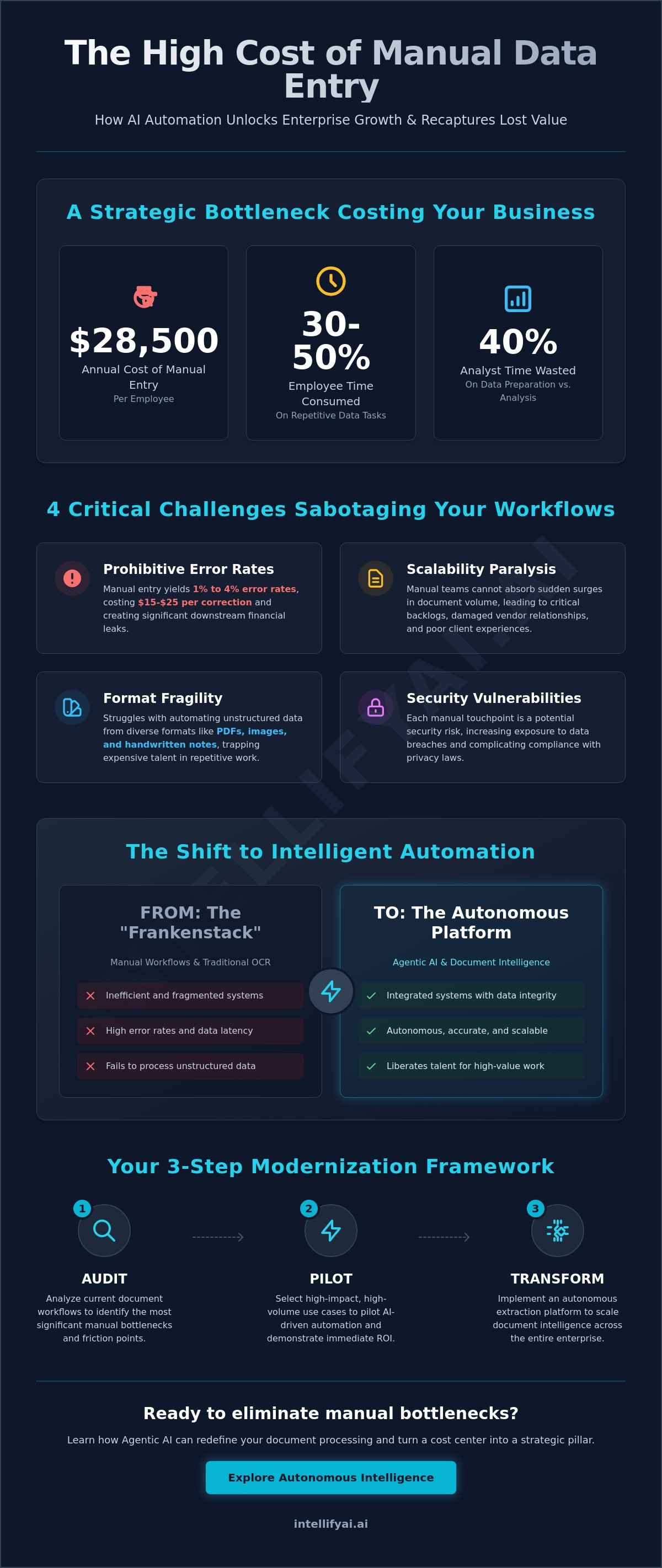
In 2026, manual data entry costs American enterprises an average of $28,500 per employee annually; it's a staggering figure for a process that still yields error rates between 1% and 4%. For most organizations, the primary obstacle isn't just the speed of processing but the complexity of automating unstructured data entry across fragmented legacy systems. You likely feel the weight of these high operational costs and the downstream financial losses caused by frequent, avoidable errors. It's a strategic liability that tethers your most capable human intelligence to low-value, repetitive tasks.
This article provides a clear roadmap to eliminate these manual bottlenecks and transition toward autonomous, AI-driven document intelligence. You'll learn how to replace inefficient "Frankenstacks" with integrated systems that ensure data integrity and long-term compliance with evolving state privacy laws. We'll examine the strategic shift toward agentic AI, showing you how to liberate your talent for high-value cognitive work while securing a frictionless, scalable future for your enterprise operations.
Key Takeaways
• Identify how manual data entry acts as a strategic friction point that misallocates human capital and stalls enterprise growth.
• Recognize the operational risks inherent in manual workflows, including prohibitive error rates and the inability to scale during document surges.
• Evaluate the limitations of traditional OCR and learn the advantages of automating unstructured data entry through AI-driven intelligence.
• Execute a structured modernization framework by auditing current document flows and identifying high-impact pilot use cases.
• Explore the shift toward agentic AI and autonomous extraction platforms like i_Nova to transform document processing into a strategic business pillar.
Defining the Strategic Erosion: Why Manual Data Entry Stalls Enterprise Growth
Manual data entry is no longer just a simple operational task; it's a strategic bottleneck. While some might frame it as a standard business practice, in 2026, it functions as a persistent drag on enterprise agility. Research indicates manual entry consumes 30% to 50% of an employee's time. This creates a friction point that prevents the seamless flow of information required for modern digital ecosystems. When skilled professionals spend their hours re-keying data, they aren't just performing a task; they're experiencing human capital misallocation.
The financial implications are stark. American companies lose an average of $28,500 per employee annually to manual processes. This isn't just about the salary; it's the cost of lost innovation. Transitioning toward automating unstructured data entry allows organizations to reclaim this value. By implementing sophisticated document automation systems, enterprises can bridge the gap between raw information and actionable intelligence.
To better understand this concept, watch this helpful video:
The Opportunity Cost of Cognitive Labour
Skilled analysts often find themselves trapped in "data janitor" roles. Industry professionals report that analysts spend up to 40% of their time on data preparation rather than actual analysis. This is a profound waste of cognitive talent. Automation isn't about replacing these workers; it's about liberating them. When you remove the burden of repetitive tasks, you allow your team to focus on innovation-led projects that drive growth. This shift is a lasting investment in your company's relevance.
Data Latency and the Speed of Business
Manual entry creates a dangerous delay between data capture and strategic decision-making. In the 2026 enterprise landscape, real-time processing is the baseline, not a luxury. Manual bottlenecks prevent a responsive customer experience, as critical data stays trapped in silos for hours or days. This latency makes it impossible to leverage real-time analytics effectively. Automating unstructured data entry ensures that information moves at the speed of business, allowing for faster pivots and higher data integrity across the board.
5 Critical Challenges of Manual Data Entry Sabotaging Your Workflows
Manual data entry is a structural weakness that creates a hard ceiling on your enterprise growth. While it may seem like a controllable variable, it introduces hidden liabilities that compound over time. Organizations that rely on human labor for high-volume processing face five specific challenges that undermine their digital transformation efforts. These bottlenecks don't just slow you down; they actively sabotage your competitive edge.
Prohibitive Error Rates
With an average manual error rate of 1% to 4%, your system absorbs 100 to 400 errors for every 10,000 entries. These are financial leaks that cost between $15 and $25 each to rectify.
Scalability Paralysis
Manual teams can't absorb sudden document volume surges. This leads to backlogs that damage vendor relationships and erode client trust.
Format Fragility
Enterprises struggle with automating unstructured data entry when faced with diverse PDFs, images, or handwritten notes, forcing expensive human talent back into repetitive loops.
Security Vulnerabilities
Human touchpoints remain the primary vector for data breaches. Every manual interaction with sensitive data increases the risk of unauthorized exposure.
OpEx Bloat
Maintaining large manual teams is a capital-intensive model. In 2026, the average cost of $28,500 per employee for data entry tasks represents a significant drain on your operational budget.
Recent industry reports suggest that AI can help automate basic tasks like data entry to clear these backlogs and improve service delivery. Moving away from these legacy constraints requires a robust approach to engineering modernization that prioritizes system autonomy.
The Mathematical Reality of Data Inaccuracy
The "Rule of Ten" is a harsh reality for the modern enterprise. It posits that it costs ten times more to correct a data error than it does to capture it correctly at the source. If a minor typo enters your system, it pollutes your predictive AI models and ruins your financial forecasting. Ensuring data integrity is a cornerstone of enterprise modernization. Without high-fidelity data, your strategic decisions are built on a foundation of sand. Accuracy isn't just a metric; it's your baseline for survival.
Compliance Risks in Manual Handling
Regulatory standards like GDPR and SOC2 require rigorous control over sensitive information. Manual handling makes it nearly impossible to maintain a granular, verifiable audit trail. Every time a human opens a document to re-key information, you risk non-compliance. By automating unstructured data entry, you create a digital-first record that is inherently easier to govern. Automated validation is the only way to ensure 2026 regulatory adherence while maintaining the speed your business demands. This shift allows you to focus on growth rather than the constant fear of audit failures.
The Accuracy Trap: Why Traditional OCR Fails to Solve Manual Entry Issues
Traditional Optical Character Recognition (OCR) has long been marketed as the silver bullet for manual data entry. However, for the modern enterprise, OCR often functions as an "accuracy trap." It digitizes text without comprehending it. This creates a significant bottleneck where automation merely shifts manual labor from data entry to data verification. If your team still spends hours proofreading OCR outputs to catch misread characters, you haven't automated your workflow; you've just renamed the problem.
The core difficulty lies in automating unstructured data entry when documents don't follow a rigid, predictable pattern. Traditional OCR relies on "zonal" extraction, looking for specific data in specific coordinates. This approach is fundamentally incompatible with the fluid nature of modern business documents like complex contracts, varying invoice formats, and handwritten correspondence. It results in a context-free extraction that lacks the semantic intelligence required for strategic decision-making.
Template Fatigue in Legacy Systems
The Context Gap in Data Extraction
Traditional tools lack the semantic depth to understand the "why" behind the data. They see characters, not concepts. To move from raw text to structured business data, enterprises must leverage generative ai. Contextual understanding allows a system to distinguish between a service date and a billing date, even when they aren't explicitly labeled. This bridge between simple reading and actual intelligence is what separates legacy digitization from true document autonomy. By automating unstructured data entry through a context-aware framework, you eliminate the need for constant human oversight and ensure your data is ready for immediate strategic use.
Moving beyond OCR means transitioning from reading text to understanding intelligence. It requires a shift in how your organization perceives document processing. Instead of viewing it as a clerical task, it must be treated as a data engineering challenge. Only then can you unlock the true potential of your information and free your human talent for the high-value cognitive work they were hired to perform.
Modernising the Workflow: A Framework for Transitioning to Intelligent Automation
Transitioning from manual labor to autonomous intelligence requires more than just software implementation. It demands a structured roadmap that aligns technological capability with business-centric outcomes. Enterprises must move beyond reactive fixes and embrace a holistic philosophy of digital transformation. This starts with a clear-eyed assessment of where friction currently exists within your document flows. By systematically removing these bottlenecks, you transform document processing from a cost center into a strategic asset.
A successful transition follows a logical flow of assessment, selection, and integration:
Audit every manual touchpoint
to understand the full data lifecycle and identify where errors originate.
Identify pilot use cases
that offer high impact with manageable complexity, such as high-volume invoice processing or contract ingestion.
Prioritize Intelligent Document Processing (IDP)
platforms that handle semantic context, moving away from the limitations of legacy OCR.
Ensure seamless data flow
by integrating these tools directly into your existing cloud-native architecture.
Deploy an MLOps pipeline
to ensure your models improve continuously as they ingest more data.
Selecting the right technology is critical. While legacy OCR failed because of its rigid nature, modern IDP thrives on variability. By automating unstructured data entry through these advanced platforms, you allow the system to learn from diverse document formats without constant manual retraining. This creates a scalable model that grows with your enterprise, ensuring long-term viability and performance.
Phase 1: The Strategic Audit
Mapping your data lineage from initial entry to the final executive report is essential for identifying hidden costs. This process allows you to quantify the "Manual Tax" currently draining your resources, such as the $28,500 per employee lost to repetitive tasks. To navigate this complex shift, many enterprises partner with an ai strategy consulting expert to define a roadmap that prioritizes stability and security.
Integrating Intelligence into Legacy Stacks
Modernization doesn't mean discarding your current infrastructure. Instead, use robust APIs to connect IDP platforms with your ERP and CRM systems. This ensures that automating unstructured data entry becomes a core capability of your stack rather than a siloed tool. Strict data engineering standards must be met during this migration to maintain data integrity for strategic decision-making. Scaling these solutions effectively requires mlops pipelines, which automate the deployment and monitoring of your AI models to ensure peak performance.
Ready to modernize your operations and unlock human potential? Explore our Agentic AI Engineering Services to build a frictionless, automated future for your enterprise.
Executing the Vision: How Agentic AI Redefines Document Intelligence
The evolution of document intelligence has reached a critical inflection point. We're moving away from passive tools that require constant human oversight toward autonomous AI agents capable of independent reasoning. While previous sections highlighted the strategic erosion caused by manual processes, the focus now shifts to the architecture of the solution. Achieving a zero-touch data entry environment in 2026 isn't just a goal; it's an operational necessity for enterprises that value high-velocity growth and data integrity.
Agentic AI represents a fundamental departure from legacy systems. These agents don't just extract text; they understand intent and context. This capability is central to automating unstructured data entry at scale. When an AI agent encounters an unfamiliar document format or a complex exception, it doesn't simply trigger an error. It uses historical data and logical reasoning to resolve the issue, only escalating to human workers for high-level cognitive validation. This creates a frictionless workflow where technology acts as a collaborator rather than a burden.
Agentic AI vs. Robotic Process Automation (RPA)
Many organizations mistake RPA for true automation. However, RPA is designed for linear, repetitive tasks within structured environments. It fails when faced with the variability of modern business data. Agents are superior because they handle dynamic, non-linear workflows with ease. They learn from historical data corrections, becoming more efficient with every document processed. To understand how these systems function at a high level, read our guide on what is agentic ai. This shift allows your team to focus on creative work while the agent manages the complexity of data ingestion.
The i_Nova Advantage for Enterprise
At the heart of this transformation is i_Nova, our platform designed for intelligent extraction. Unlike standard OCR, i_Nova provides multi-format intelligence, allowing you to extract critical data from voice recordings, text documents, and images simultaneously. This level of system autonomy is essential for global operations that require scalable, cloud-native deployments. By automating unstructured data entry through a unified platform, you eliminate the "Frankenstack" problem and ensure a single source of truth for your enterprise. Explore our engineering services to learn how custom implementations can modernize your back office and drive measurable financial returns.
The transition to agentic intelligence is a lasting investment in your company's relevance. It's about more than just efficiency; it's about building a resilient, future-proof operation. By removing the burden of repetitive tasks, you empower your staff to engage in high-value innovation. This holistic approach ensures that your business remains ahead of the curve, secure in its operations, and focused on the bottom line.
Architecting a Frictionless Future for Enterprise Intelligence
The transition from manual data entry to autonomous intelligence is no longer optional for enterprises seeking long-term viability. By auditing your document flows and moving beyond the accuracy trap of legacy OCR, you reclaim the human potential currently lost to repetitive tasks. Automating unstructured data entry through agentic intelligence ensures higher data integrity for strategic decision-making while removing the high operational costs tied to manual processing. It's a fundamental shift that positions your organization as a leader in the 2026 digital landscape.
Our global expertise in Agentic AI engineering and our proven enterprise digital transformation roadmap provide the stability your operations require. With our flagship i_Nova platform, we deliver a sophisticated solution for complex document extraction that scales with your growth. Don't let legacy bottlenecks stall your innovation. Consult with our Strategic Architects to eliminate your manual bottlenecks and begin your journey toward a zero-touch data environment. The future of your enterprise is frictionless, and the path to modernization starts today.
Frequently Asked Questions
What are the main risks of continuing with manual data entry in 2026?
The primary risks include prohibitive operational costs and significant financial loss due to a 1% to 4% error rate. In 2026, manual processes also create massive compliance liabilities under new state privacy laws like the California Delete Act. These errors don't just cost money to fix; they degrade the integrity of your predictive models. Relying on human labor for high-volume tasks prevents your organization from scaling effectively during demand surges.
How does Intelligent Document Processing (IDP) differ from traditional OCR?
Traditional OCR simply digitizes text based on rigid templates, while Intelligent Document Processing (IDP) understands semantic context. OCR fails when a vendor changes a document layout because it lacks the cognitive ability to locate data in new positions. IDP uses generative AI to comprehend the meaning behind the characters. This distinction is crucial for automating unstructured data entry, as it eliminates the need for constant manual template updates and verification.
Can Agentic AI handle handwritten or poorly scanned documents?
Agentic AI handles handwritten notes and low-resolution scans with significantly higher accuracy than legacy systems. While traditional OCR struggles with character recognition in non-standard formats, advanced agents use computer vision and large language models to infer meaning from visual data. This capability allows the system to process diverse document types, including photos and scribbled annotations, without requiring human intervention for every exception. It ensures your data capture remains consistent across all input formats.
What is the typical ROI for transitioning from manual entry to automated IDP?
Enterprises typically see ROI by eliminating the $28,500 annual cost per employee currently dedicated to repetitive data tasks. Additional savings come from reducing the $15 to $25 cost associated with fixing every manual entry error. Beyond direct cost reduction, the true value lies in the liberation of human capital. Redirecting skilled staff to innovation-led projects drives long-term revenue growth that far exceeds the initial investment in automation technology.
How do we ensure data security when using AI for document processing?
Automated systems enhance security by removing human touchpoints, which remain the primary vector for data breaches. Modern platforms implement end-to-end encryption and maintain granular, immutable audit trails for every document processed. This ensures compliance with 2026 regulatory standards like SOC2 and the CCPA. By centralizing data handling within a secure, autonomous environment, you reduce the risk of unauthorized exposure and ensure that sensitive information is governed by strict, automated protocols.
Does automating data entry mean we have to replace our existing staff?
Automation is designed to liberate your talent rather than replace it. By removing the burden of low-value, repetitive tasks, you allow your employees to focus on high-value cognitive work that requires human judgment and creativity. This shift improves employee satisfaction and reduces the burnout often associated with manual data management. It's a collaborative relationship where technology handles the volume while humans lead the strategic direction of the enterprise.
How long does it take to implement an Intelligent Document Processing platform?
Implementation timelines vary based on the complexity of your document flows and existing infrastructure. However, a high-impact pilot use case can typically be deployed within a few weeks to demonstrate immediate value. The transition involves a strategic audit followed by the integration of IDP platforms into your cloud-native stack. A phased approach ensures minimal disruption to your operations while allowing your team to adapt to the new autonomous workflows gradually and securely.
What is the Human-in-the-Loop model and is it still necessary?
The Human-in-the-Loop model remains essential for high-level validation and managing complex exceptions that require nuanced reasoning. While the goal of automating unstructured data entry is to achieve a zero-touch environment, humans provide the necessary oversight for edge cases. This partnership ensures 100% data integrity for critical strategic decisions. Over time, the AI agent learns from these human corrections through an MLOps pipeline, further reducing the need for intervention as the system matures.









.svg)