
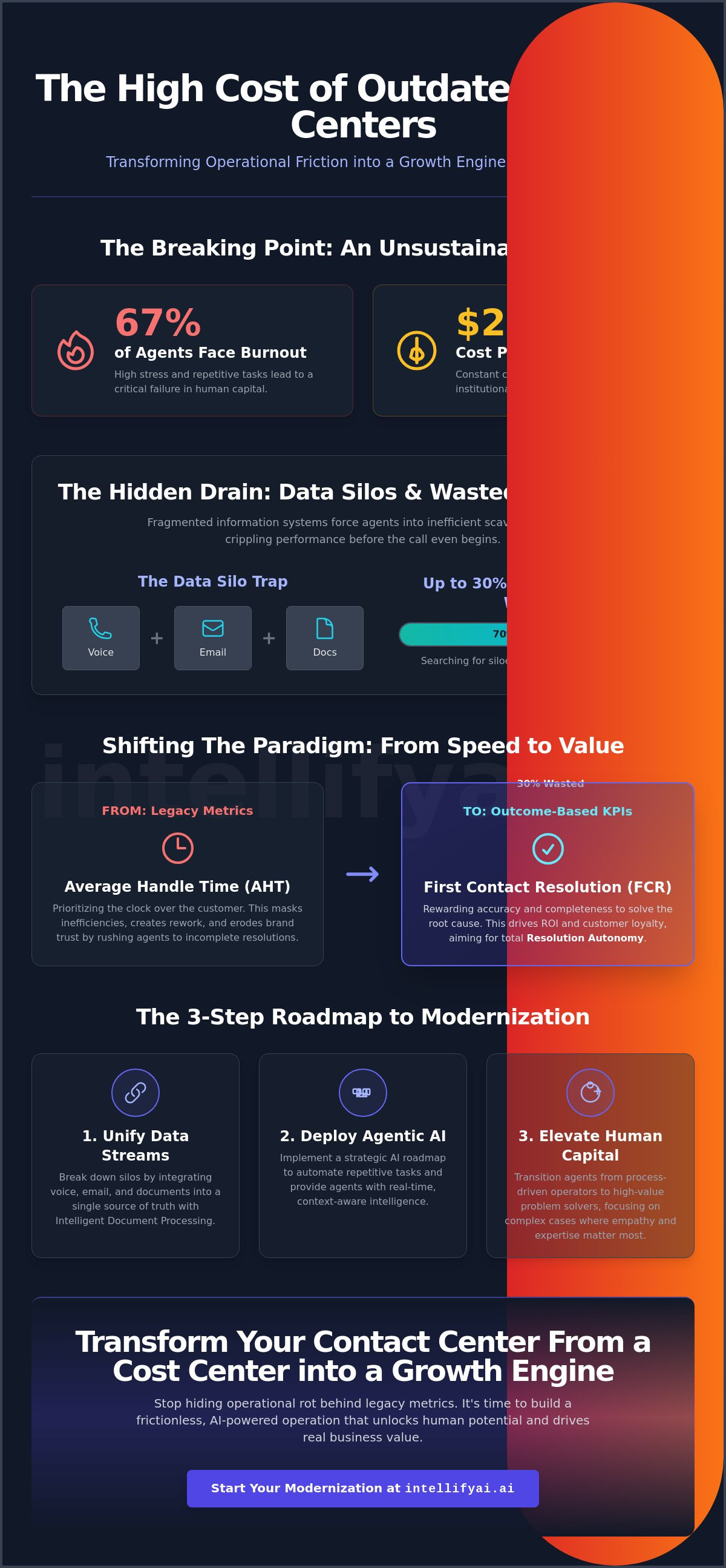
With 67% of agents currently facing burnout and turnover costs reaching $20,000 per hire, the traditional contact center model isn't just inefficient; it's unsustainable. Many leaders believe they've modernized by adding basic chatbots, yet they continue to struggle with common call center operational mistakes like rigid information silos and repetitive data requests. These failures don't just frustrate customers. They sabotage your ROI and drive your best talent toward the exit.
You likely recognize that legacy metrics like Average Handle Time often hide deeper structural flaws in your data architecture. This article identifies the technological and human capital failures preventing your enterprise from reaching the 2026 efficiency frontier. We'll provide a clear roadmap to rectify these gaps, showing you how to integrate agentic AI into your workflows to reduce friction and unlock human potential. By the end of this guide, you'll understand how to transform your operations from a cost center into a high-velocity engine for growth.
Key Takeaways
• Move beyond legacy speed metrics to optimize for Customer Lifetime Value and eliminate the costly cycle of repetitive call attempts.
• Bridge the information gap by identifying common call center operational mistakes that trap data in silos and waste 30% of agent productivity.
• Combat high attrition rates by transitioning human agents from repetitive tasks to high-value, complex problem-solving roles.
• Deploy a strategic roadmap for agentic AI to achieve true resolution autonomy through systematic workflow audits and custom engineering.
• Transform your contact center from a cost-heavy liability into a frictionless engine for growth with expert-led AI strategy and enterprise modernization.
Beyond Average Handle Time: Why Legacy Metrics Hide Operational Rot
Average Handle Time (AHT) is a deceptive master. For decades, it has served as the primary yardstick for performance, yet it often masks the very inefficiencies it seeks to measure. Speed does not equate to value. In fact, prioritizing the clock over the customer is one of the most common call center operational mistakes in the modern enterprise. While measuring the duration of a call provides a clear data point for payroll, it fails to capture the underlying quality of the interaction or the long term health of the account.
The strategic focus is shifting from cost-per-call metrics to Customer Lifetime Value (CLV) optimization. This transition requires a departure from the evolution of call center technology that prioritized volume over outcome. Modern operations must prioritize frictionless resolution. When an agent rushes to meet an AHT target, they often leave the root cause of an issue unaddressed. This creates a cycle of re-work where customers call back multiple times for the same problem, effectively multiplying the cost of service while eroding brand trust.
To better understand the risks of misaligned metrics, watch this strategic overview:
The Fallacy of the High-Speed Interaction
Rushing agents creates a cascade of operational failures. When speed is the only incentive, agents skip critical documentation and provide surface-level answers. This leads to incomplete data entry and future errors that other departments must eventually correct. In an enterprise context, fast service is useless if it's incomplete. There is a measurable point where speed begins to erode brand trust. If a customer feels processed rather than helped, the relationship is compromised regardless of how quickly the call ended.
Transitioning to Outcome-Based KPIs
First Contact Resolution (FCR) is the new primary driver of ROI. It's a metric that rewards accuracy and completeness. To implement this effectively, businesses are turning to AI Strategy & Consulting to integrate sentiment analysis into their reporting. Sentiment data provides the qualitative context that quantitative speed metrics lack. It reveals the real operational health by measuring customer frustration levels and agent empathy. Resolution Autonomy is the ultimate operational goal, defined as the ability of a system or agent to resolve a customer's intent entirely within the first interaction without external intervention.
The Data Silo Trap: How Unstructured Information Cripples Agent Performance
Data silos are the silent killers of contact center ROI. A frequent entry in the list of common call center operational mistakes is the failure to unify voice, email, and document streams into a single source of truth. Most enterprises treat these as separate, disconnected silos. This fragmentation forces agents to swivel between disparate screens while a customer waits. Internal benchmarks show that agents waste 20-30% of their time searching for information across legacy systems. This isn't just a loss of time; it's a loss of context that directly impacts resolution quality. When information is trapped in unstructured formats like emails or scanned PDFs, the front-line agent is effectively flying blind.
The Hidden Cost of Manual Data Extraction
Manual data entry remains a significant bottleneck in the efficiency frontier. When agents are forced to transcribe customer details from unstructured sources during a live interaction, the risk of error spikes. These inaccuracies create "stale data" that persists through the customer lifecycle, leading to repetitive questions and frustrated callers. Adopting an Intelligent Document Processing platform addresses this by converting unstructured text into structured, searchable data. This shift moves the agent from a data entry clerk to a high-value consultant. Eliminating manual extraction doesn't just save seconds. It preserves the integrity of your entire data ecosystem.
Integrating Back-Office Intelligence with Front-Line Voice
Strategic orchestration requires the back office to inform the front line in real time. Consider a scenario where a caller asks about a document they uploaded minutes ago. In a siloed environment, the agent is blind. In a modernized ecosystem, the agent has immediate access to processed document data. This level of integration turns unstructured documents into actionable intelligence. Our i_Nova platform serves as this critical bridge, ensuring your voice agents are never operating in a vacuum. By removing these information barriers, you enable a frictionless experience that drives loyalty and performance. This approach allows your organization to leverage every piece of data, regardless of its origin, to solve customer problems faster.
Modernization is not a luxury; it is a competitive necessity. Review our AI Strategy & Consulting services to begin auditing your current data architecture for these hidden gaps.
Attrition and Burnout: The Strategic Failure of Underutilizing Human Capital
Treating human capital as a disposable resource is among the most damaging common call center operational mistakes. While technical data silos cripple performance, the human cost of poor system design is even higher. Current industry data shows that 67% of agents are close to burnout at any given time. This exhaustion fuels an annual attrition rate between 30% and 45%. Replacing a single agent costs between $10,000 and $20,000. These aren't just HR problems; they're structural failures that drain ROI. When leadership assigns high-value human agents to low-value, repetitive tasks, they're wasting their most versatile assets. Advanced technology isn't a replacement for human labor. It's a liberating force that removes the burden of monotony.
The Cognitive Overload Problem
Agents often switch between five or more browser tabs during a single interaction. This swivel-chair activity degrades empathy and focus. It's impossible to listen deeply when you're hunting for a policy in a legacy database. The mental toll of managing frustrated customers without adequate data support is immense. To solve this, enterprises must embrace cloud-native modernization. Streamlining the interface reduces cognitive load. It allows agents to focus on the person on the other end of the line rather than the software. High attrition isn't an inevitability. It's a symptom of a cluttered, inefficient workspace.
Empowering Agents with Agentic AI Co-Pilots
Real-time assistance is no longer optional for serious enterprises. An AI co-pilot handles the swivel-chair tasks while the agent speaks. It fetches data, summarizes history, and suggests resolutions instantly. This shifts the agent role from a data entry clerk to a complex problem solver. We integrate this through our CX Improvement Framework. This framework ensures human-centric design remains at the core of your transformation. By automating the routine, we empower the human workforce to handle high-stakes, emotionally charged interactions that require genuine judgment. This collaborative relationship between technology and humans is the foundation of long-term operational viability.
Modernizing your talent strategy requires more than just a new training manual. It demands a technical architecture that respects the cognitive limits of your team. Transitioning to a co-pilot model reduces errors and increases job satisfaction. This isn't just about efficiency; it's about building a sustainable operation that retains its best people.
Implementing Agentic AI: A Strategic Roadmap to Resolution Autonomy
Scripted IVRs are a relic. They contribute to common call center operational mistakes by trapping customers in rigid logic loops that fail to address modern complexity. True resolution autonomy requires voice agents that can reason through issues and execute tasks across multiple systems without human intervention. Cisco projects that 56% of customer support interactions will involve agentic AI by mid-2026. This shift moves technology from a reactive tool to a proactive partner. Transitioning to this model requires a disciplined, four-step roadmap:
Step 1: Audit Workflows.
Identify high-volume, low-complexity patterns. These are the repetitive tasks that currently drain your human agents' time.
Step 2: Deploy for End-to-End Resolution.
Implement Agentic AI engineering services to build agents capable of completing entire transactions, not just answering questions.
Step 3: Establish MLOps Feedback Loops.
Create a continuous cycle where AI performance is monitored and refined by human oversight. This ensures accuracy and maintains the integrity of your brand's voice.
Step 4: Scale Omnichannel.
Once the core logic is proven, deploy the solution across all touchpoints to ensure a frictionless experience regardless of the channel.
Why Traditional Chatbots Fail the Enterprise
Most enterprises have experienced the frustration of "looping" scripts. Traditional chatbots are reactive. They wait for a specific keyword and offer a canned response. If the customer's intent deviates even slightly, the bot fails. In 2026, Natural Language Understanding (NLU) is the baseline. Proactive AI agents understand context and history. They don't just talk; they act. Gartner predicts that conversational AI will reduce contact center labor costs by $80 billion in 2026. This saving is only possible when the AI can resolve the issue without escalating to a human.
Orchestrating Autonomous Workflows
Resolution autonomy means the AI has the authority to solve the problem. An agentic AI can access a CRM, update a billing record, and send a confirmation email in seconds. This eliminates the need for "swivel-chair" manual entry discussed in previous sections. By integrating these autonomous enterprise workflows, you remove the structural friction that sabotages ROI. The technology becomes a bridge between your back-office data and your front-line customer needs. This orchestration creates a seamless environment where speed and quality coexist.
Ready to move beyond basic automation? Explore our Agentic AI engineering services to build a custom roadmap for your organization.
Orchestrating the Future: How IntellifyAi Redefines Contact Center Operations
IntellifyAi serves as the Strategic Architect for enterprises ready to transcend legacy limitations. Rectifying common call center operational mistakes requires more than a tactical software patch. It demands a holistic redesign of how data and intelligence flow through your organization. We don't just sell tools. We engineer autonomous ecosystems that align with your specific financial and operational goals. Our end-to-end approach moves seamlessly from AI Strategy & Consulting to custom engineering; this ensures every implementation delivers measurable ROI. This is not about chasing the latest tech trend. It's about securing long-term viability in an increasingly competitive efficiency frontier.
Strategic Roadmapping for 2026 and Beyond
Every transformation begins with a clear vision of the destination. A custom AI Strategy Consulting engagement allows us to audit your existing infrastructure and identify the specific friction points sabotaging your performance. We bridge the gap between abstract AI capabilities and bottom-line results. Our team systematically deconstructs complex business challenges into digestible, solvable segments. Once the strategy is defined, IntellifyAi engineering services bring that vision to life through robust, scalable implementations. We focus on building systems that grow with your company, ensuring your investment remains relevant as market demands evolve.
Measuring the Transformation
The impact of a modernized contact center is visible across every core metric. By eliminating data silos and automating repetitive tasks, we deliver a frictionless CX that builds lasting brand loyalty. You can expect a significant reduction in overhead and a marked improvement in operational speed. We prioritize outcomes that reflect real-world growth:
Resolution Autonomy
Lowering overhead by allowing AI to handle end-to-end tasks.
Intelligence Integration
Achieving zero-silo operations where back-office data informs every front-line interaction.
Human Empowerment
Reducing attrition by shifting agents toward high-value, creative work.
This transformation changes the agent experience fundamentally. When you remove the burden of monotony, you unlock human potential. Our collaborative partnership ensures that technology serves your people, not the other way around. This is the hallmark of a truly modern enterprise. We don't just help you keep up with the industry. We position you to lead it.
Stop settling for incremental gains. Contact us today for a strategic audit to identify the common call center operational mistakes holding your organization back and begin your journey toward a frictionless, autonomous future.
Securing the Efficiency Frontier through Strategic Orchestration
IntellifyAi provides the specialized Agentic AI engineering expertise and proprietary tools, like our i_Nova IDP platform, to bridge the gap between legacy systems and autonomous workflows. With a global presence across the UK, USA, India, and the UAE, we are positioned to support your enterprise modernization at scale. We offer the strategic roadmapping necessary to ensure your digital transformation remains a lasting investment in relevance.
Architect your frictionless contact center with IntellifyAi consulting services. Your organization is ready for a future where technology removes the burden of repetition to unlock true human potential. Let's build that future together.
Frequently Asked Questions
What are the most common call center operational mistakes in 2026?
Leading failures include over-relying on vanity metrics like Average Handle Time, maintaining data silos that disconnect front-line agents from back-office intelligence, and failing to automate repetitive "swivel-chair" tasks. These common call center operational mistakes prevent organizations from achieving resolution autonomy and drive high attrition rates. Focusing on speed over first-contact resolution creates a cycle of re-work that erodes customer trust and inflates operational costs.
How does Agentic AI differ from traditional call center automation?
Traditional automation relies on rigid, keyword-based scripts and reactive chatbots that often lead to customer frustration loops. Agentic AI is proactive. It uses Natural Language Understanding to reason through complex intents and execute end-to-end tasks across multiple enterprise systems. While traditional bots only provide information, agentic systems act as autonomous partners that can update records, process documents, and resolve issues without human intervention.
Why is unstructured data processing a bottleneck for contact centers?
Unstructured data in emails, voice notes, and documents currently forces agents to waste 20% to 30% of their time on manual searching and data entry. This fragmentation creates an information gap where the front-line agent lacks the context needed for immediate resolution. When this data isn't processed into a structured format, it remains inaccessible to automated systems. This forces high-value human agents to perform low-value clerical work instead of solving problems.
Can AI agents really handle complex customer resolutions without human help?
Yes, agentic AI can handle end-to-end resolutions by accessing CRMs and executing workflows autonomously. Cisco projects that 56% of customer support interactions will involve agentic AI by mid-2026. These systems are designed for high-volume, low-complexity patterns. This allows human agents to focus on the high-stakes, emotionally charged escalations that require genuine judgment. A robust MLOps feedback loop ensures these autonomous actions remain accurate and compliant with your brand standards.
How do operational mistakes in the call center impact Customer Lifetime Value?
Operational failures like repetitive data requests and long resolution times directly correlate with customer churn. When a contact center prioritizes speed over quality, it sacrifices the long-term relationship for a short-term metric. Providing a frictionless, high-quality interaction is essential for CLV optimization. Strategic modernization ensures that every touchpoint reinforces brand loyalty rather than creating a reason for the customer to leave for a competitor.
What is the first step in modernizing a legacy contact center infrastructure?
The process begins with a comprehensive audit of existing workflows to identify "swivel-chair" patterns and data silos. Engaging in AI Strategy & Consulting allows leadership to align technical implementation with specific business outcomes. This roadmap identifies where agentic AI can deliver the highest immediate ROI. Modernization is not about a total replacement. It's a strategic orchestration of data and intelligence to support your human workforce.
How does Intelligent Document Processing (IDP) improve agent productivity?
IDP bridges the gap between back-office documents and front-line voice agents by automatically extracting and structuring data. This eliminates the need for manual transcription, which is a primary source of data entry errors. By providing agents with real-time access to processed document intelligence, IDP reduces the time spent on administrative tasks. It allows the agent to focus entirely on the customer interaction rather than searching through disconnected systems.
Is it possible to reduce call center attrition through technology?
Technology reduces attrition by lowering the cognitive load on agents and removing the burden of repetitive tasks. With 67% of agents currently facing burnout, implementing AI co-pilots and agentic workflows is a strategic necessity. These tools handle the monotony of data retrieval and entry. This allows employees to engage in more fulfilling, creative work. Reducing the mental toll of poor system design is a direct path to higher job satisfaction and retention.









.svg)